
24/7 Customer Support

Free returns

Same-day & Next-day Delivery

Quality Guaranteed

Unlock Your Welcome Offers: FREE Delivery | Up to 80% OFF | Free 30-day JoyPlus trial
Download the APP
Choosing a baby activity table can look straightforward until you compare age ranges, materials, sounds, stability and safety information. Many products use phrases such as “educational” or “sensory development” without explaining what children can actually do with them.
Parents, grandparents and gift buyers should watch for three common pitfalls:
An activity centre for 6-36 months should offer an appropriate way to play at different stages. Removable legs can be useful because a table may work as a floor-play panel for younger babies and as a standing activity centre once a child can pull themselves upright.
Always supervise babies and toddlers during play. A standing activity table is not a substitute for a properly supported walking aid, and it should be placed on a stable, level surface away from stairs, heaters and furniture that could cause tipping.
Look for clearly stated materials such as ABS plastic, solid wood or MDF, together with smooth, rounded edges and a surface without visible burrs. If a listing states that the plastic is BPA-free, treat this as a product specification rather than a guarantee that every aspect of the toy is risk-free.
Safety markings also need context. EN71 refers to European toy safety standards, while UKCA is a UK conformity marking used for applicable products. A listing may state that a product complies with one or both, but buyers should still read the supplied instructions and inspect the item after delivery. Check for loose parts, damaged packaging and accessible battery compartments before allowing a child to play.
A musical activity table for toddlers can support interactive play through piano keys, drums, gears and instrument sounds. However, volume control is important in a family home, particularly in flats or during quiet times. A mute function or adjustable volume dial gives adults more control.
Also check whether batteries are included. Some baby musical toys require batteries that must be purchased separately. For quieter, screen-free play, consider a combination of sound-making features and tactile activities, including shape matching, bead mazes and rotating components. This creates a more varied fine motor skills toy rather than one that relies mainly on lights and noise.
The following options suit different household needs and play stages. Product specifications are based on the supplied listings; check the individual product page for current availability, delivery information and instructions.
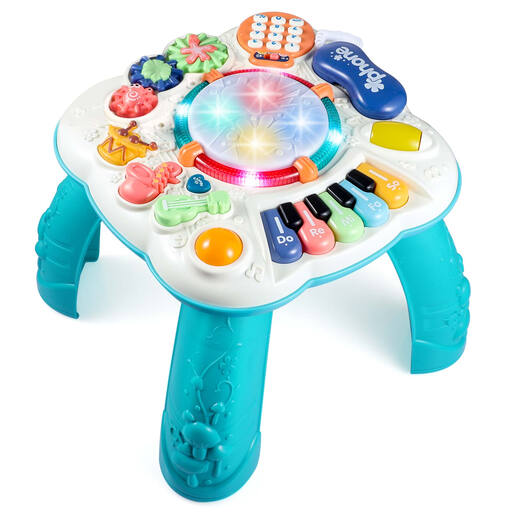
Why This Fits Their Persona: This compact option suits families seeking one play centre for floor play and standing activities, with a footprint of approximately 11.8 × 11.8 inches.
The removable legs allow it to change from a floor-play panel to a standing table, reducing the risk of buying a product that is quickly outgrown. The listing also specifies rounded edges and no loose parts.
Six play zones include a piano, light-up drum, telephone, gears and instrument buttons. It also includes adjustable volume and a mute mode; batteries are not included.
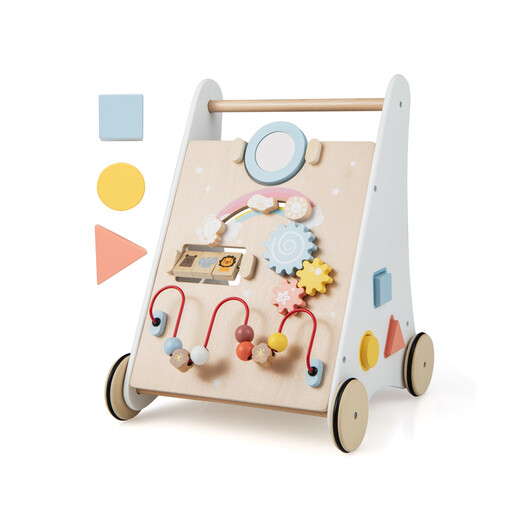
Why This Fits Their Persona: A suitable choice for households that prefer a wooden baby walker with tactile activities, storage and a neutral white-and-natural finish.
It uses physical activities rather than relying on batteries or electronic sounds. Its triangular structure, four wheels with non-slip rubber rings and rounded, burr-free surfaces address stability and finish concerns listed on the product page.
Features include shape matching, gears, sliding blocks, a bead maze, reversible mirror and rear storage. It is listed for children over 12 months and requires assembly.
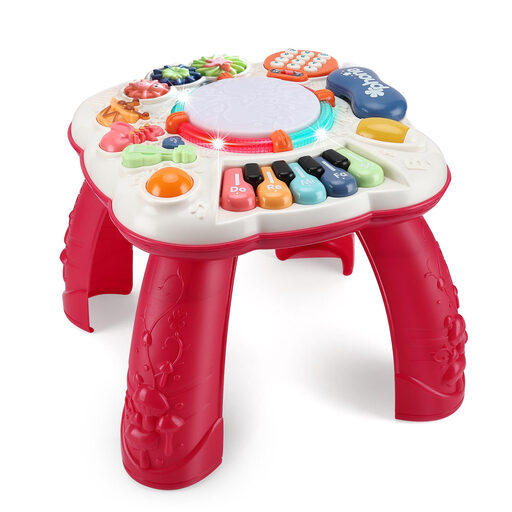
Why This Fits Their Persona: This version suits children who enjoy repeated musical interaction and families wanting a colourful, compact centre for daily play.
The six-zone layout provides more than a single button panel, while removable legs support two play positions. Adjustable volume and mute mode help manage noise in shared living spaces.
The ABS construction is listed as BPA-free, with rounded edges. Piano keys, a drum, gears, telephone and instrument sounds provide pressing, tapping and turning actions.
Before first use:
For a toddler birthday gift or Christmas gift for toddlers, consider the recipient’s current abilities rather than buying solely for a stated upper age limit. A child who enjoys quiet construction play may prefer a wooden activity centre, while a child attracted to rhythm may engage more with a baby musical toy.
We have compiled a complete, real-time list of products that fully satisfy these strict selection criteria and UK safety regulations.
Some models are designed for floor play from six months, particularly those with removable legs or a detachable play panel. At this age, use the toy on the floor and follow the manufacturer’s guidance. Do not encourage standing before the child is developmentally ready.
Electronic musical tables commonly require batteries, and they may not be included. Check the product description before ordering. A wooden baby walker or non-electronic Montessori-inspired baby toy generally avoids ongoing battery costs.
Lifespan depends on construction, frequency of use and how quickly the child outgrows the format. A 2-in-1 baby activity centre can remain useful for longer because it offers floor and standing play. For products with wheels, inspect the wheel fittings and frame regularly, and stop use if any part becomes damaged or loose.