
24/7 Customer Support

Free returns

Same-day & Next-day Delivery

Quality Guaranteed

Unlock Your Welcome Offers: FREE Delivery | Up to 80% OFF | Free 30-day JoyPlus trial
Download the APP
By the Joybuy Product Recommendation Officer
Spilt milk, drool-soaked clothing and food rubbed into sleeves are familiar parts of caring for a baby. The right baby bibs can reduce laundry and keep mealtimes more manageable, but choosing by colour or pack size alone often leads to waste.
Before buying, look beyond attractive prints and broad claims. The most useful bib depends on your child’s age, feeding stage, level of mess and how often you want to wash it.
Small dribble bibs can work for teething or light milk spills, but they may offer little protection during weaning. Food can quickly reach shoulders, sleeves and the sides of a top. For messy meals, consider full coverage bibs, long sleeves or a wide front panel.
Water-resistant fabrics help stop liquids reaching clothes, but they may not absorb drool or milk. Conversely, cotton and muslin absorb moisture but can become saturated during a long meal. A practical collection often includes both absorbent muslin baby bibs and wipe-clean waterproof baby bibs.
A bib that is difficult to fasten may be left unused. Tie closures can take longer to fit, while poorly positioned snaps may press against the neck. Also check whether the bib is genuinely machine washable, wipe-clean or dishwasher suitable. “Easy care” can mean different things depending on the material and care label.
Cotton muslin bibs are lightweight, breathable and useful for milk, dribbles and everyday spills. Two to four layers can provide different levels of absorbency, but thicker fabric may take longer to dry. Some muslin burpy bibs can also be draped over the shoulder as a burp cloth, making them useful from the newborn stage.
Silicone bibs and flexible polymers do not absorb liquid, but they can be rinsed after meals. Look for a shaped food-catching pocket and a smooth surface without difficult-to-clean seams. Always check the stated material, age guidance and care instructions rather than relying only on phrases such as “baby-safe”.
For bibs for newborns, a soft, lightweight shape and a correctly fitting neck opening are more important than a large food pocket. Newborns may need bibs for milk and dribble rather than solid-food protection.
From around the weaning stage, a wider bib with a pocket can catch crumbs and purées. Toddler bibs may need sleeves, a longer front or adjustable fastenings, particularly when children feed themselves. Always follow the product’s stated age range. A bib labelled 12 months+ should not be treated as suitable for a younger baby.
Adjustable snap bibs can provide more than one neck position as a child grows. Check that the fastening closes securely without being tight, and inspect snaps, stitching and edges regularly. A bib should be removed immediately after feeding and must not be used during sleep or when a child is unattended.
For busy households, machine washable baby bibs can be more convenient than products requiring hand washing. A useful baby bib multipack also reduces the temptation to reuse a damp or soiled bib. Compare the number of pieces with how many meals, bottles or dribble changes your baby has each day.
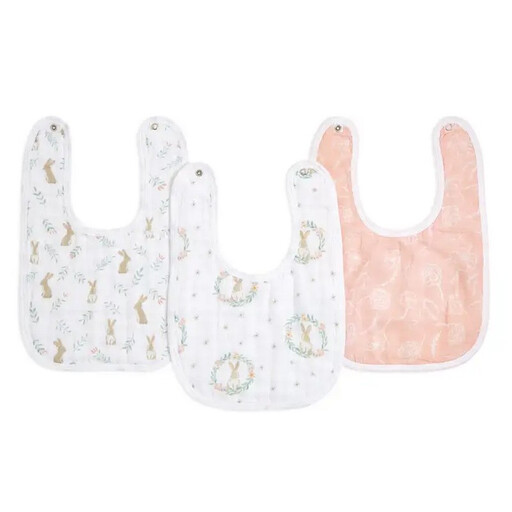
Why This Fits Their Persona: A three-piece set gives new parents several bibs for bottles, dribbles and early feeding without relying on one item throughout the day. It is listed as suitable from 0+ months.
The four-layer cotton muslin construction provides more coverage and absorbency than a thin decorative dribble bib, while front snaps avoid the inconvenience of tie fastenings.
100% cotton muslin, four absorbent layers, multiple snap positions and machine-wash care instructions.
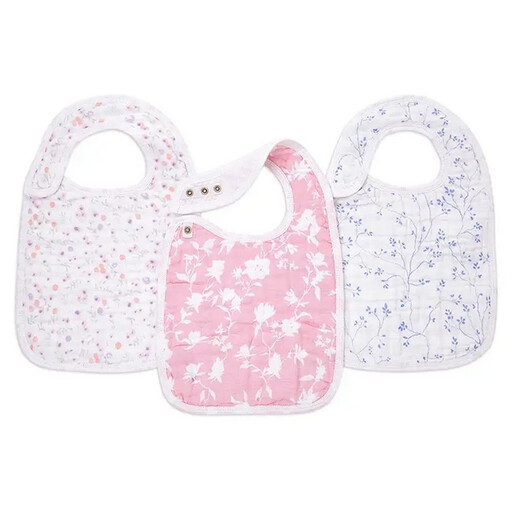
Why This Fits Their Persona: Suitable from 0+ months, this three-piece set is designed for parents prioritising a soft fabric feel alongside adjustable everyday use.
The product specifies three layers of muslin and three front snaps, addressing the common problems of limited absorbency and a short-lived fit.
Three-layer muslin, adjustable front snaps, pre-washed fabric and machine-wash care instructions.
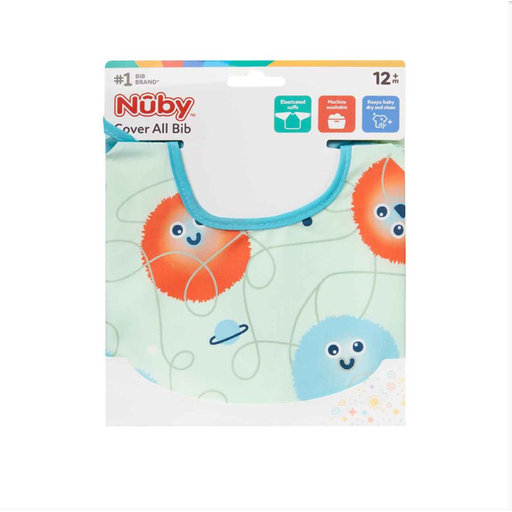
Why This Fits Their Persona: Designed for toddlers aged 12 months and over, it suits messy self-feeding, nursery meals and activities where clothing needs broader protection.
Long sleeves, elastic cuffs and a waterproof front extend protection beyond the chest. The listed age guidance also helps avoid buying an unsuitable size.
Long sleeves, elasticated cuffs, snap fastening and machine-washable polyester construction.

Why This Fits Their Persona: A practical option for babies aged 6 months and over who eat away from home, with a compact roll-up design for changing bags.
The wide crumb-catching pocket addresses food falling into laps, while the adjustable neck strap avoids a fixed fit. It can be wiped clean or placed on the top rack of a dishwasher.
Water-resistant flexible polymer, roll-up storage, three neck adjustments and top-rack dishwasher suitability.
We have compiled a complete, real-time list of products that fully satisfy these strict selection criteria and UK safety regulations.
For occasional dribbling, two or three absorbent bibs may be enough. Bottle-fed or teething babies can require several changes each day. During weaning, keep a rotation of feeding bibs available so one can be worn while another is being washed.
A mixed collection can be more practical than a large single-style pack: cotton muslin bibs for milk and drool, plus waterproof or silicone bibs for solid food. Store clean bibs fully dry, particularly silicone styles, and follow the care label to reduce odour and material deterioration.
Not necessarily. Many silicone baby bibs are designed for older babies beginning solids and may state an age such as 4 months+. Always follow the individual product guidance and check that the neck opening fits comfortably. Soft muslin bibs are often more appropriate for newborn dribbles and milk spills.
Lifespan depends on washing frequency, fabric quality and how the bib is used. Replace any bib with damaged snaps, loose stitching, tears, sharp edges or a deteriorated food pocket. A bib should remain secure and comfortable; do not continue using it simply because the printed design still looks attractive.
They can be useful for children who self-feed, attend nursery or frequently spill food on sleeves and their lap. A full coverage style takes up more space than a dribble bib, so it may not be necessary for every meal. Match the design to the mess level and check whether it can be machine washed.