
24/7 Customer Support

Free returns

Same-day & Next-day Delivery

Quality Guaranteed

Unlock Your Welcome Offers: FREE Delivery | Up to 80% OFF | Free 30-day JoyPlus trial
Download the APP
As a new or expectant parent, finding a moment for yourself can feel like a monumental task. You need a safe and comfortable place for your baby to rest or play, giving you a few precious, hands-free minutes. The world of baby bouncers and rockers is vast, with an array of options designed to soothe, entertain and support your little one.
This guide is here to help you navigate the choices. We'll break down the key features to look for, from safety standards to space-saving designs and highlight a few standout products to help you find the right fit for your family's needs.
Making an informed decision starts with understanding the different types of products available and what makes them suitable for your baby and your home.
The terms 'bouncer', 'rocker' and 'swing' are often used interchangeably, but they offer distinct functions:
Safety is the most important consideration. In the UK, look for products that comply with the relevant safety standards, such as BS EN 12790:2009 for reclined cradles. Key safety features to check for include:
Your living space is a major factor. If you live in a smaller flat or plan to travel, a foldable baby bouncer or a portable baby rocker can be an excellent choice. Look for models that are lightweight and feature a compact, quick-fold mechanism for easy storage under a sofa or in a car boot.
Here are a few recommendations that cater to different needs, from active play to on-the-go soothing.
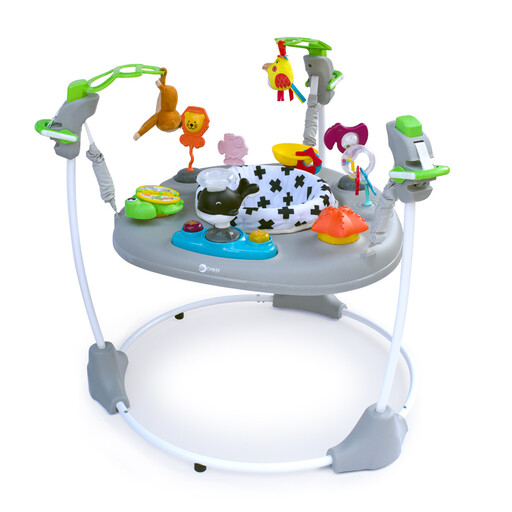
Why It Stands Out: This baby jumper is a complete baby activity centre designed to engage and stimulate. The 360-degree rotating seat gives your baby full access to ten different activities, including lights, sounds and textures that support cognitive and fine motor skill development.
Pros:
Who is it for?: Parents of babies from around 4 to 12 months (who can sit unaided) looking for a stationary baby entertainer that encourages active play and sensory exploration.

Why It Stands Out: This device offers a unique solution for soothing on the move. It’s not a seat, but a clever portable baby rocker mechanism that clips onto your stroller or pram, creating a gentle rocking motion to help your baby settle. It’s the ultimate baby soother for families on the go.
Pros:
Who is it for?: Parents who are frequently out and about and want a portable, tech-forward solution to help soothe their baby during naps in the pram.

Why It Stands Out: This newborn rocker combines elegant, minimalist design with clever functionality. It uses your baby’s own natural movements to create a gentle, wave-like rocking, requiring no batteries or power. Its ability to fold completely flat makes it an excellent foldable baby bouncer for modern homes with limited space.
Pros:
Who is it for?: Style-conscious parents looking for a sustainable, battery-free bouncer chair for baby that complements their home decor and is easy to store away.
Every baby has their own preferences, and what works for one may not work for another. If these recommendations aren't quite what you're looking for, there are many other styles and designs to consider.
Explore our full collection of baby bouncer toys to find the perfect fit for your little one.
1. When can a baby start using a bouncer or rocker? Most newborn rocker models are designed to be used from birth, but you should always check the manufacturer's specific age and weight guidelines. Traditional bouncers are generally suitable once a baby has good head and neck control, usually around 3-4 months. A baby jumper or activity centre should only be used once a baby can sit up completely unaided.
2. How long can a baby stay in a bouncer? It is generally recommended to limit sessions to around 20-30 minutes at a time, a couple of times per day. This ensures your baby gets plenty of tummy time and floor play, which is crucial for their development. Bouncers and rockers are not intended for sleep; if your baby falls asleep, they should be moved to a firm, flat sleep surface like their cot.
3. Are baby bouncers and jumpers safe? Yes, provided they are used correctly. Always place the product on a flat, level floor—never on a raised surface. Use the safety harness every time and never leave your child unattended. Finally, respect the weight and developmental milestones provided by the manufacturer and discontinue use when your child reaches them.