
24/7 Customer Support

Free returns

Same-day & Next-day Delivery

Quality Guaranteed

Unlock Your Welcome Offers: FREE Delivery | Up to 80% OFF | Free 30-day JoyPlus trial
Download the APP
Choosing a baby cot bed with mattress can seem straightforward until you compare mattress sizes, base heights, conversion features and safety instructions. Many products look similar online, but small differences can affect how long the cot remains useful and how practical it is in a UK nursery.
Before buying, watch for three common traps:
The right choice should balance safe construction, practical dimensions, washable materials and a realistic lifespan.
For a cot or cot bed, the mattress should sit firmly against the sides. A loose mattress can create an entrapment risk, so avoid buying a replacement based on appearance alone. Check the manufacturer’s stated mattress dimensions and use the supplied mattress where the instructions require it.
A water-repellent cot mattress can help protect the cover from small spills, but it is not a substitute for a well-fitted waterproof protector or regular cleaning. Look for a removable cover, clear washing instructions and a firm, supportive core. Avoid adding extra toppers, cushions or padding unless they are specifically approved for that cot.
An Aloe Vera mattress generally refers to a cover treated or infused with Aloe Vera extracts. Treat this as a material and comfort feature rather than a medical benefit. The practical points to assess are breathability, cover care, firmness and exact fit.
An adjustable cot bed with multiple mattress heights can make lifting a newborn easier during the early months. However, the highest position should not be used once your baby can sit up, pull up or otherwise become more mobile. The base should then be lowered according to the instructions.
Three height positions are available on several wooden cot bed models in this guide. That gives useful adjustment, but it does not remove the need for regular checks. Confirm that the base locks securely and inspect bolts and fittings after assembly and during use.
A convertible cot bed can offer longer use than a standard baby cot because it changes into a toddler bed. Check:
Solid wood can provide a substantial frame, while composite panels may be used for drawers or supporting sections. A non-toxic, lead-free or baby-safe finish is a useful product detail, but you should still ventilate the room after assembly and follow the care guidance.
For UK shoppers, look for clear manufacturer information, safety warnings and relevant product standards such as BS EN 716 for domestic cots where applicable. Do not rely on vague wording such as “safe design” without checking the manual, dimensions and user limits.
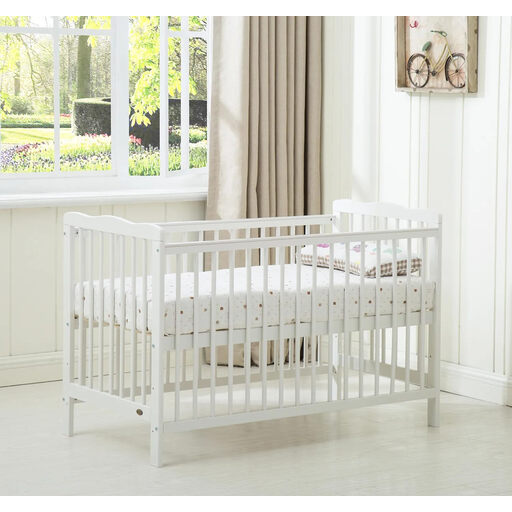
Why This Fits Their Persona: A straightforward cot and mattress combination for parents setting up a first nursery without adding travel or storage functions they may not use.
The included mattress is specified for the cot, helping avoid the uncertainty of buying a separate mattress with the wrong dimensions. Its three-position base also avoids a fixed-height design.
Solid wood and composite construction; water-repellent mattress cover; rounded edges and fixed side rails.
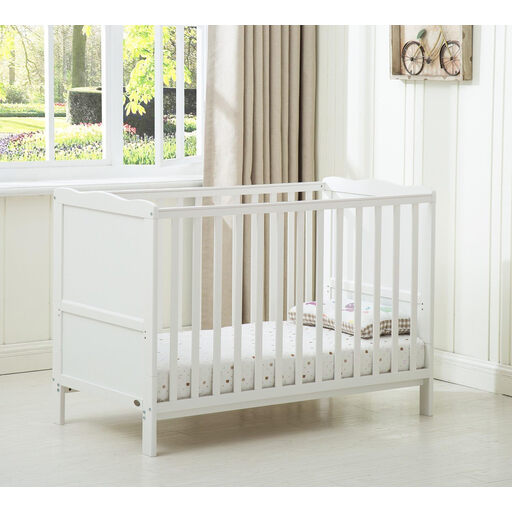
Why This Fits Their Persona: Suitable for parents who want coordinated nursery furniture and a longer-use sleeping solution rather than replacing a cot soon after the baby stage.
It is clearly described as a two-stage cot bed with conversion rails included, rather than leaving parents to source separate toddler-bed parts later.
Solid wood frame; three adjustable base positions; included high-density foam mattress with breathable, water-repellent cover.
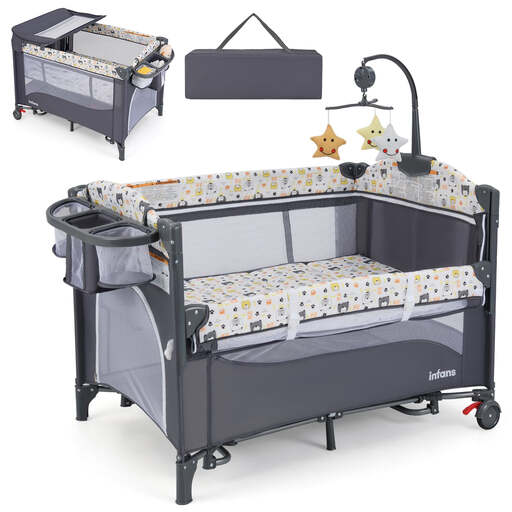
Why This Fits Their Persona: A practical option for families needing one portable unit for visits, travel, bedside use, changing and supervised daytime play.
Its functions are listed clearly, including a carry bag, lockable wheels and safety straps. This makes it easier to judge whether the extra features match your routine.
Six configurations; five-position bedside rail; mesh sides, carry bag and lockable wheels.
Allow time for full assembly and keep the instructions in a safe place. Check that every bolt, base support and locking mechanism is secure before use. Keep the cot away from windows, blind cords, curtains, heaters and open flames.
A baby travel cot should be used only with its supplied mattress unless the manufacturer specifically approves another one. Do not add a second mattress to increase softness. For a bedside crib, use the supplied straps and follow the required distance and height settings beside your bed.
Useful baby cot accessories include fitted sheets and a washable mattress protector, but each must fit tightly. A cot mobile should remain out of reach and be removed when your baby begins pushing up on their hands and knees.
We have compiled a complete, real-time list of products that fully satisfy these strict selection criteria and UK safety regulations.
It can be practical because the mattress is designed for the cot’s stated dimensions. However, always confirm the size, firmness, cover care instructions and whether the mattress must remain with the product during use.
This depends on the model’s instructions and your child’s development. Stop using cot mode when your child can climb out or reaches the stated limit. Convert to a toddler bed only when the child can safely enter and leave it, following the supplied conversion guidance.
Usually not. Travel cots are designed around their included base and mattress. Adding a thicker or softer mattress can create gaps or raise the sleeping surface, so use only an approved replacement specified by the manufacturer.