
24/7 Customer Support

Free returns

Same-day & Next-day Delivery

Quality Guaranteed

Unlock Your Welcome Offers: FREE Delivery | Up to 80% OFF | Free 30-day JoyPlus trial
Download the APP
Spills, drool, milk dribbles and sticky weaning food can quickly turn a clean outfit into another laundry load. The right baby feeding bibs can make everyday care easier, but attractive packaging and broad claims do not always tell you whether a bib will suit your child or routine.
Before buying, watch for three common pitfalls:
The practical choice depends on your child’s age, the type of mess you expect and how many bibs you need between washes.
Cotton muslin baby bibs are lightweight, breathable and suitable for milk feeds, teething dribble and burping. Look for the number of fabric layers and whether the bib is machine washable. Four-layer designs, such as the muslin burp cloth bibs in the recommendations below, provide more fabric for absorbing moisture than a single-layer style.
For baby-led weaning and toddler meals, silicone baby bibs or waterproof toddler bibs are often more practical. Their structured shape can help food fall into a front pocket rather than directly onto clothing. Silicone is also easier to rinse after use, although it should still be washed thoroughly and dried fully.
If you are choosing BPA-free feeding bibs, check that the product description clearly identifies the material and the parts covered by the claim. For example, the BC Babycare silicone options specify food-grade, BPA-free and PVC-free silicone, with polypropylene used in some hard components.
A bib should sit securely without pressing tightly against the neck. Adjustable snap bibs with several positions can accommodate growth more effectively than a fixed fastening. Always check the stated age range, dimensions and closure instructions rather than relying only on a general “newborn” or “toddler” label.
Three front snap positions are featured on several cotton muslin styles. This can be useful when moving from newborn feeding to early weaning. Silicone bibs with multiple adjustment settings may offer a similarly adaptable fit, but the structured shape should not sit too high or restrict movement.
Remove any bib after feeding and do not leave it on a child during sleep, play or unsupervised periods. Inspect fabric, snaps and clips regularly for damage.
A compact roll-up bib can be useful for changing bags, prams and visits to cafés. A bib with a wide pocket may help catch crumbs and runny food, while a full-cover style with sleeves offers more protection for messy toddler meals.
Think about your washing routine too. A three-pack of fabric bibs gives you spares while others are in the wash. Silicone bibs may be convenient for daily weaning, but they still need rinsing, washing and complete drying to prevent odours or damp storage.
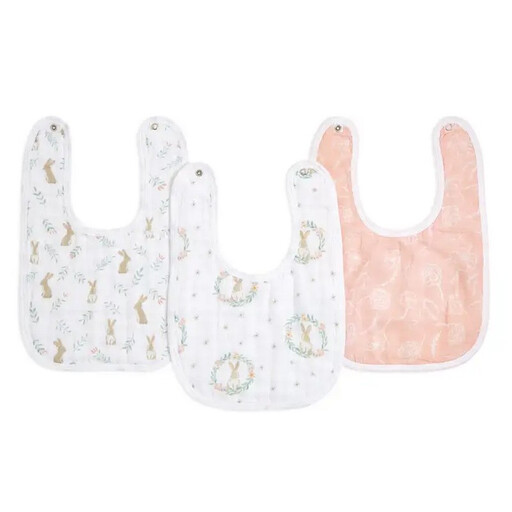
Why This Fits Their Persona: A three-pack provides rotation for newborn feeding, drooling and burping, making it practical for families building their first set of baby essentials.
The four-layer 100% cotton muslin construction addresses the problem of thin bibs becoming saturated quickly. Three front snaps help avoid a short usable fit.
Machine washable; pre-washed for softness; can also be draped over the shoulder as a burp cloth.

Why This Fits Their Persona: Suitable for parents who want generous coverage and a softer-feel fabric for feeding, teething and burping at home or while travelling.
The 57cm x 28cm size gives more shoulder and chest coverage than a small dribble bib, while the snap closure provides a defined bib configuration.
Four layers of organic cotton muslin; reversible prints; two-in-one bib and no-slip burp cloth design.

Why This Fits Their Persona: Designed for weaning, nursery trips and meals away from home where crumbs, sauces and drinks can create heavier mess.
The water-resistant material and wide roll-up crumb catcher address the limitation of absorbent fabric bibs during wet, food-heavy meals.
Three adjustable neck positions; rolls up for storage; suitable for top-rack dishwasher cleaning.

Why This Fits Their Persona: A practical option for families beginning weaning who want a bib alongside plates, a bowl, cup and child-sized utensils.
The included three-dimensional bib is intended to catch food, while the silicone material avoids relying on absorbency alone during meals.
Food-grade, BPA-free and PVC-free silicone; includes suction-base bowl and plate; top-rack dishwasher suitable.
We have compiled a complete, real-time list of products that fully satisfy these strict selection criteria and UK safety regulations.
For a newborn, a small rotation of three to six fabric bibs can be useful, particularly if your baby dribbles frequently or feeds several times a day. During weaning, adding one or two silicone or waterproof bibs can reduce the number of stained outfits and provide a quicker-clean option between meals.
Many silicone styles are designed for weaning rather than newborn feeding. The products listed here include age guidance from four or six months, so check the individual listing before buying. For younger babies, soft cotton muslin bibs and burp cloth bibs may be more suitable, provided the fit is comfortable and the bib is removed after use.
There is no fixed lifespan. Durability depends on washing frequency, exposure to food, fastening wear and storage conditions. Replace a bib if it has torn fabric, damaged snaps, cracks, loose parts or a closure that no longer holds securely. A washable three-pack or a combination of fabric and silicone styles can help manage everyday use while individual bibs are being cleaned.