Parents serving a baby-adapted family curry
For a baby moving beyond first tastes at 7 to 9 months, the NHS suggests a spoonful of full-fat yoghurt with its lamb curry recipe. The baby’s portion needs to be prepared without added salt.


For a baby at the NHS 7-to-9-month feeding stage, choose an age-appropriate plain fromage frais or full-fat yoghurt to serve by the spoonful with a mild baby portion of curry; the NHS suggests full-fat yoghurt alongside its curry recipe for this age. Check the exact pack for age guidance, pasteurisation, milk allergen information and ingredients. A children’s pot labelled “no added sugar” is not automatically suitable for a baby, and some sweetened pots are labelled for much older children.
For a baby moving beyond first tastes at 7 to 9 months, the NHS suggests a spoonful of full-fat yoghurt with its lamb curry recipe. The baby’s portion needs to be prepared without added salt.
Age guidance, the dairy ingredients and added sugar matter more to this decision than a familiar children’s brand or a vitamin claim. Check the exact flavour and pack: ranges can contain products with different age statements and ingredients.
Here, “stage 2” means the NHS 7-to-9-month feeding stage, not a universal label on fromage frais. Match the food and its texture to the baby’s age and ability rather than relying on the search term.
Decide what will accompany the baby’s curry portion, then check the exact dairy product and how the meal is prepared.
Consider it when: The age guidance fits your baby and you want a plain spoonful beside a savoury curry, as in the NHS yoghurt serving suggestion.
Check: A baby label does not replace checking pasteurisation, ingredients and the milk allergen declaration on the exact pack.
Consider it when: The exact product’s age guidance and ingredients suit your baby and a fruit flavour works with the meal.
Bear in mind: “No added sugar” does not mean sugar-free or establish suitability from 6 months.
For this age: Do not treat a general children’s pot as baby food without checking its exact age statement and ingredients.
For example: A Petits Filous multipack listed by Sainsbury’s is labelled from 3 years old and lists added sugar, so it does not fit this 7-to-9-month decision.
| Priority | What to check | Your needs |
|---|---|---|
| Age and texture | Read the exact pack’s age guidance. Choose a texture the baby can manage while continuing to offer suitable variety and texture as feeding progresses. | “Stage 2” alone does not tell me whether this pot or its texture fits my 7-to-9-month-old. |
| Baby’s curry portion | Set aside a mild portion before adding salt, stock cubes or gravy. Adjust its texture to the baby’s ability; NHS guidance says babies do not need salt or sugar added to food. | I want the baby to share the curry-night meal without simply serving the finished family sauce. |
| Dairy type | Check pasteurisation, the milk allergen declaration and whether the product is full-fat. The NHS recommends full-fat yoghurt and fromage frais up to age 2. | A baby-labelled pot catches my eye, but I still need to check what is in this particular one. |
| Ingredients | Compare plain and fruit-flavoured ingredients and look for added sugar. Read sugars per 100g alongside the ingredient list: milk and fruit can contribute sugars without sugar being added. | I would prefer a plain accompaniment to a savoury meal, rather than choosing by a “no added sugar” claim alone. |
The NHS describes feeding by age and development, while a children’s product can be intended for a much older child.
Start with your baby’s age and ability, then check the exact pot’s age statement and texture.
The NHS advises against adding salt to babies’ food or using stock cubes and gravy for their portion.
Set aside the baby’s portion before those ingredients go into the family meal, then prepare it at a suitable texture and temperature.
Such claims do not establish age suitability. A Petits Filous multipack listed by Sainsbury’s is labelled from 3 years old and lists added sugar.
Check the exact product’s age statement, dairy type and ingredient list before choosing it for a 7-to-9-month-old.
Ingredients and allergen details can change between a listing and the pack you receive.
Before serving, read the pack’s age guidance, milk allergen declaration, ingredients, use-by date and storage instructions.
These examples show why the exact product matters; a brand or retailer name does not establish suitability for a baby.
Glenisk describes its organic baby dairy range as suitable from 6 months. Its natural fromage frais lists organic skimmed milk, cream and cultures, with 4.2g fat and 3.9g sugars per 100g.
Yoplait’s No Added Sugar Strawberry & Banana fromage frais lists pasteurised semi-skimmed milk, cream and fruit, with 4.9g sugars per 100g. Its product information does not state suitability from 6 months.
Tesco lists a Healthy Living Natural Fromage Frais described as fat free. That description differs from NHS guidance recommending full-fat yoghurt and fromage frais up to age 2.
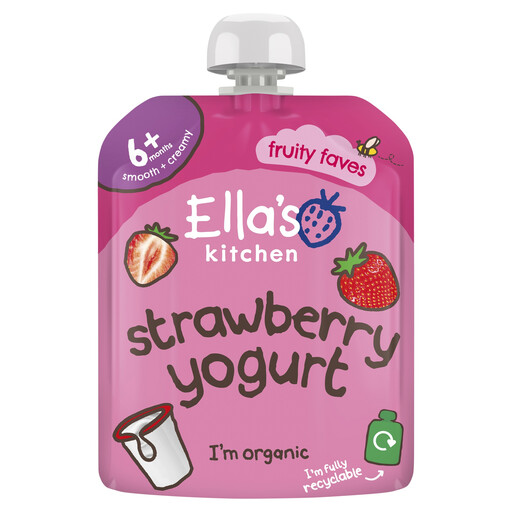
This fruit-flavoured yoghurt is an age-labelled dairy option for a baby’s curry-night meal, rather than the plain fromage frais suggested for a neutral accompaniment.
 No image available
Its 6+ months age statement makes this a yoghurt option to consider for the baby’s portion, though strawberry flavour makes it different from a plain accompaniment. Check the current pack for pasteurisation, the milk allergen declaration and whether it meets your full-fat dairy preference. Keep the pouch cap away from the child.
A baby-adapted curry can be part of a meal at this stage: the NHS provides a lamb curry recipe for ages 7 to 9 months and suggests a spoonful of full-fat yoghurt alongside it. Prepare the baby’s portion without added salt, stock cubes or gravy, and make its texture suitable for the child.
No. Milk and fruit can contribute sugars even when sugar has not been added as an ingredient. For example, Yoplait lists 4.9g sugars per 100g for its Petits Filous No Added Sugar Strawberry & Banana fromage frais; check the ingredients as well as the nutrition panel.
No: check the exact pack’s age statement rather than relying on “kids” branding. A Petits Filous multipack listed by Sainsbury’s is labelled from 3 years old, which does not fit a 7-to-9-month-old.
Check its age guidance, pasteurisation statement, milk allergen declaration, ingredients, use-by date and storage instructions on the current pack. If your child has a diagnosed or suspected milk allergy or additional feeding needs, seek individual advice from an appropriate healthcare professional rather than relying on general buying guidance.