
24/7 Customer Support

Free returns

Same-day & Next-day Delivery

Quality Guaranteed

Unlock Your Welcome Offers: FREE Delivery | Up to 80% OFF | Free 30-day JoyPlus trial
Download the APP
Choosing a baby highchair can look straightforward until you compare folding mechanisms, harnesses, trays, weight limits and cleaning instructions. A chair may appear compact online but occupy valuable floor space when opened. Another may promise years of use while offering limited adjustment or an unclear weight recommendation.
For UK parents and carers, the right choice should match your child’s development, your available space and how you use mealtimes at home or elsewhere. The following guide highlights common buying traps, essential specifications and suitable options for different family routines.
A compact highchair may fold flat for storage but still require substantial room around the tray when opened. Check both the folded dimensions and the assembled footprint. This matters particularly in smaller UK kitchens, flats and dining areas.
For example, the Mychild Hideaway folds to approximately 70 x 60 x 8cm, while its listed package dimensions are 75 x 60 x 95cm. Always measure the space where your chair will be used, not just the cupboard or car boot where it will be stored.
A label such as “from 6 months to 3 years” does not mean every child will be comfortable for the full period. Children develop at different rates, and a chair’s maximum weight recommendation, seat width, footrest and harness adjustment are more useful indicators.
A genuine adjustable highchair should provide practical support as your child grows. Features such as a multi-position footrest, removable tray or adaptable seating can be more valuable than decorative extras.
Food can collect around harness clips, tray edges, seams and seat cushions. A wipe-clean surface is useful, but removable parts make deeper cleaning easier. Look for a dishwasher-safe tray, removable seat cover or smooth, non-porous materials.
Check the care instructions before buying. Some padded covers can only be hand-washed, while faux leather or leatherette surfaces generally require a damp cloth and mild soap rather than abrasive cleaners.
Most highchairs in this category are intended for children from approximately 6 months, but the child should be able to sit upright unaided before use. Age guidance is not a substitute for checking the product’s instructions and warnings.
A highchair for babies from 6 months should provide stable support without allowing excessive movement. For toddlers, confirm that the chair remains suitable for their weight and that the harness can be adjusted correctly.
A highchair with a 5-point harness offers restraint at the shoulders, waist and between the legs. It must be adjusted snugly according to the manufacturer’s instructions. Never rely on the tray as a restraint.
Look for a sturdy frame, a locking mechanism that visibly engages and a broad, stable base. Before every use, place the chair on a flat, level surface and check that folding catches, tray locks, footrests and fixings are secure. Do not use a damaged chair or one with missing parts.
When comparing products, check whether the manufacturer identifies compliance with the relevant UK safety requirements, including BS EN 14988:2017+A1:2020 where applicable. Product listings should also provide clear warnings, age guidance and maximum weight information.
A foldable highchair is useful for grandparents’ homes, occasional travel or homes where the chair cannot remain assembled. A portable highchair should be light enough to move safely without compromising stability when opened.
Consider:
A chair that is slightly heavier but easier to clean and lock securely may be more practical than an ultra-light model with awkward set-up.
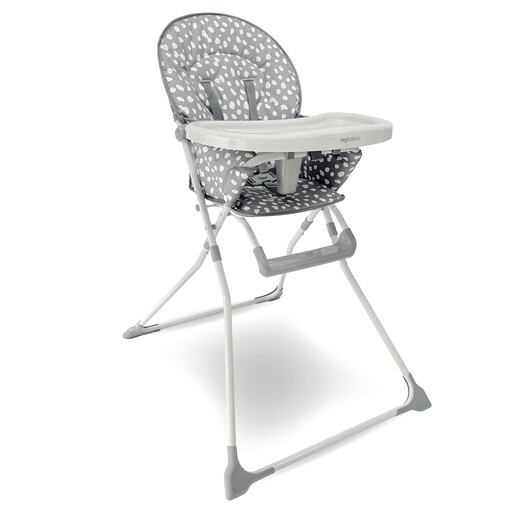
Why This Fits Their Persona: A practical starting point for families who want a lightweight, space-saving highchair for everyday weaning without a bulky frame.
Its fold-flat design addresses storage concerns, while the stated 6-month to 3-year range and 15kg maximum recommendation make the intended use clear.
Weighs 5kg, includes a 5-point harness, padded seat, leg rest and removable wipe-clean surfaces. The tray also has a cup holder.

Why This Fits Their Persona: Suitable for households prioritising adaptable furniture, coordinated styling and use beyond the initial weaning period.
Its value is based on documented modes rather than an extended age claim alone: highchair, booster seat and junior stool. Highchair and booster use are listed up to 15kg.
Includes a 2-position removable tray, 4-position footrest, dishwasher-safe top tray and wipe-clean faux leather cushion.
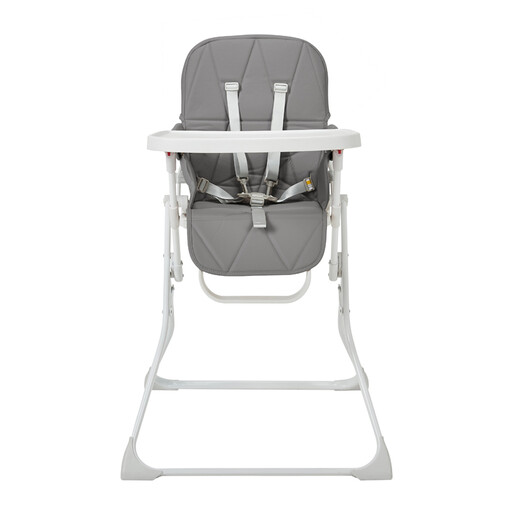
Why This Fits Their Persona: A useful match for families needing one highchair for daily meals, small-footprint storage and trips to relatives or childcare settings.
The listing gives specific folded dimensions and a product weight of 4.3kg, helping buyers judge portability instead of relying on vague “travel-friendly” wording.
Features a BPA-free dishwasher-safe tray, wipe-clean leatherette seat, adjustable footrest and satin 5-point harness. The maximum recommendation is 15kg.
Before placing your child in any toddler highchair, unfold it completely and confirm that the locking mechanism has engaged. Fit the tray securely, adjust the harness so it is snug without being restrictive and ensure the child cannot stand or climb.
Keep the chair away from stairs, open fires, heaters and unstable furniture. Do not leave a child unattended, even for a short time. Clean food residue after each meal and inspect the frame, harness, tray and fasteners regularly.
We have compiled a complete, real-time list of products that fully satisfy these strict selection criteria and UK safety regulations.
Most models are designed from around 6 months, but your baby should be able to sit upright unaided and meet the product’s stated requirements. Always follow the individual instruction manual rather than relying on age alone.
The usable period depends on the child’s weight, size, comfort and the chair’s design. Many models list use from 6 months to approximately 3 years, while a 3-in-1 highchair may convert into a booster or junior seat. Check the maximum weight for each mode and inspect the chair for wear before continued use.
Yes, provided the chair is stable when opened, locks securely and is used on a level surface. A foldable model can be convenient in a small kitchen, but it should not be selected on folded size alone. Compare its open footprint, tray position, harness design and cleaning routine before purchasing.