
24/7 Customer Support

Free returns

Same-day & Next-day Delivery

Quality Guaranteed

Unlock Your Welcome Offers: FREE Delivery | Up to 80% OFF | Free 30-day JoyPlus trial
Download the APP
Navigating the world of baby pushchairs can feel overwhelming. With so many models, features and marketing claims, it's easy to end up with a purchase that looks great online but proves impractical for daily life in the UK. As the Joybuy Product Recommendation Officer, my role is to help you sidestep the confusion and focus on what truly matters for you and your little one.
Before you commit, let's look at a few common pitfalls that can lead to buyer's remorse.
To make a confident choice, focus on the practical specifications that will impact your day-to-day use. Here are three non-negotiable points to consider.
If you plan to use the pushchair for a newborn, the term "pushchair from birth" is critical. This isn't just a guideline; it's a safety requirement. A newborn needs to lie completely flat to support their developing spine and ensure their airway remains open. Look for models with a full lie-flat recline (a seat that adjusts to a near-180-degree angle) or those compatible with a separate carrycot. A seat that only partially reclines is not suitable for babies under six months who cannot yet support their own head.
Think carefully about your lifestyle. Do you have limited storage space at home? Do you frequently use public transport or have a small car boot? These factors will determine whether you need a compact buggy or an umbrella fold stroller.
Always check the folded dimensions (Length x Width x Height) and compare them to your available space.
The wheels dictate the smoothness of the ride. For city dwellers navigating pavements and shops, smaller, swivel wheels offer excellent manoeuvrability. If your routes include parkland, cobblestones or uneven country paths, larger wheels and all-round suspension become more important. They absorb bumps, preventing your little one from being jostled around. Most UK pushchairs are tested to the EN 1888 safety standard, which ensures a baseline of structural integrity and stability.
To help you find a match, we've selected a few options from our range that are well-suited to different UK family lifestyles.
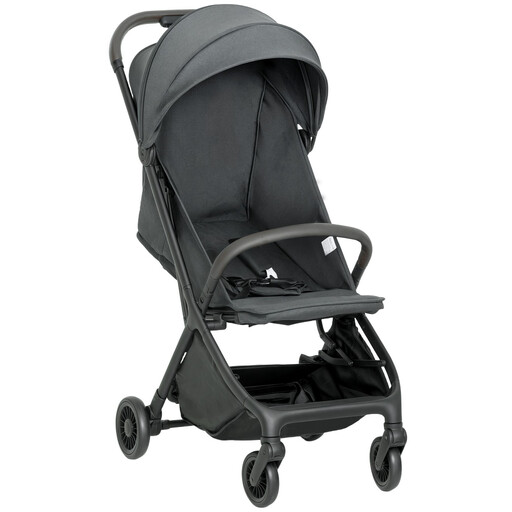
Why This Fits Their Persona: Ideal for city living, this stroller's low weight and simple fold make it perfect for navigating public transport, tight shop aisles and storing in flats with limited space.
It directly counters the "Awkward Fold" and "Hidden Weight" pitfalls. At just 6.3 kg and with a genuine single-hand fold, it is truly a lightweight stroller that remains compact and manageable.
The backrest reclines from 115° to 170°, making it suitable from birth. The four-wheel suspension provides a surprisingly smooth ride for such a compact model.
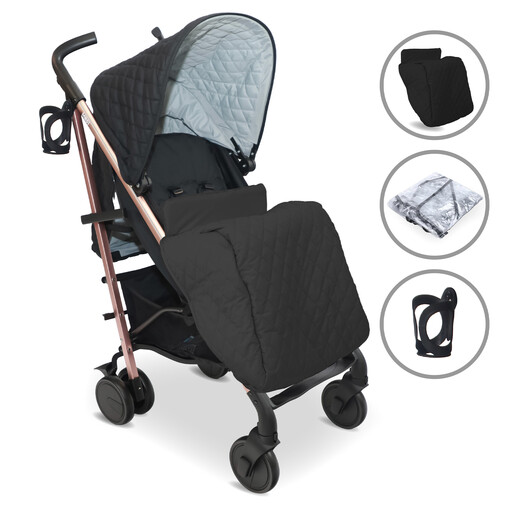
Why This Fits Their Persona: For parents who want practicality without sacrificing style. The quilted black fabric and rose gold frame offer a premium look, while the features cover all the essentials for daily outings.
This stroller avoids the "Hidden Weight" trap by including the raincover, footmuff and cup holder as standard. You get a complete, stylish package without the need to buy costly extras.
It features a full lie-flat recline suitable from birth, an extendable UPF 50+ canopy for sun protection and a practical umbrella fold mechanism for easy storage.
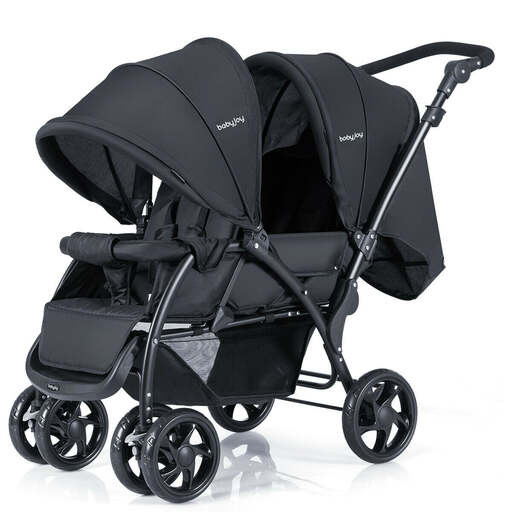
Why This Fits Their Persona: A purpose-built solution for parents with a baby and a toddler. It removes the stress of juggling two children of different ages and needs on one outing.
This double pushchair is a specific solution, not a flawed compromise. The rear seat is suitable from birth, while the front seat accommodates a toddler, addressing both children's needs safely.
Its tandem (in-line) design is narrower than side-by-side models, making it much easier to get through standard doorways and down shop aisles. Each seat has its own adjustable canopy.
As your family grows, accessories can extend the life of your pushchair. For a toddler who is starting to walk but still gets tired, a buggy board like the MyChild On-Board Stroller Board can be a great addition. And to keep essentials organised, a handlebar accessory like the Clippasafe Stroller Organiser is invaluable.
For older siblings who want to be just like mum or dad, a dolls pram such as the Tiny Tears Stroller can be a wonderful way to encourage nurturing play.
We have compiled a complete, real-time list of products that fully satisfy these strict selection criteria and UK safety regulations.
Historically, these terms had distinct meanings. A pram was a lie-flat carriage for newborns. A pushchair had a seated unit that could often face either the parent or the world. A stroller was typically a lightweight, forward-facing, collapsible buggy. Today, the terms are used almost interchangeably, with many modern "pushchairs" offering all these functions in one modular system.
This depends on the model's weight limit. Most standard pushchairs are suitable for children up to 15 kg (around 3 years old). However, some sturdier models are tested up to 22 kg (around 4 years old). Always check the manufacturer's maximum weight recommendation to ensure you are using it safely.
Yes, if you intend to use it for a newborn. A baby under six months old does not have the neck strength to support their head, and a seated position can cause their head to slump forward, potentially restricting their breathing. A full lie-flat position is the safest way for a newborn to travel in a pushchair.