
24/7 Customer Support

Free returns

Same-day & Next-day Delivery

Quality Guaranteed

Unlock Your Welcome Offers: FREE Delivery | Up to 80% OFF | Free 30-day JoyPlus trial
Download the APP
Choosing baby sensory toys can seem straightforward until you compare flashing lights, musical functions, age labels and safety claims. A toy may look educational but still be difficult to clean, too noisy for a flat or unsuitable for a young child’s current abilities.
For parents, grandparents and gift buyers in the UK, the priority is finding a product that offers engaging play while matching the child’s age, available space and supervision needs. The following guide highlights common buying traps, key specifications to check and a selection of products for different households.
A toy with numerous buttons and modes may appear good value, yet a younger baby may only be able to reach one or two functions. For toddlers, a product that combines pressing, turning, matching and role play can offer more varied interaction than a device focused solely on lights and sounds.
Look for clearly described play actions such as grasping, spinning, tapping, sorting or squeezing. These are easier to use independently and can support fine motor practice through ordinary play.
Terms such as BPA-free, rounded edges, CE marking and EN71 compliance are useful points to check, but they do not make a toy risk-free. Age guidance, battery compartments, small parts and condition after repeated use still matter.
For example, bath toys require close adult supervision because of the water environment. Toys with batteries also need regular checks for secure compartments and damage. Always follow the product’s warning instructions and keep children within sight and reach where advised.
Interactive musical toys can be engaging, but loud or repetitive sounds may not suit every home. Adjustable volume or mute settings are practical features for shared accommodation, nap times and car journeys.
For bath toys, the hidden issue is moisture. Water left inside squirters or sealed openings may create hygiene concerns over time. Choose products that can be emptied, rinsed and dried thoroughly, and inspect them before each use.
Age ranges should be treated as a starting point rather than a guarantee that every child will enjoy the same toy. Sensory toys for infants often focus on grasping, visual tracking and gentle sounds. From around six months, babies may begin to enjoy rattles, textured surfaces, shape buttons and tummy-time toys.
For children aged one to three, toddler learning toys, activity cubes and musical instruments can provide more complex actions. Check whether the product is intended for floor play, seated play or standing use. A toy that can be adapted between positions may be more practical in a changing play area.
Check the listed materials and look for smooth, rounded edges. Plastic toys may be convenient to wipe clean, while wooden Montessori toys for babies can offer a tactile, non-electronic alternative. However, wooden products may require assembly and should still be checked for splinters, loose fittings or damaged paint.
Avoid relying only on phrases such as “non-toxic” or “safe”. Read the complete warning information, including choking hazards, battery details and supervision requirements. EN71-1-2-3 is a European toy safety standard referenced by several products below; buyers should still follow the individual instructions supplied with the toy.
Measure the intended play area before buying. Activity cubes and soft play sets may need more floor space than their product photographs suggest. For toddlers who pull, climb or lean on toys, a stable base is important.
Also consider ongoing costs. Electronic toys may require AA batteries, while wooden activity toys and soft play equipment do not require power. A wipe-clean surface can be more convenient for everyday use, whereas fabric or crochet toys may need specific washing instructions.
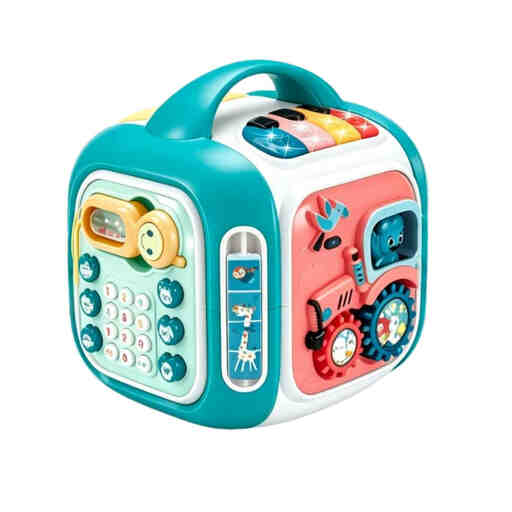
Why This Fits Their Persona: A compact 23 x 23 x 24 cm format combines eight play modes, making it suitable for families wanting varied toddler play without buying several separate toys.
Its functions involve pressing, turning, strumming and pretend phone play rather than relying on lights alone. It is listed for ages 1 to 3 years.
ABS construction, BPA-free material description, rounded edges and a carry handle are listed features.
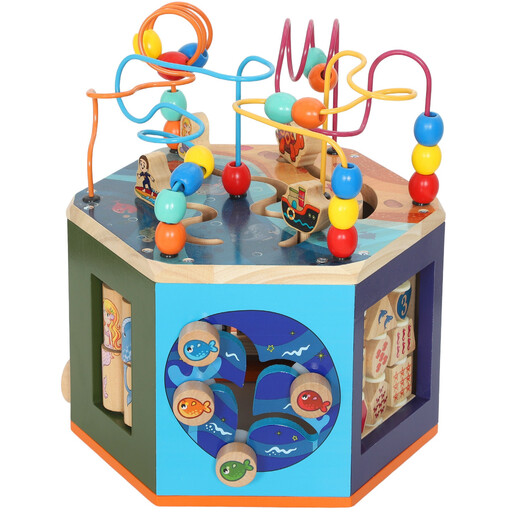
Why This Fits Their Persona: This 28 x 26.2 x 32 cm wooden cube suits households seeking a screen-free activity centre with a bead maze, pattern sorter and number-learning elements.
It does not depend on batteries or electronic sound. The product is listed for 18 months and above, with assembly required.
Solid wood and MDF construction, polished edges and EN71-1-2-3 standard information are provided.
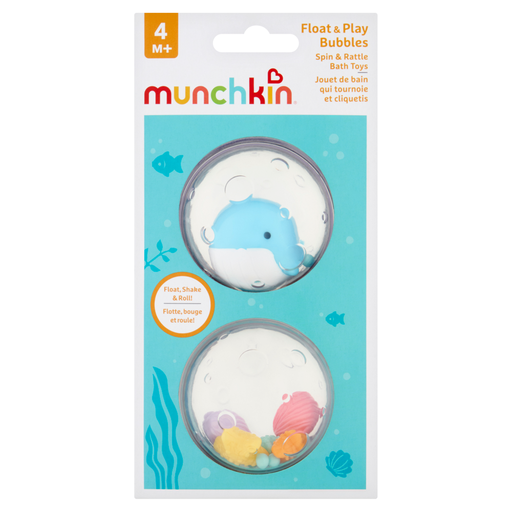
Why This Fits Their Persona: Designed for bath-time play from around four months, these lightweight floating toys suit families looking for a small, dedicated sensory activity.
The watertight design is intended to prevent water ingress, addressing a common maintenance concern with bath toys. Dry fully after use.
Floating, spinning and rattling functions provide visual, auditory and tactile interaction; the pack contains two assorted designs.
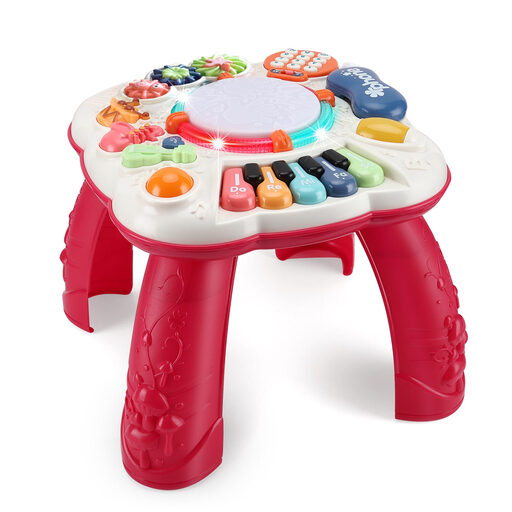
Why This Fits Their Persona: Families wanting interactive musical toys can use it as a floor-play panel for younger babies, then attach the legs when a child is ready for standing play.
It includes adjustable volume and a quiet mode, helping reduce disruption in flats or during quieter parts of the day. Batteries are not included.
Six play zones include piano keys, a drum, gears, a toy telephone and instrument sounds. The listed age range is 6 to 36 months.
We have compiled a complete, real-time list of products that fully satisfy these strict selection criteria and UK safety regulations.
Soft rattles, textured toys, high-contrast items, suction-cup toys and simple musical products may suit infants, provided the age label and warnings are followed. Babies should always be supervised, particularly when a toy contains batteries, small components or moving parts.
Not always. Wooden activity cubes, soft play blocks, crochet rattles and some bath toys work without batteries. Musical tables, light-up toys and electronic activity cubes usually require batteries, so check whether these are included and consider the ongoing replacement cost.
Lifespan depends on materials, frequency of use, cleaning and how the toy is handled. Durable plastic and wooden activity toys may remain useful as a child develops, while bath toys require closer inspection because of constant water exposure. Stop using any product that becomes damaged or develops loose parts, leaks or exposed wiring.