
24/7 Customer Support

Free returns

Same-day & Next-day Delivery

Quality Guaranteed

Unlock Your Welcome Offers: FREE Delivery | Up to 80% OFF | Free 30-day JoyPlus trial
Download the APP
Choosing baby soothers and feeding teats can seem straightforward until you compare nipple shapes, flow rates, materials, age labels and sterilisation instructions. Marketing terms such as “breast-like”, “orthodontic” and “anti-colic” may sound reassuring, but they do not remove the need to check whether a product suits your baby’s age, feeding method and daily routine.
The wrong choice can mean a teat that delivers milk too quickly, a dummy your baby refuses, or a natural latex soother that is difficult to clean using your preferred method. This guide separates useful specifications from features that may not suit every family.
A teat designed for a newborn may not provide enough milk for an older baby, while a fast-flow teat can be unsuitable for a young feeder. Always check the manufacturer’s age guidance and observe your baby during feeds.
Signs that the flow may not suit your baby include coughing, gulping, leaking milk around the mouth or becoming frustrated during feeding. These signs are not a diagnosis, but they indicate that you should review the teat size and, if needed, seek advice from a health visitor or other qualified professional.
Breast-like bottle teats may help some combination-feeding families move between breast and bottle, but babies have individual preferences. A flattened teat, round teat or symmetrical teat can feel different in the mouth. A trial pack may reduce the cost of buying several full packs that your baby will not use.
Silicone soothers are generally straightforward to wash and may be compatible with dishwashers or different sterilisation methods, depending on the instructions. Natural latex dummies require more careful handling: heat, direct sunlight, some cleaning products and prolonged sterilising can weaken the material. Latex may also cause an allergic reaction in some children.
For bottle feeding, match the teat to your baby’s developmental stage rather than relying on a larger size to make feeds quicker. Common options include:
The Vital Baby Nurture range includes newborn, slow, medium and fast-flow options. Its medium-flow version is marked for babies aged 3 months and over, while the fast-flow six-pack is marked suitable from 0+ months in the supplied product listing but includes guidance describing fast flow for older babies. Check the specific pack and your baby’s feeding needs before ordering.
Look for clear material information rather than vague descriptions. Several options in this range use BPA-free baby feeding products, with silicone teats and polypropylene shields or bottles. Some products also state that they are free from latex and phthalates.
If choosing silicone soothers, inspect the teat before every use, particularly once your child has teeth. If you prefer natural rubber, remember that latex can change slightly with use and may need replacing more frequently. Discard any dummy or teat at the first sign of cracking, stickiness, weakness or other damage.
For baby dummies, a curved shield with ventilation holes can reduce the amount of material touching the skin around the mouth. This may be useful for babies who dribble or have sensitive skin, although it cannot guarantee that irritation will not occur.
Also check the cleaning routine. Some MAM products include a self-sterilising travel box using 25ml of water in a microwave. Other soothers, particularly natural latex designs, may recommend scalding or boiling instead and specifically advise against dishwashers or microwave sterilisation.
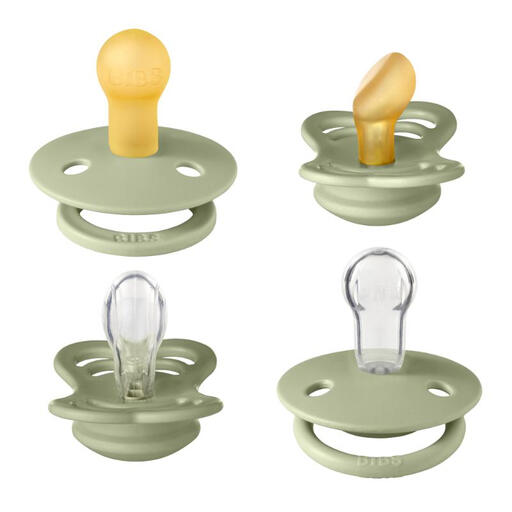
Why This Fits Their Persona: A trial set gives new parents four nipple styles and two materials to compare before committing to several packs, which can help limit waste during the early weeks.
It avoids assuming that one shape suits every baby by including round, anatomical and symmetrical options in one pack.
Size 1 is intended for 0–6 months; the set includes silicone and natural rubber latex nipples with ventilated shields.
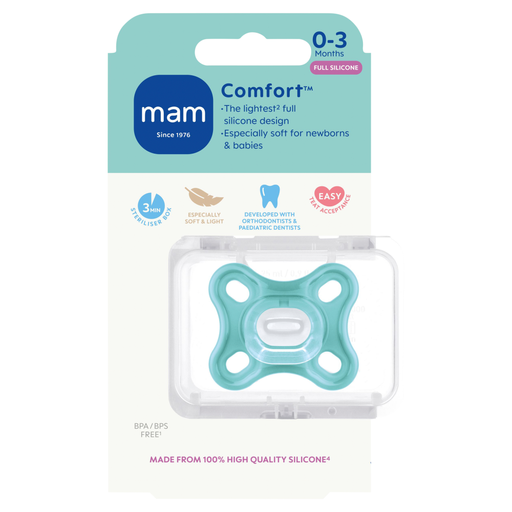
Why This Fits Their Persona: The one-piece construction and included sterilising case suit parents who prioritise a simple routine for a newborn.
The clear 0–3-month age range helps prevent choosing a larger soother simply because it looks more substantial.
Made from one piece of soft silicone and supplied with a microwave self-sterilising travel case.
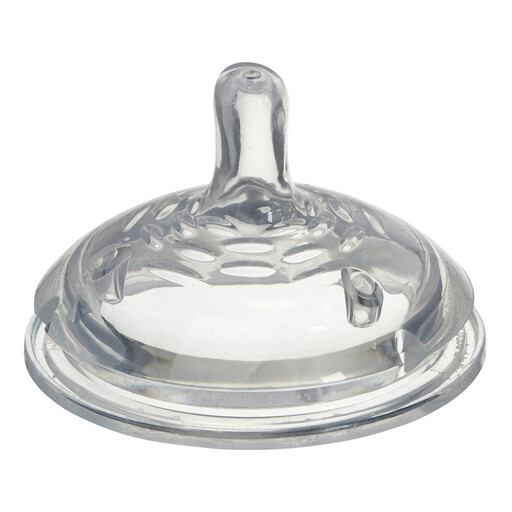
Why This Fits Their Persona: A six-pack is practical for families managing frequent bottle feeds, nursery bags and regular replacement.
The 3+ months medium-flow label makes the intended stage clearer than selecting a teat based only on a “natural” shape.
The silicone teat has a wide-neck design and triple anti-colic valves; materials are listed as BPA-free, latex-free and phthalate-free.
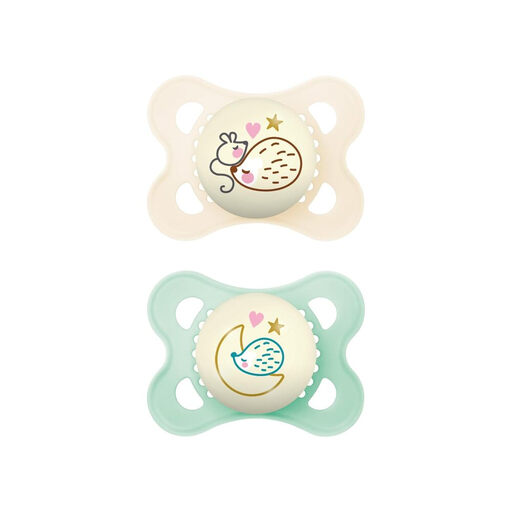
Why This Fits Their Persona: Parents who regularly search for a dummy in a dark nursery may appreciate a glow-in-the-dark button and a compact sterilising case.
The glow feature addresses visibility rather than promising that a soother will improve sleep. It must be charged in daylight and is not a substitute for safe supervision.
Symmetrical silicone teat, BPA/BPS-free materials and a self-sterilising box requiring 25ml of water.
We have compiled a complete, real-time list of products that fully satisfy these strict selection criteria and UK safety regulations.
Follow the product instructions and replace immediately if there is damage or weakness. Many silicone soothers recommend replacement every one to two months, while natural latex dummies may require replacement every four to six weeks. Feeding teats should also be checked before every use, especially after a baby develops teeth.
Often, yes, but always follow the individual care instructions. Silicone soothers may be suitable for warm soapy water, dishwashers or several sterilisation methods. Natural latex commonly requires scalding or boiling and can deteriorate if exposed to excessive heat, direct sunlight or unsuitable cleaning products.
A dedicated clip can help keep a soother clean and within reach, but it must be used correctly. Choose a product intended for soothers, attach it only to clothing and use it while your baby is awake and supervised. Never tie a dummy around a child’s neck or leave a soother clip attached during sleep.