
24/7 Customer Support

Free returns

Same-day & Next-day Delivery

Quality Guaranteed

Unlock Your Welcome Offers: FREE Delivery | Up to 80% OFF | Free 30-day JoyPlus trial
Download the APP
Choosing baby soothers and pacifiers is rarely as simple as picking a colour. Parents need to consider age suitability, teat shape, material, sterilisation, night-time visibility and how often the product will need replacing. A low-priced pack can become poor value if the teat deteriorates quickly, cannot be cleaned using your preferred method or is unsuitable for your baby’s age.
As the Joybuy Product Recommendation Officer, I focus on the practical details behind the packaging so you can compare baby dummies, newborn soothers and accessories with fewer surprises.
Silicone soothers are generally easy to clean and may be compatible with steam sterilisers, microwave systems or dishwashers, depending on the instructions. Natural rubber latex soothers feel softer and more flexible, but they require different care. Several BIBS latex products advise boiling or scalding only, and specifically warn against dishwashers and microwave sterilisation.
Latex can also cause an allergic reaction in some children. If irritation appears, stop using the product and seek appropriate advice.
A dummy labelled 0+ months is designed around a smaller mouth and younger baby. A larger orthodontic pacifier or toddler teat may be less suitable for a newborn, while a newborn soother may not provide the size or durability required for an older child.
Always check the manufacturer’s stated age range. The products below cover newborns through to toddlers aged 18–36 months.
Glow-in-the-dark dummies can make a handle easier to find, but the button usually needs exposure to daylight to charge and may not glow brightly under indoor LED lighting. A pacifier clip can help prevent a soother falling onto the floor, but it must never be used around the neck or left attached during sleep.
Clips should only be attached to clothing while the child is awake and supervised. Do not extend them or attach them to cots, beds, loose cords or ribbons.
Look for the exact age category, such as 0–2 months, 0–6 months, 6+ months, 16+ months or 18–36 months. Some babies prefer a round, cherry-shaped teat, while others accept a symmetrical or flat-drop design more readily.
A symmetrical teat is less dependent on being inserted in a particular orientation. However, no teat shape is guaranteed to suit every baby. If you are breastfeeding, you may wish to browse the wider breastfed dummy range and compare round and symmetrical options.
Check both the teat and shield materials:
Replacement guidance varies. The supplied product information recommends changing some silicone soothers every one to two months, while several BIBS latex soothers recommend replacement every four to six weeks. Inspect the teat before every use, pulling it gently in all directions, and discard it at the first sign of weakness, tearing or colour change.
A curved shield with ventilation holes can reduce the amount of plastic touching the skin and may help keep the area around the mouth drier. This is a comfort and design feature, not a guarantee against irritation.
For clips, check the length, attachment method and cleaning requirements. The BIBS braided clips are 22 cm long and the supplied information states compliance with EN 12586:2007+A1:2011. The Loop clip is machine-washable at 30°C and has no metal parts, while braided versions require spot cleaning.
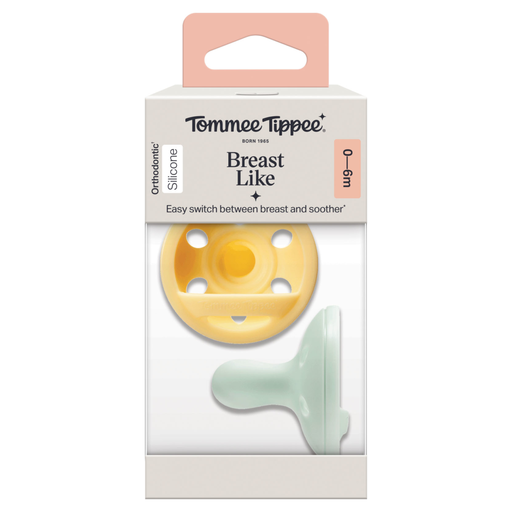
Why This Fits Their Persona: A two-pack gives new parents a spare for the changing bag, pram or night-time routine. The 0–6 months sizing is suited to early use.
The age range is clearly stated, and the silicone construction avoids the latex-specific cleaning restrictions found on some natural rubber designs.
BPA-free silicone teat; suitable for steam, microwave and cold-water sterilisation according to the product information.
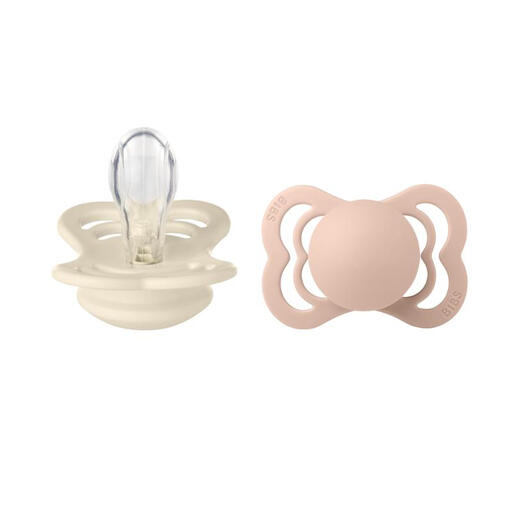
Why This Fits Their Persona: Suitable for parents seeking a silicone soother with a modern flat-drop teat and a lightweight shield for newborn use.
The product specifies its teat shape, age range and ventilation holes, making it easier to compare substance rather than colour-led packaging.
Symmetrical silicone teat; BPA-, PVC- and phthalate-free materials with EN 1400+A2 stated in the product details.
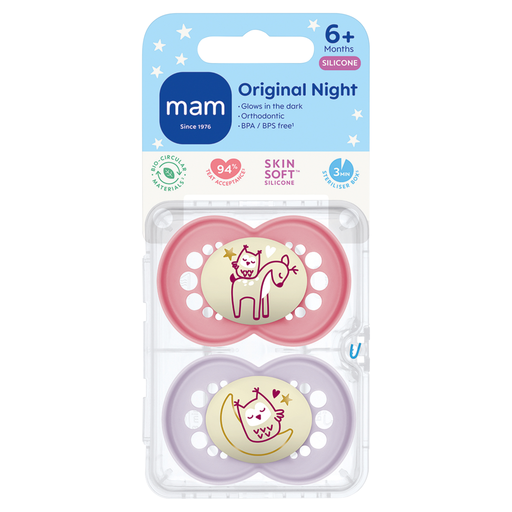
Why This Fits Their Persona: The glow-in-the-dark button helps parents locate the dummy during night-time routines, while the 6+ months sizing suits older babies.
The glow is a locating aid rather than a promise of continuous illumination; it needs natural daylight charging as directed.
Symmetrical SkinSoft silicone teat; included case can be used for microwave sterilisation with 25 ml of water.
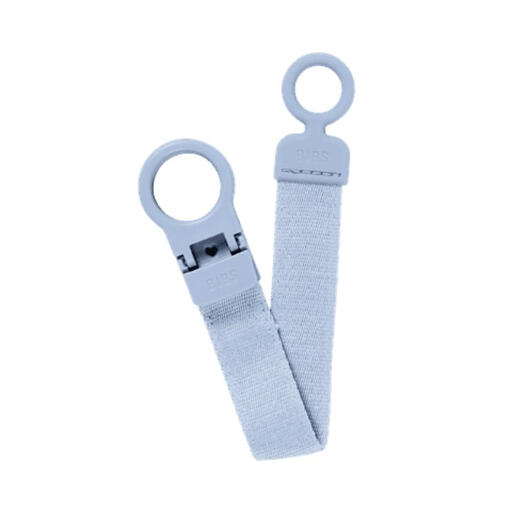
Why This Fits Their Persona: Useful for families managing frequent drops at home, in the pushchair or during trips around the UK.
It has a stated universal fit and a 30°C machine-washable construction, so maintenance does not depend on hand washing alone.
One-handed snap mechanism; no metal parts and a slim profile designed to reduce bulk.
We have compiled a complete, real-time list of products that fully satisfy these strict selection criteria and UK safety regulations.
Follow the product instructions and inspect the teat before every use. Many silicone designs recommend replacement every one to two months, while natural rubber latex soothers may require replacement every four to six weeks. Replace immediately if the teat is sticky, cracked, stretched, discoloured or weakened.
No. Silicone soothers may include a self-sterilising case or be suitable for microwave steam sterilisation, but natural rubber latex soothers may be damaged by microwave heat. Check the individual instructions. Never open a hot steriliser case immediately, as steam and water may cause burns.
Pacifier clips should not be used in a cot, bed or sleep area. Use them only while the child is awake and under direct adult supervision, attaching them to clothing as instructed. Never tie a dummy around a baby’s neck or use homemade cords.