
24/7 Customer Support

Free returns

Same-day & Next-day Delivery

Quality Guaranteed

Unlock Your Welcome Offers: FREE Delivery | Up to 80% OFF | Free 30-day JoyPlus trial
Download the APP
Choosing baby soothers can seem straightforward until you compare teat shapes, materials, age ranges, sterilisation methods and shield designs. A soother that suits one baby may be rejected by another, while an attractive design may be inconvenient to clean or unsuitable for your preferred feeding routine.
This guide explains the practical details worth checking before buying newborn soothers, including options for breastfeeding families, babies aged 0–6 months and parents looking for silicone, natural rubber latex or glow-in-the-dark soothers.
Round, symmetrical and anatomical teats feel different in the mouth. A round, cherry-shaped teat may feel familiar to some breastfed babies, while a symmetrical or orthodontic soother may be preferred by babies who settle more easily with a flatter profile.
Buying a large multi-pack of one style before your baby has tried it can result in unused products. A smaller two-pack or a try-it collection can reduce this risk.
Natural rubber latex is soft and flexible, but it can change in texture and colour with use and may not suit babies with a latex allergy. Silicone soothers are typically more consistent in shape and are suitable for families seeking a latex-free option.
Cleaning instructions also differ. Some natural rubber latex soothers should be scalded rather than placed in a microwave steriliser or dishwasher. Always follow the product’s own instructions instead of assuming that every soother can be cleaned in the same way.
The term orthodontic is often used for symmetrical or anatomically shaped teats, but it should not be treated as a guarantee of a particular dental outcome. Look at the actual teat profile, shield size and ventilation openings. A well-ventilated shield may be more relevant to everyday comfort than a broad marketing description.
For babies aged 0–6 months, select a product clearly marked for the correct age range. Newborn soothers often have a smaller, lighter shield designed for smaller faces. MAM Start and MAM Comfort products, for example, are marked for early age ranges such as 0–2 or 0–3 months.
As your baby grows, check whether the manufacturer recommends moving to another size. Age guidance is a starting point, but your baby’s comfort and the product instructions should also be considered.
Natural rubber latex soothers offer a soft, flexible feel. They should be inspected frequently because latex can become sticky, enlarged, cracked or weakened. Keep latex away from direct sunlight and heat, and replace it according to the manufacturer’s guidance.
Silicone soothers are a practical choice for parents seeking latex-free materials. Food-grade silicone is used in several options, including the BIBS Supreme Silicone and MAM Comfort. Silicone teats should still be checked before every use, particularly once a baby starts developing teeth.
If your family has concerns about latex sensitivity, choose a clearly labelled silicone product and stop using any soother if irritation occurs.
A shield should be large enough to remain outside the baby’s mouth and include ventilation openings. These openings help air circulate around the skin. Outward-curved shields, such as those found on some BIBS soothers, are designed to reduce contact around the mouth and nose.
Look for clear material information, such as BPA-free polypropylene, food-grade silicone or natural rubber latex. Products sold for the UK market should also include appropriate safety information. The BIBS Supreme range states compliance with EN1400:2013+A2:2018, while other product descriptions may reference different standards. Check the packaging and instructions supplied with the item.
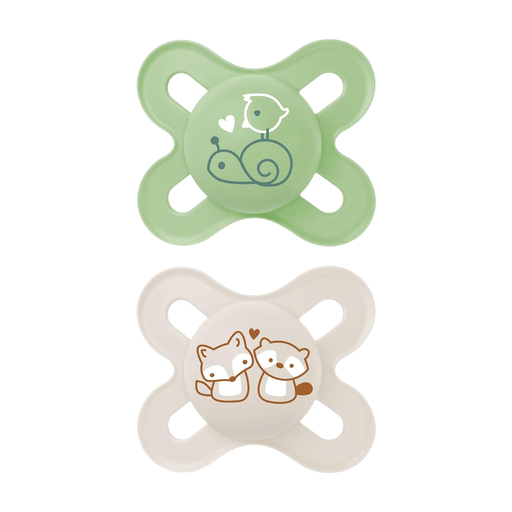
Why This Fits Their Persona: A two-pack gives new parents a spare for the changing bag, while the included steriliser and carry case can simplify preparation at home or when travelling.
The extra-small newborn format avoids buying a larger soother too early, and the symmetrical silicone teat avoids natural rubber latex.
BPA- and BPS-free silicone teat; microwave sterilising case included.
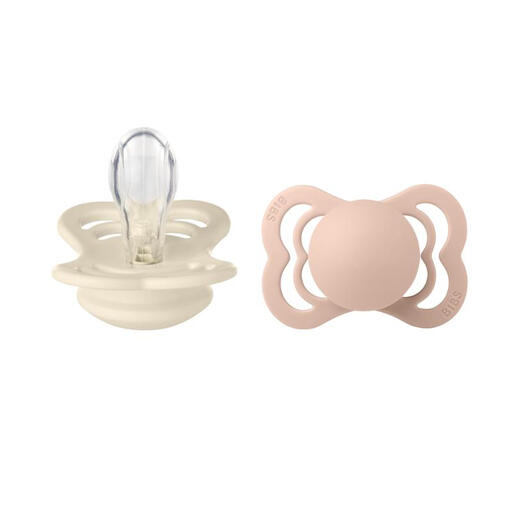
Why This Fits Their Persona: Suitable for parents who prioritise a modern symmetrical design, food-grade materials and a two-pack for rotation between nursery, pram and changing bag.
Its specification identifies silicone rather than leaving the material unclear, and the wide shield includes ventilation openings instead of relying on appearance alone.
Food-grade silicone teat; product description states compliance with EN1400:2013+A2:2018.
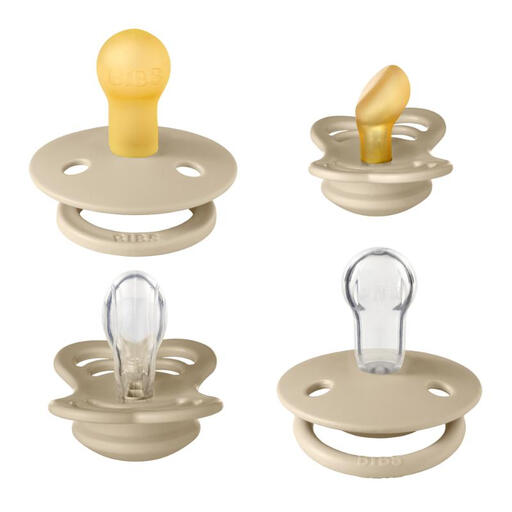
Why This Fits Their Persona: A practical option for families still discovering their baby’s preference, with several shapes and materials to try before committing to one style.
It avoids investing in several identical soothers that may be rejected by offering round, anatomical and symmetrical shapes in latex and silicone.
Four Size 1 soothers for babies aged 0–6 months; includes BPA-free food-grade materials.
A dedicated soother clip can help keep a dummy off the floor during supervised daytime use. Choose a product designed for soothers, inspect it before use and attach it only to clothing. Never lengthen a clip, tie it around a baby’s neck or use it in a cot, bed or cradle. Remove it while the baby is sleeping.
Glow-in-the-dark soothers, such as glow handle versions, can be easier to locate during night-time settling. This is a convenience feature rather than a safety feature, so the soother still needs regular inspection and replacement.
Replace a soother at the first sign of damage, weakness, stickiness, enlargement or cracking. Many latex options recommend replacement every 4–6 weeks, while some silicone newborn products advise replacement every 1–2 months. Follow the product instructions and replace sooner if necessary.
We have compiled a complete, real-time list of products that fully satisfy these strict selection criteria and UK safety regulations.
Some are specifically sized for newborns from 0 months, but not every soother has the same shield or teat dimensions. Check the stated age range and select an extra-small design if recommended for very young or premature babies.
Replace them immediately if damaged and otherwise follow the supplied instructions. Common guidance ranges from four to six weeks for natural rubber latex soothers and one to two months for some silicone newborn soothers.
No. Soother clips should be used only when the baby is awake and under direct adult supervision. Never attach cords or ribbons to a soother, and do not use a clip in a cot, bed or cradle.