
24/7 Customer Support

Free returns

Same-day & Next-day Delivery

Quality Guaranteed

Unlock Your Welcome Offers: FREE Delivery | Up to 80% OFF | Free 30-day JoyPlus trial
Download the APP
The transition to solid foods is an exciting milestone, but it often comes with a less-than-thrilling side effect: mess. As your little one discovers the joy of self-feeding, plates can quickly become frisbees, and carefully prepared meals can end up on the floor. A good baby suction plate promises to keep mealtimes tidy and stress-free, but not all are created equal.
As the Joybuy Product Recommendation Officer, my role is to help you navigate the market and find products that genuinely deliver on their promises. Many parents find themselves disappointed by plates that fail to stick or are difficult for a child to use. Before you buy, let's look at the common pitfalls to avoid.
To ensure you're getting a product that works, focus on a few key parameters. These are the non-negotiable features that separate a helpful tool from a frustrating piece of plastic.
The effectiveness of a toddler suction plate depends entirely on its base. Look for a large, single suction base, as these tend to create a stronger seal on smooth, non-porous surfaces like plastic highchair trays, glass or stone countertops. Some designs use multiple smaller suction pads, which can also be effective.
Practical Tip: Before first use, always ensure both the suction base and the surface are clean and completely dry. A small amount of moisture or a few crumbs can be enough to break the seal. Press down firmly from the centre to expel all the air.
When it comes to tableware for your child, material is paramount. 100% food-grade silicone is a widely recommended material for a silicone baby plate. It is durable, flexible, easy to clean and generally resistant to high and low temperatures.
Crucially, look for products that are explicitly labelled as BPA free plates for babies, and also free from PVC and Phthalates. This ensures the material is stable and won't leach unwanted chemicals into your child's food.
A well-designed plate should actively help your child learn to eat independently. A divided toddler plate is excellent for introducing different food groups and textures without them mixing. More importantly, look for plates with deep, curved sidewalls. These act as a barrier, helping your child to scoop food onto their spoon or fork, building their confidence and fine motor skills.
Instead of a one-size-fits-all approach, we've matched some standout products to specific parenting scenarios.

Why This Fits Their Persona: This is for the parent who wants to be fully equipped for the weaning journey from day one. It provides a complete, coordinated baby feeding set, removing the guesswork of buying individual items.
It directly counters the 'weak suction' trap with a strong suction base on both the plate and bowl. The ergonomic utensils and bib also avoid the 'awkward design' flaw by being built for purpose.
Comprehensive convenience. The set includes a suction plate, suction bowl, sippy cup, bib and utensils, all made from food-grade, BPA-free silicone.
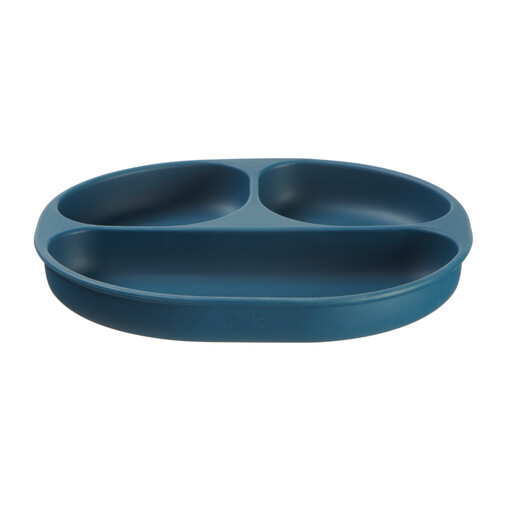
Why This Fits Their Persona: This parent's primary goal is to stop the plate from flying. They may already have cutlery and bibs, and need a single, highly effective plate that excels at one job: staying put.
It tackles the 'weak suction' trap head-on with four strong suction pads for enhanced stability. It also avoids the 'unsafe material' pitfall by being made from 100% silicone that is free from BPA, Latex and Phthalates.
Excellent adhesion from its four-pad system. The scooped sides and divided sections are great for encouraging self-feeding and introducing varied meals.
While the suction plates above are excellent for messy mealtimes, you might also be looking for other tableware as your child grows. For a wider selection, including stylish dinnerware for the whole family, you can explore our broader collections.
We have compiled a complete, real-time list of products that fully satisfy these strict selection criteria and UK safety regulations.
This is the most common issue and usually has a simple fix. For a suction plate to work, it needs an airtight seal. This is only possible on a surface that is completely smooth, flat and non-porous. Good surfaces include a plastic highchair tray, a granite or quartz countertop or a glass table. It will not stick to unfinished or porous wood, or surfaces with a heavy texture. Always ensure both the plate's base and the surface are clean and dry before pressing down firmly.
A key benefit of a high-quality silicone baby plate is its durability. When cared for properly, it can easily last for several years and can often be used for more than one child. To prolong its life, avoid using sharp knives on the surface, as this can create cuts where bacteria could gather. Most are dishwasher-safe, which simplifies cleaning. You should inspect it periodically for any signs of tearing or significant wear.
While silicone is generally a safe material, it's wise to choose products from brands that are transparent about their standards. Always look for plates that are explicitly described as 100% food-grade silicone. Furthermore, check for certifications that confirm it is free from BPA, PVC and Phthalates. This ensures the product meets established safety standards for items that come into contact with food.