
24/7 Customer Support

Free returns

Same-day & Next-day Delivery

Quality Guaranteed

Unlock Your Welcome Offers: FREE Delivery | Up to 80% OFF | Free 30-day JoyPlus trial
Download the APP
Choosing between baby walkers can be surprisingly difficult. Listings often highlight lights, melodies and colourful toys, while important details such as height range, wheel resistance and storage dimensions receive less attention. The right choice depends less on the number of features and more on whether the walker suits your child’s development stage, your home and your everyday routine.
A label such as “6 to 18 months” is only a guide. Children develop at different rates, so a baby should be able to sit unaided before using a seated walker. Check the product’s weight limit, height settings and instructions, then confirm that your child’s feet can rest comfortably and securely.
A wooden baby walker designed for toddlers over 12 months is a different product from a seated baby walker intended for children who can sit independently. Confusing these two formats is a common source of wasted purchases.
Musical buttons and activity trays can be engaging, but they may not be useful if the tray cannot be removed, the batteries are difficult to replace or the sound is unsuitable for your household. Consider whether the activities can be used separately and whether the walker remains practical once your child loses interest in the toys.
A baby walker with wheels needs sufficient clearance for doorways, furniture and flooring. Smooth wheels may move too quickly on hard floors, while overly restrictive wheels can make movement frustrating. Folding baby walker designs are useful in smaller UK homes, but always check the folded dimensions rather than relying on the word “compact”.
A seated baby activity walker surrounds the child with a frame and usually includes a padded seat, activity tray and height adjustment. It is generally intended for children who can sit unaided and has a stated maximum weight.
A baby push walker, including a wooden baby walker, is pushed from behind while the child stands. These models are often aimed at older toddlers and require a stable handle, a broad base and suitable wheel traction. They are not interchangeable with a seated toddler walking aid.
Look for clearly stated:
For a baby walker for 6 to 18 months, the 4-in-1 model below provides three height settings and an adjustable rear-wheel speed level. The manufacturer’s instructions should still take priority, and use should stop when the child can walk independently or reaches the stated weight limit.
A padded seat should be removable or washable where possible. Activity trays should have smooth surfaces without accessible sharp edges, and wooden walkers should have rounded, burr-free surfaces.
The wooden model featured below is described as using basswood and MDF, with four wheels fitted with non-slip rubber rings. Its listing also states EN-71 and UKCA certification. These markings are useful checks, but buyers should still read the supplied warnings and assembly instructions.
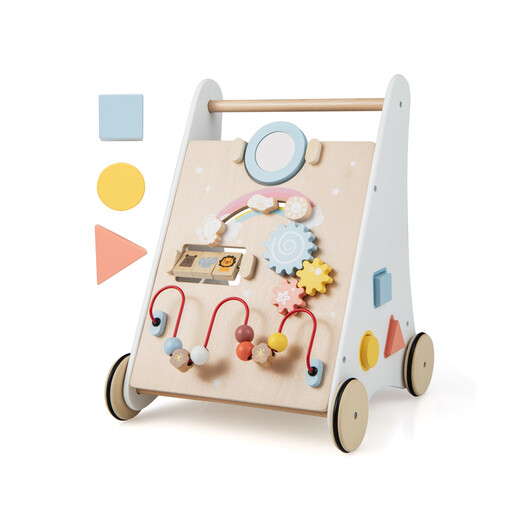
Why This Fits Their Persona: A practical option for families wanting one push-along toy with play value and storage, rather than a battery-powered seated unit.
Its 45 cm height, triangular structure and rubber-ringed wheels provide clearer suitability information than a generic age claim alone. It is designed for toddlers over 12 months old.
Seven listed activity areas, four wheels with non-slip rubber rings and a rear storage shelf. Assembly is required.
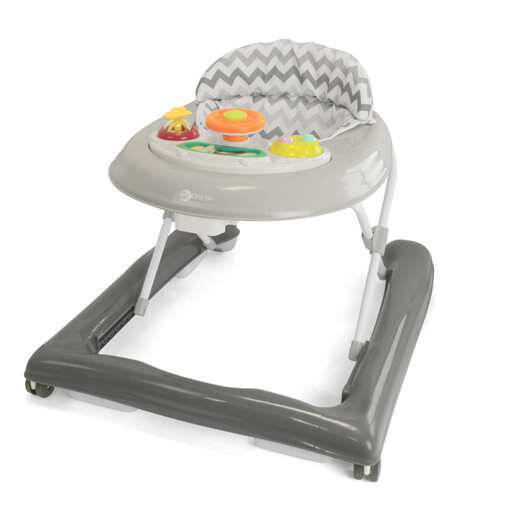
Why This Fits Their Persona: Suitable for households that value comfort, adjustable positioning and quick storage between uses.
The three-position height adjustment counters poor fit, while anti-tip safety pads address stability. The seat and tray functions are not permanently fixed together.
The tray detaches for floor play or snack use, and the frame folds flat. It accommodates children who can sit unaided up to 12 kg.
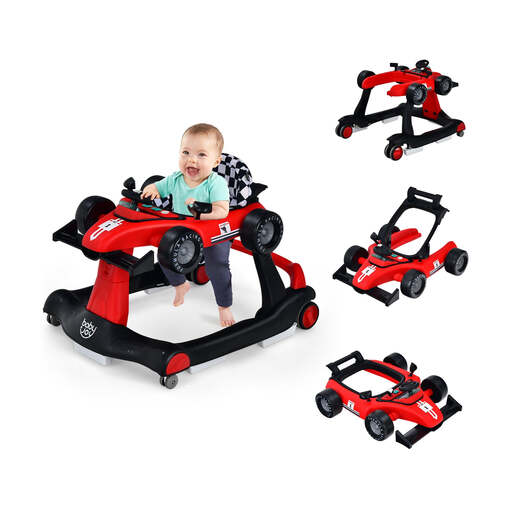
Why This Fits Their Persona: A flexible choice for families seeking several play and movement modes, particularly where storage space is limited.
Rather than relying only on entertainment features, it offers three height positions, rear-wheel speed adjustment, an anti-slip base and a safety bumper.
Four modes, quick folding to 73 x 64 x 29 cm and a padded, breathable seat. The musical functions require two AA batteries, which are not included.
We have compiled a complete, real-time list of products that fully satisfy these strict selection criteria and UK safety regulations.
Before the first use, assemble the frame exactly as instructed and check that every clip, wheel and height lock is secure. For seated walkers, confirm that the seat is properly attached and that the child’s feet make appropriate contact with the floor.
Keep all baby walkers away from stairs, steps, uneven surfaces, heaters, fires and electrical cables. Never leave a child unattended. Inspect wheels, anti-tip pads, locks and the seat regularly, particularly if the walker is used daily or moved between rooms. Stop using it if a component is broken, loose or missing.
Some seated models are suitable once a child can sit unaided, often from approximately six months, but the exact age, height and weight instructions vary. A push-along wooden baby walker is usually aimed at an older toddler who can stand and control their movement. Always follow the individual product guidance.
The usable period depends on the design and the child’s development. A seated model should no longer be used when the child can walk independently or exceeds its stated weight limit. A wooden push walker may remain useful as an activity centre or toy after walking practice, provided it remains intact and age-appropriate.
Not all do. Musical baby walker models commonly need AA batteries for lights and sounds, while wooden activity walkers usually use no batteries. Check whether batteries are included and consider whether the sound features justify the ongoing replacement cost for your household.