
24/7 Customer Support

Free returns

Same-day & Next-day Delivery

Quality Guaranteed

Unlock Your Welcome Offers: FREE Delivery | Up to 80% OFF | Free 30-day JoyPlus trial
Download the APP
Choosing between baby walkers and pushchairs can feel straightforward until you compare age limits, folded dimensions, harnesses, wheels and comfort features. A pushchair suitable from birth serves a different purpose from an interactive walker designed for a sitting baby, so buying based on appearance alone can lead to an unsuitable or short-lived purchase.
This guide from the Joybuy Product Recommendation Officer focuses on practical details rather than marketing language, helping UK parents, guardians and gift buyers compare products for everyday travel, storage and early movement.
A baby pram from birth should offer a sufficiently reclined position and proper support, but the usable position depends on the manufacturer’s instructions and the child’s development. A seat that reclines is not automatically suitable for an unsupervised newborn.
Check:
A lightweight travel pushchair may be easy to lift but awkward to store if the folded size is large. Before ordering, measure your car boot, hallway cupboard or public transport storage area. Also check whether the fold can be operated without removing the seat or canopy.
A compact pushchair should be assessed using both its weight and folded dimensions. A 6.3 kg frame, for example, may be manageable for stairs and train journeys, but the folded height still matters when space is limited.
A musical baby walker or interactive tray can make floor play more engaging, but lights and sounds do not replace anti-tip features, stable construction or active supervision. Wheeled walkers can move quickly towards stairs, hot surfaces, cables and uneven flooring.
Use any baby walker with wheels only when the child can sit unaided, follow the specified weight limit and remain supervised. Keep stair gates closed, remove hazards and stop use when the child can walk independently or reaches the stated limit.
Look for a properly fitted five-point harness, reliable brakes and a canopy that can be adjusted for changing outdoor conditions. Product information may list standards such as EN1888; this is a pushchair-related European safety standard. Always read the supplied instructions, warnings and care information, as a standard listing does not remove the need for correct assembly and use.
For town pavements and parks, suspension and larger rear wheels can make a noticeable difference to handling. EVA foam tyres avoid punctures, while a spacious basket can reduce the need to carry a separate changing bag.
Compare:
A foldable baby pushchair with a one-hand mechanism is particularly useful for parents managing a baby, bags and transport at the same time. Still, confirm that the locking mechanism engages fully after folding.
Most walkers for babies 6 to 18 months are intended for children who can sit unaided, not newborns. Check the stated maximum load, seat height and stopping point for use. A height-adjustable walker should allow the child’s feet to reach the floor comfortably without forcing them onto their toes.
Useful practical features include:
An adjustable baby walker can accommodate growth for longer, but it should not be used beyond its instructions simply because the child still fits the seat.
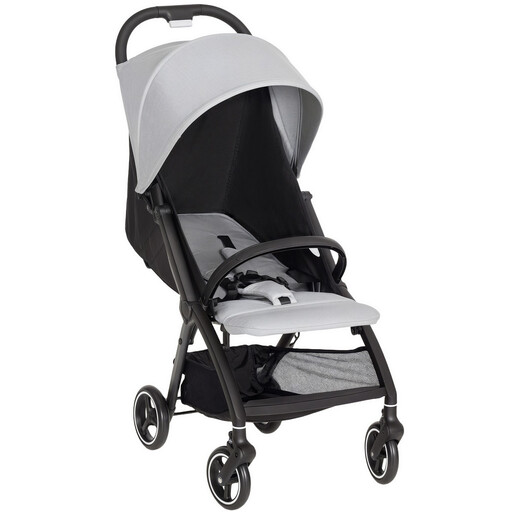
Why This Fits Their Persona: A practical option for families needing one everyday pushchair from birth to 36 months, with a 15 kg maximum load and compact one-hand folding for routine trips.
The listed 115°–170° backrest range, two-position footrest, five-point harness and dual brakes address comfort and basic security checks that can be missed when focusing only on price.
6.3 kg weight, front-wheel suspension, adjustable canopy and a large under-seat basket for city errands.
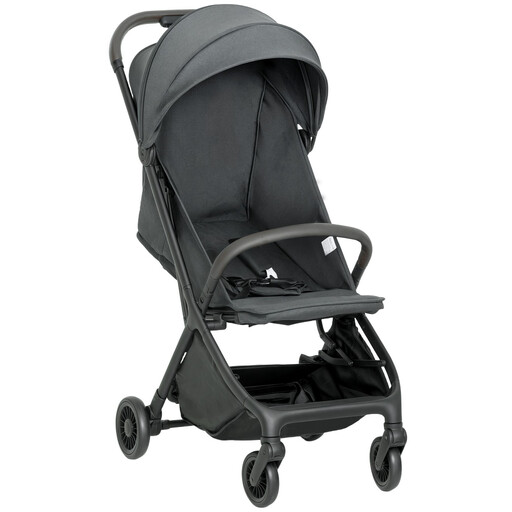
Why This Fits Their Persona: Suits buyers prioritising a refined set of travel and comfort features, including upright or reclined seating, all-wheel suspension and a single-hand fold.
Its listed 103 x 87 x 50 cm open size and 56 x 50 x 25 cm folded size make storage easier to plan than relying on vague “travel-ready” wording.
6.3 kg aluminium frame, EVA tyres, four-wheel suspension, 170° maximum recline and EN1888 listed in the product information.
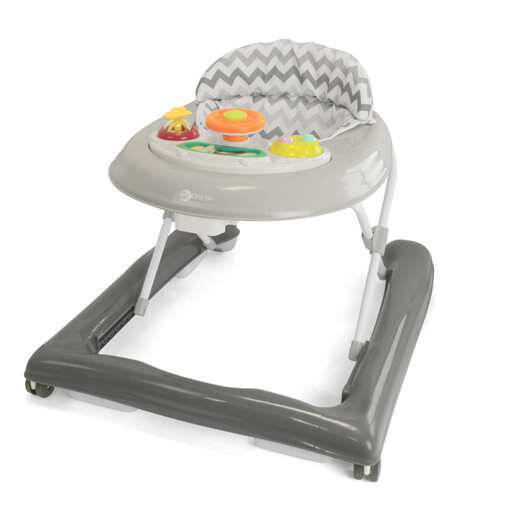
Why This Fits Their Persona: Appropriate for families seeking a walker with play value as well as movement, particularly where flat folding and removable parts are useful in smaller UK homes.
The product is specified for children who can sit unaided, up to 12 kg, and includes anti-tip pads. These limits should be followed rather than treating it as a general-purpose toddler pushchair.
Three-position height adjustment, detachable musical tray, padded seat and flat-folding frame; batteries are required and not included.
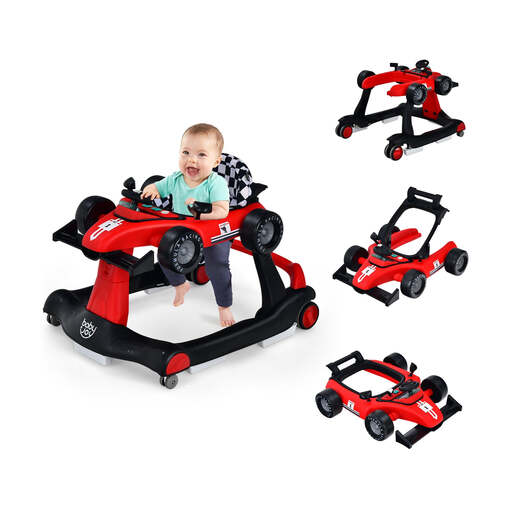
Why This Fits Their Persona: Designed for households wanting several play and movement configurations in one product, with a stated 6–18-month range and 12 kg weight capacity.
Adjustable height and rear-wheel speed settings provide more control than a fixed walker, while the anti-slip base, stair pads and safety bumper are clearly specified.
Four modes, three height settings, adjustable speed, quick folding and a musical light feature; two AA batteries are needed.
We have compiled a complete, real-time list of products that fully satisfy these strict selection criteria and UK safety regulations.
No. Wheeled walkers are generally intended for babies who can sit unaided and meet the product’s stated age and weight requirements. For a newborn, choose a suitable baby pram from birth and follow the manufacturer’s recline and harness instructions.
Lifespan depends on the frame, fabric care, frequency of use and whether the child remains within the maximum weight limit. Regularly check brakes, wheels, harness stitching, folding locks and fasteners. Stop using the pushchair if a safety-critical part is damaged or missing.
They can be, provided the wheels, suspension, basket and seat support match your routine. A compact pushchair is convenient for buses, trains and smaller car boots, while a larger frame may be more comfortable on rough paths. Measure your storage space and consider your usual routes before selecting a lightweight travel pushchair.