Parents introducing savoury foods
The NHS advises starting solid foods at around 6 months. Coconut milk can be considered as an ingredient in a suitable savoury recipe, rather than served in place of a milk feed.


For a baby starting solids at around 6 months, use coconut milk as an ingredient in food, not as a replacement for milk feeds. A light cooking tin is worth considering for a less rich recipe base; a two-ingredient tin puts a shorter ingredient list first, while a carton coconut drink is a separate option for mixing into food. Check the exact product for salt and allergen warnings, and keep breast milk or infant formula as the main drink until 12 months, as advised by Frimley Health NHS Foundation Trust.
The NHS advises starting solid foods at around 6 months. Coconut milk can be considered as an ingredient in a suitable savoury recipe, rather than served in place of a milk feed.
If a soup or curry is being made for everyone, set aside the baby’s portion before adding salt, stock cubes or gravy. The NHS advises against adding these to baby food.
Frimley Health NHS Foundation Trust says carton plant-based drinks can be used for cooking or mixing into food from 6 months unless a dietitian advises otherwise. Breast milk or infant formula should remain the main drink until 12 months.
Choose the format for the recipe first, then compare the flavour description and current label before preparing the baby’s portion.
| Priority | What to check | Your needs |
|---|---|---|
| Product format | Choose a culinary tin for a coconut cooking ingredient or a carton drink for mixing into food. Frimley Health NHS Foundation Trust says breast milk or infant formula should remain the main drink until 12 months. | I need an ingredient for food, not a substitute for my baby’s milk feeds. |
| Flavour and texture | Read the product’s flavour description rather than assuming every light tin tastes mild. Tesco lists 25% coconut extract for Blue Dragon Light; Sainsbury’s lists 48% for Tropical Sun, but those figures alone do not establish how either will taste in a recipe. | For a savoury purée or sauce, I want to judge how noticeable the coconut flavour will be in the finished food. |
| Ingredients and salt | Compare ingredient lists and the stated salt value using the label’s per-100ml or per-100g basis. The NHS advises against adding salt, stock cubes or gravy to baby food. | A short ingredient list matters to me, but I also want to check the rest of the recipe before serving a portion. |
| Allergen statements | Read the ingredients and precautionary warnings on the current pack. Tesco’s Blue Dragon Light listing, for example, says it may contain peanuts and nuts; the word “coconut” does not settle whether a particular product meets an allergy-related need. | If allergies are relevant in my family, I need to check the exact product rather than rely on “mild”, “natural” or “dairy-free” wording. |
A culinary tin is used to add coconut flavour to cooking; a carton drink is a different product for uses such as mixing into food. Frimley Health NHS Foundation Trust says plant-based drinks should not replace breast milk or infant formula as the main drink before 12 months.
Decide whether the recipe needs a cooking ingredient or a liquid for mixing, while keeping the baby’s usual milk feeds.
Precautionary statements vary by product. Tesco’s listing for Blue Dragon Light says it may contain peanuts and nuts, despite its ingredient list containing no milk ingredient.
Check the current pack. The NHS advises particular care when introducing foods if a baby has an existing allergy or eczema, or there is a family history of allergic conditions.
A mild coconut ingredient does not remove salt or other ingredients already added to a sauce. The NHS advises against adding salt to baby food and against using stock cubes or gravy for it.
Take out the baby’s portion before seasoning the rest of the meal.
Sainsbury’s lists coconut extract and water for Tropical Sun’s tin, alongside 12g fat per 100g. A short list does not establish that its flavour will be especially mild.
If mild flavour is the main aim, check the exact product description as well as its ingredients. Shake a naturally separated tin if its instructions say to do so.
These examples illustrate different product formats and label checks; the details apply to the named products, not every item from each brand.
Blue Dragon Light Coconut Milk 400ml is a culinary tin described as having a mild coconut flavour.
The 100% Natural Coconut Milk 400ml tin offers a short ingredient list for cooking.
Koko Unsweetened Coconut UHT 1L is a carton drink to consider for mixing into food rather than for the same cooking role as a tin.
Alpro Coconut No Sugars Drink 1L is a carton option for recipes needing a coconut-based liquid.
M&S Coconut Milk 400ml is another tinned cooking option with a two-ingredient list.
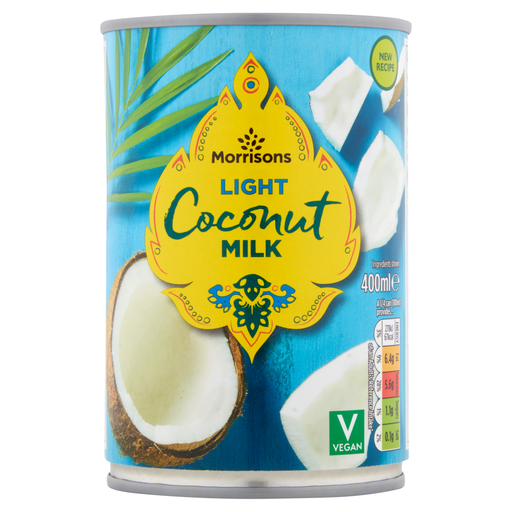
This reduced-fat coconut-milk tin represents the culinary-ingredient route for savoury recipes. Its name does not establish how mild it tastes, so check the current product description and pack if flavour is the deciding factor.
 No image available
A canned cooking ingredient to consider for a savoury baby-food recipe. Check the current label for salt, ingredients and allergen warnings, and set aside the baby’s portion before adding salt or stock cubes.
Coconut milk can be used as an ingredient in a suitable food recipe when your baby is ready for solids. The NHS advises starting complementary feeding at around 6 months; coconut milk should not replace milk feeds.
No. Frimley Health NHS Foundation Trust says breast milk or infant formula should remain the main drink until 12 months. Its milk-free weaning guidance allows carton plant-based drinks for cooking and mixing into food from 6 months unless a dietitian advises otherwise.
No. “Light” does not replace checks on the exact product and recipe. Tesco’s Blue Dragon Light listing includes salt and a precautionary peanut-and-nut warning; the NHS also advises against adding salt, stock cubes or gravy to baby food.
The word “milk” does not tell you whether a particular coconut product contains a dairy ingredient. Check its current ingredient and allergen information, including precautionary warnings. The NHS advises particular care when introducing foods if a baby has an existing allergy or eczema, or there is a family history of allergic conditions.
Follow the instructions on the exact tin. Joybuy’s information for Blue Dragon Light says to refrigerate the contents in a suitable container and use them within 2 days of opening.