
24/7 Customer Support

Free returns

Same-day & Next-day Delivery

Quality Guaranteed

Unlock Your Welcome Offers: FREE Delivery | Up to 80% OFF | Free 30-day JoyPlus trial
Download the APP
Introducing solid foods can quickly turn into a search for the right baby weaning cutlery. A spoon that worked for smooth purée may be frustrating once your baby starts scooping thicker food, while a fork that looks suitable may have tines that are difficult for small hands to control.
The product description, age guidance and cleaning instructions matter more than colourful packaging. This guide explains the common buying traps, the specifications worth checking and which options may suit different feeding routines.
Soft-tip weaning spoons are often designed for early feeding, but age guidance differs between products. Some are suitable from 4 months plus, while baby fork and spoon sets may be intended for 6 months and over. Always check the manufacturer’s stated age range and use the utensil only when your baby is developmentally ready for complementary foods.
A coordinated colour is useful, but it does not tell you whether the handle is easy to hold, the fork tips are rounded or the utensil can be cleaned thoroughly. A toddler cutlery set with chunky, textured handles may be more practical for self-feeding than a slimmer adult-style design.
Food can collect around fork joints, textured handles and pouch attachments. If the cutlery is difficult to wash or cannot dry properly, it may become inconvenient for daily use. A baby cutlery with storage case option can be useful outside the home, but the utensils should still be washed and dried completely before being stored.
For first purées, a shallow spoon bowl and a flexible tip can make it easier to offer small amounts of food. Baby weaning spoons labelled for 4 months plus may suit this stage, subject to your baby’s readiness and the instructions supplied.
As your child begins to grasp utensils, look for:
No cutlery should be treated as a toy. Constant adult supervision is required during use.
Many parents search for silicone baby cutlery or BPA-free baby spoons. These terms can help narrow your options, but check the full material specification rather than relying on front-of-pack wording. The products below list materials such as food-grade silicone, polypropylene, bamboo or combinations of these.
Also check for other stated exclusions where relevant, such as latex, phthalates, BPS or lead. These are product-specific details, not a guarantee that every item in a category has the same construction.
Dishwasher suitability can reduce daily effort, although you should follow the product’s temperature and rack instructions. Some utensils are suitable for sterilisation, while bamboo-handled spoons may require hand washing and must not be microwaved.
For nursery days, visits to grandparents or meals in cafés, a case can help separate clean and used utensils in a changing bag. Pouch spoon tips are another portable format, particularly where prepared food pouches are part of your routine.

Why This Suits Their Persona: A straightforward two-piece set for families starting self-feeding at home, with a spoon, fork and storage box included.
The stated 6 months plus guidance, rounded fork tips and adult-supervision warning make the intended use clearer than vague age labelling.
Food-grade silicone and PP construction; textured, non-slip handles and a portable storage box.

Why This Suits Their Persona: Suits households that prefer a bamboo handle and are comfortable with hand washing for an early self-feeding routine.
The care instructions clearly state hand wash only and no microwave use, reducing the risk of treating it like dishwasher-safe plastic cutlery.
Bamboo handle with food-grade silicone tip; listed as BPA-, BPS-, phthalate- and lead-free.
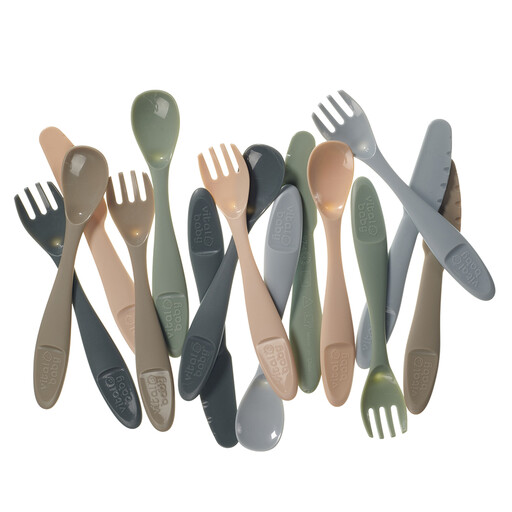
Why This Suits Their Persona: A practical choice for families managing several meals, nursery visits, picnics or frequent washing between uses.
The 15-piece format provides spare utensils, while the stated 12 months plus age guidance avoids presenting toddler-sized cutlery as suitable for younger babies.
Chunky handles; BPA-, latex- and phthalate-free polypropylene; top-rack dishwasher guidance up to 65°C.

Why This Suits Their Persona: Designed for families who regularly feed from pouches during travel, park visits or days away from home.
The pouch attachment is purpose-specific: twist it firmly onto a standard pouch and check the connection before feeding rather than assuming universal compatibility.
Two soft-flex silicone spoon tips; stated compatibility with most standard baby food pouches; supplied travel case.
We have compiled a complete, real-time list of products that fully satisfy these strict selection criteria and UK safety regulations.
Whichever self-feeding utensils for babies you choose, build these habits into every mealtime:
There is no universal replacement period for baby cutlery. Lifespan depends on use, washing methods and material. Replace an item at the first sign of wear rather than keeping it because it is part of a set.
Some products are labelled for 4 months plus, including the Vital Baby Ella’s Kitchen spoon tips listed above. Others are labelled for 6 months or 12 months plus. Age suitability is product-specific, and parents should also follow NHS guidance on when their baby is ready to begin solid foods.
Silicone and polypropylene sets may offer dishwasher or sterilisation compatibility, depending on the instructions. Bamboo-handled spoons commonly require hand washing and air drying, and may not be suitable for microwave use. Choose according to the cleaning routine you can maintain consistently.
Spoons are generally useful for purées, yoghurt and soft mashed foods. A baby fork and spoon set becomes more useful when your child is practising self-feeding with soft pieces and wants to explore different utensil movements. A pouch spoon tip is more specialised and may not replace everyday toddler cutlery.