Parents starting solids
If your baby is ready for solids at around 6 months, the NHS says plain, full-fat yoghurt can be offered alongside their usual milk feeds. Choose a product with no added sugar.


For a baby starting solids at around 6 months, the NHS advises choosing plain, full-fat yoghurt with no added sugar. Greek or Greek-style yoghurt can fit that advice if the individual pot meets those checks; a fruit-blended pouch is not the same as a plain pot. Check the milk ingredient before serving, and follow your child’s allergy plan if cow’s-milk protein allergy has been diagnosed.
If your baby is ready for solids at around 6 months, the NHS says plain, full-fat yoghurt can be offered alongside their usual milk feeds. Choose a product with no added sugar.
Greek, Greek-style, light and flavoured products can differ. Compare the ingredients and fat information on the particular pack rather than relying on its range name.
Yoghurt made with cow’s milk contains a potential allergen. If cow’s-milk protein allergy has been diagnosed, follow the child’s allergy plan rather than choosing an ordinary dairy yoghurt.
Start with the NHS advice on plain, full-fat yoghurt with no added sugar, then check the particular pack for ingredients, allergens and storage instructions.
| Priority | What to check | Your needs |
|---|---|---|
| Fat and added sugar | Look for plain, full-fat yoghurt and check the ingredients for added sugar. A Greek-style label alone does not establish either point. | I’m choosing yoghurt for a baby starting solids, rather than a light or sweetened product intended for other members of the household. |
| Milk allergen | Read the milk declaration. The NHS advises introducing foods that can trigger allergies one at a time and in very small amounts. | If milk is new to my baby, I want to be able to identify a reaction. For a diagnosed cow’s-milk protein allergy, I need to follow the child’s allergy plan. |
| The actual recipe | Compare the ingredients and nutrition panel on each pot. For example, Sainsbury’s lists 7.6g fat and 4.2g sugars per 100g for its 200g Greek Style Natural Yogurt. | A familiar brand name or the word “natural” is not enough for me to judge a different product or variant. |
| Pack and storage | Check the use-by date, refrigeration directions and instructions for use after opening before choosing a pack size. | For occasional servings, I’d choose a size my household can use within the selected pack’s instructions. |
Tesco’s range includes full-fat and 0% products as well as flavoured options. The category name does not tell you whether a pot follows NHS advice to choose plain, full-fat dairy with no added sugar.
Check the ingredients and fat information on the individual pack.
Lactose and cow’s-milk protein are different parts of milk. A lactose-free description alone does not establish whether a product is suitable for a child with cow’s-milk protein allergy.
Follow the child’s allergy plan and check the ingredients with their healthcare professional before choosing an alternative.
The current pack is the place to confirm its ingredients, milk declaration and storage instructions.
Read the label each time you buy, particularly if you switch variants or pack sizes.
A larger tub may be impractical if it cannot be finished within its after-opening instructions. Sainsbury’s directs customers to refrigerate its 200g Greek Style Natural Yogurt and consume it within three days of opening.
Choose the pack size against how often it will be served, and follow that pack’s storage directions.
An unfinished tub can mean food waste.
These ranges illustrate why the individual yoghurt label matters; a brand name does not establish the ingredients or nutrition of every variant.
Tesco lists Fage Total Greek-recipe yoghurt in both 5% and 0% fat versions.
Yeo Valley describes natural yoghurt made with British whole milk.
Sainsbury’s lists Greek Style Natural Yogurt in 200g and 1kg packs.
M&S describes its Greek-Style Natural Yogurt as unsweetened and lists yoghurt made from milk and cultures.
Tesco’s Greek-style yoghurt range includes own-label and branded, full-fat, 0% and flavoured products.
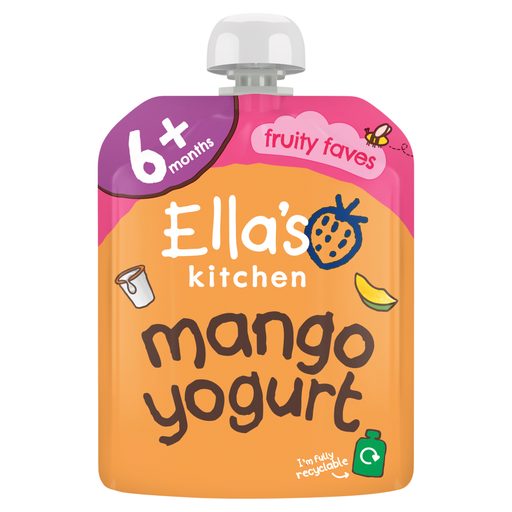
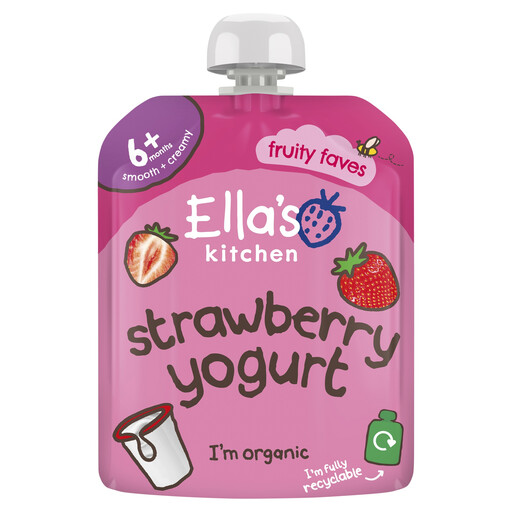
These are Greek-style fruit yoghurt pouches labelled for babies from 6 months, not the plain pots described in NHS weaning advice. Check each current label for ingredients and fat information before deciding whether it fits your needs.
 No image available
This mango yoghurt pouch is a fruit-blended option for babies from 6 months, rather than a plain yoghurt. It contains milk; check the current label against your baby’s needs and follow an allergy plan where applicable. Serve from a spoon or bowl as directed, and keep the cap away from children because it presents a choking hazard.
 No image available
This strawberry yoghurt pouch is a fruit-blended option for babies from 6 months, not a plain yoghurt. It contains milk; check the current label against your baby’s needs and follow an allergy plan where applicable. Serve under adult supervision and keep the pouch cap away from children because it may present a choking hazard.
The NHS says plain, full-fat yoghurt can be given from around 6 months, when a baby is ready to start solids. It is offered alongside breast milk or first infant formula, not as a replacement for those feeds.
Choose plain, full-fat yoghurt for a baby under 2 unless you have been given different individual advice. The NHS recommends full-fat dairy products for young children up to that age; check the fat information on the particular pot.
The fruit description alone does not answer that question. The NHS advises choosing dairy products with no added sugar, so read the individual ingredients list; a fruit-blended product is still different from a plain yoghurt.
The NHS advises introducing foods that can trigger allergies one at a time and in very small amounts, so a reaction is easier to spot. If your baby has a diagnosed milk allergy, follow their allergy plan before offering dairy yoghurt.
Ordinary yoghurt made from cow’s milk contains milk protein. For a baby with diagnosed cow’s-milk protein allergy, follow the child’s clinical allergy plan and seek advice from their healthcare professional when selecting an alternative.