For a baby starting solids at around 6 months, a multipack is useful only if the yoghurt itself suits early weaning. NHS guidance identifies pasteurised, full-fat, unsweetened or plain yoghurt as a suitable choice; compare age labelling, ingredients, portion size and milk-allergen information before choosing individually packed pots or pouches. For nursery or outings, also plan how to follow the product’s storage instructions until it is eaten.
Who is this for?
Parents starting baby-led weaning
The NHS says solids can be introduced from around 6 months. If you are choosing yoghurt at this stage, check that your baby is ready for complementary feeding and look for a pasteurised, full-fat, unsweetened or plain option.
Parents packing nursery or outing snacks
Individual portions may be convenient away from home. Choose a size your child can manage, follow the pack’s storage instructions and check how the yoghurt will be kept until it is eaten.
Families managing milk-allergen rules
Standard dairy yoghurt contains milk. Read the current allergen label and check the nursery or school’s arrangements before including it in a packed lunch.
What to check when choosing
Start with suitability for your baby, then compare the yoghurt and its portion format; a child-focused multipack label does not answer all three questions.
| Priority |
What to check |
Your needs |
| Starting solids |
Check your baby’s readiness and any stated lower age on the pack. NHS guidance places the start of complementary feeding at around 6 months and identifies pasteurised full-fat yoghurt as suitable from around that age. |
For a first yoghurt, I want a product that fits the stage at which my baby is starting solids, rather than relying on children’s packaging alone. |
| Ingredients and sugars |
Compare the ingredients list with the total-sugars figure per 100g. Check whether sugar is added: a no-added-sugar label does not mean the yoghurt contains no sugars. |
I would prefer a plain or unsweetened full-fat yoghurt for early weaning, in line with NHS guidance, and want to distinguish added sugar from sugars already present in milk or fruit. |
| Portion format |
Check the weight of each pot or pouch and the number in the pack. Tesco Groceries lists Yeo Valley Little Yeos as 6 x 42g and Onken Kids Raspberry & Banana Yoghurt as 4 x 90g; those are different individual portion sizes. |
A smaller portion may fit what my baby eats now; for nursery, I also need a format that is practical to pack and serve. |
| Milk allergen |
Read the current ingredients and allergen information for the exact variety. The Food Standards Agency identifies milk as an ingredient in yoghurt. |
If my child has a milk allergy or the setting has allergen rules, I need to check the specific product and follow the child’s allergy-management arrangements. |
| Storage away from home |
Follow the product’s storage instructions and ask the nursery or school what chilled storage is available. Tesco Groceries instructs refrigeration for its Strawberry & Raspberry fromage frais pouches. |
Before packing yoghurt, I need a way to keep it as directed until my child eats it. |
Common buying mistakes
-
Assuming every children’s yoghurt is intended for first weaning
A children’s label does not establish a lower suitable age or replace checking whether your baby is ready for solids.
Look for an age statement where relevant, or compare a plain pasteurised full-fat yoghurt with NHS guidance for feeding from around 6 months.
-
Reading “no added sugar” as “sugar-free”
A yoghurt without added sugar can still show sugars on its nutrition panel. Conversely, the Onken Kids ingredients listed by Tesco Groceries include sugar.
Read the ingredients and compare total sugars per 100g, rather than comparing figures for differently sized pots.
-
Choosing a lunchbox portion without a storage plan
Individual packaging does not remove the need to follow a chilled product’s storage instructions.
Check the pack before leaving home and confirm what refrigeration or other suitable storage the setting can provide.
-
Overlooking milk and setting-specific rules
Dairy yoghurt contains milk, and a nursery or school may have its own arrangements for managing allergens in packed food.
Read the full current label and check the child’s allergy plan and the setting’s policy before packing it.
Brand and product-line references
Yeo Valley
Tesco Groceries lists Organic Little Yeos No Added Sugar Kids Yogurt as a 6 x 42g pack and describes it as intended for babies from 6 months.
- The stated age and no-added-sugar positioning make this particular product relevant to an early-weaning comparison.
- It is a dairy product; check the current milk-allergen label and storage instructions.
Onken
Tesco Groceries lists Onken Kids Raspberry & Banana Yoghurt in 4 x 90g pots.
- The individual 90g size offers a larger portion to compare with smaller packs.
- The listed ingredients include sugar and pasteurised cow’s-milk yoghurt. Check the current pack’s age information before considering it for a baby starting solids.
Tesco
Tesco’s Strawberry & Raspberry fromage frais pouches are listed as a 4 x 80g pack.
- The pouch format provides an individually packed option to compare for outings.
- Tesco instructs that these pouches be kept refrigerated; check the current ingredients, allergens and age labelling for the exact variety.
Müller
Tesco Groceries lists Müller Little Stars Smooth Yoghurt as a 12 x 85g multipack.
- Its pack count and individual portion size provide a comparison for families using more yoghurt servings.
- Check the current ingredients, nutrition, allergen and age information before considering this particular multipack for early weaning.
Joybuy multipack option
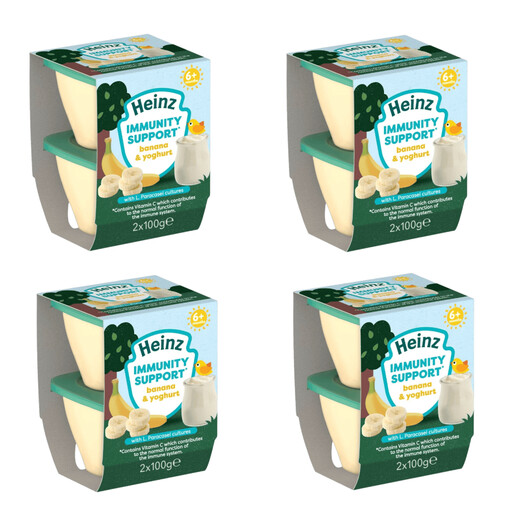
This baby-labelled banana and yoghurt multipack offers eight individual 100g pots. Compare its ingredients, dairy details and pot size with what you need for early weaning.
 No image available
Heinz Banana & Yoghurt Pots 6+ Months, 2 x 100g × 4
The 6+ months label makes this multipack relevant to compare when your baby is starting solids; each 100g pot may be more than you need for a small serving. The bundle contains four twin-packs, or eight pots in total. Check the current ingredients, milk-allergen information, fat content, pasteurisation and storage directions before choosing it as a first yoghurt.
View on Joybuy
Questions about weaning and lunchboxes
Can a baby have yoghurt when starting baby-led weaning?
Yes: the NHS identifies pasteurised full-fat yoghurt as suitable from around 6 months, when a baby is ready to start solids. Breast milk or first infant formula remains the main source of nutrition at the beginning of weaning.
Does a children’s multipack mean the yoghurt suits a baby from 6 months?
No. Check the product’s age statement and ingredients rather than relying on its children’s packaging. Tesco Groceries describes Yeo Valley Little Yeos as intended from 6 months; check the current label of any other pack you are considering.
Should I choose plain or fruit yoghurt for early weaning?
Plain, unsweetened full-fat yoghurt follows the NHS guidance for an option without added sugars. For a fruit yoghurt, check the ingredients for added sugar and use the per-100g nutrition figures when comparing products with different portion sizes.
Can I pack a yoghurt pot for nursery?
Check the nursery’s food and allergen rules and whether you can follow the pot’s storage instructions until it is eaten. Do not assume the setting will refrigerate packed lunches; ask what arrangements it provides.
What if my child has a milk allergy?
Standard dairy yoghurt contains milk, so it is not a milk-free choice. Follow your child’s allergy-management advice, read the full current label and check any alternative’s ingredients and allergen information before packing it.


