
24/7 Customer Support

Free returns

Same-day & Next-day Delivery

Quality Guaranteed

Unlock Your Welcome Offers: FREE Delivery | Up to 80% OFF | Free 30-day JoyPlus trial
Download the APP
Starting solids is an exciting stage, but choosing a baby weaning cutlery set can quickly become confusing. Product pages often highlight colours, character designs and broad claims about independence while leaving out the details that affect everyday use.
Three common buying traps deserve attention:
The right choice depends on your child’s stage, eating routine and tolerance for washing up. Below is a practical way to compare a baby spoon and fork set, silicone baby cutlery and complete feeding bundles.
Always begin with the stated age guidance. Several sets in this guide are suitable from 6 months, while others are intended for 12 months and over. Age guidance does not replace supervision, but it helps you select a size and shape appropriate for your child’s stage.
For early weaning, look for:
A shallow spoon can be particularly useful when offering purées or mashed foods. The Vital Baby Nourish set, for example, specifies a shallow spoon bowl, while its fork has rounded, blunt prongs.
Independent eating requires more than a small utensil. Babies and toddlers usually benefit from a chunky handle that is easier to close their fingers around. Textured or non-slip sections can also reduce slipping during messy meals.
Compare the following features:
Avoid choosing purely by appearance. A handle that looks compact in a product image may still be too thin for your child’s grip.
Parents commonly search for BPA-free baby utensils, but it is worth checking the full materials list rather than relying on a headline. The products below specify materials such as food-grade silicone, polypropylene or stainless steel. Some also state that they are free from PVC, latex, phthalates or other substances.
Cleaning instructions differ considerably:
No material removes the need for inspection. Replace any item showing cracks, weakness, loose sections or damaged fork tips.
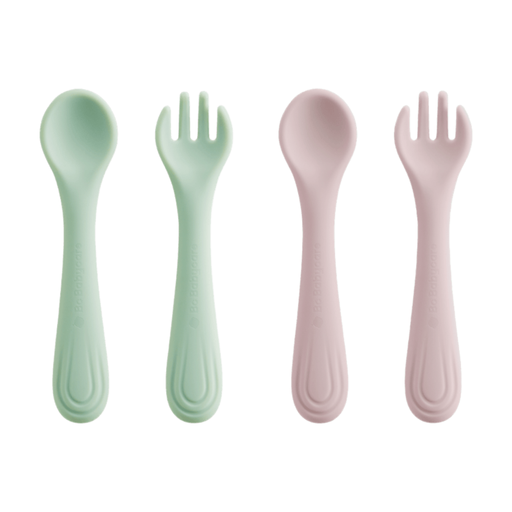
Why This Fits Their Persona: A straightforward two-piece baby fork and spoon set for families starting self-feeding without buying a larger baby feeding set.
The textured silicone grip is described as non-slip, while the fork has rounded tips and flexible tines. A storage case also avoids carrying loose utensils in a changing bag.
Food-grade silicone and PP; suitable from 6 months; spoon and fork can be soaked and air-dried.
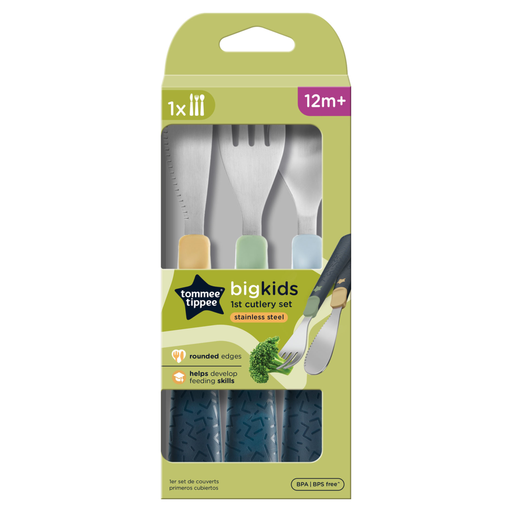
Why This Fits Their Persona: A stainless steel option for toddlers ready for a more traditional table setting and a durable-feeling utensil.
The product description specifies rounded edges, chunky handles and a deep, wide spoon bowl rather than relying only on appearance.
Stainless steel construction; stated as dishwasher- and steriliser-safe; intended for children aged 12 months and over.

Why This Fits Their Persona: Designed for parents who feed from pouches while travelling, commuting or managing meals away from home.
Instead of carrying a separate spoon and open pouch, the tip twists onto most standard baby food pouches and comes with a travel case for clean storage.
Soft-flex silicone; BPA-, latex- and phthalate-free materials stated; top-rack dishwasher safe and suitable for sterilisation.
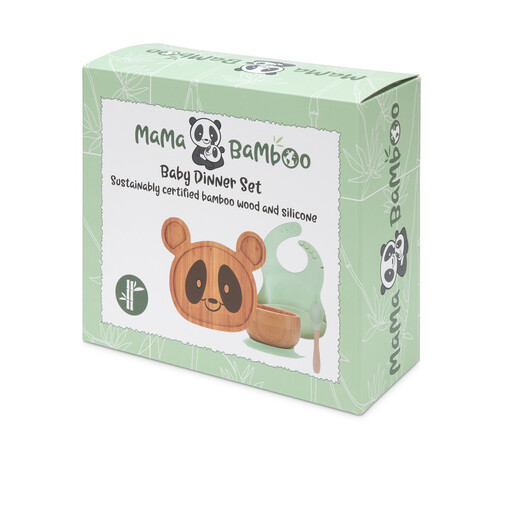
Why This Fits Their Persona: A broader feeding bundle for households wanting a plate, bowl and baby self-feeding utensils together.
The plate and bowl have suction bases for smooth, flat surfaces, while the product clearly states that it is hand-wash only rather than implying dishwasher convenience.
Four pieces include a sectional plate, bowl, fork and spoon; bamboo and LFGB food-grade silicone are specified.
We have compiled a complete, real-time list of products that fully satisfy these strict selection criteria and UK safety regulations.
Many baby weaning cutlery products are marked as suitable from 6 months, when complementary feeding begins. Some toddler cutlery sets are marked for 12 months and over because their dimensions and materials suit more developed self-feeding skills. Follow the product guidance and supervise every use.
They can be, particularly when the spoon and fork are fully washable and have no narrow joints. However, cleaning instructions vary. Some silicone and PP sets can be soaked, while bamboo-handled weaning spoons require hand washing. Check whether dishwasher use is permitted and dry all parts thoroughly.
There is no fixed lifespan. Frequency of use, chewing, cleaning methods and storage all affect condition. Replace a spoon or fork at the first sign of cracks, weakness, loose parts or worn edges. Buying a two- or four-piece set can provide a practical spare, while a storage case helps keep an extra utensil clean when travelling.