Students stocking a first cupboard
A four-tin pack gives you several unopened tins without committing as much cupboard space as a six- or eight-tin pack. Think about how often you expect to use them before adding more to a shared kitchen.


For a student moving in, a four-tin pack keeps the initial cupboard stock manageable; consider six or eight tins when you expect to use them and have room to store them. Choose standard, reduced-sugar-and-salt or no-added-sugar beans by checking the exact recipe and label, and plan how you will refrigerate any leftovers.
A four-tin pack gives you several unopened tins without committing as much cupboard space as a six- or eight-tin pack. Think about how often you expect to use them before adding more to a shared kitchen.
Standard, reduced-sugar-and-salt and no-added-sugar beans are distinct options. Check the exact tin’s ingredients, nutrition and allergen information rather than assuming one variant’s label applies to the range.
Unopened tins need cupboard space, while beans left after opening need a suitable container and refrigeration. Check the pack’s instructions if fridge space or access is uncertain.
Choose a pack quantity you can store and use, then check the recipe and the instructions for an opened tin.
| Priority | What to check | Your needs |
|---|---|---|
| Pack size | Compare the number of tins and grams per tin. Tesco lists a 4 x 420g pack, while checked Heinz listings include 4 x 415g, 6 x 415g and 8 x 415g packs. | For my first cupboard stock, four tins may be enough; I would choose more only if I expect to use them and have space. |
| Recipe | Read the exact variant’s ingredients, nutrition and allergen label. Standard, reduced-sugar-and-salt and no-added-sugar descriptions do not describe every tin in a brand’s range. | If I want a particular formulation or need to avoid an ingredient, the label on the pack I buy matters more than the brand name alone. |
| Opened tins | Check the container, refrigeration and time instructions. The checked Heinz no-added-sugar listing says to use refrigerated leftovers within two days; the checked M&S product says within three. | Sharing a fridge means I need room for leftovers and a plan to use them within the period on my tin. |
| Date labels | Check the best-before date and the condition of the tin. GOV.UK student food-safety guidance for England, Northern Ireland and Wales explains that best-before dates concern quality, not the same safety deadline as use-by dates. | I can rotate my unopened tins by date without treating a best-before label as a use-by label. |
A six- or eight-tin pack takes more cupboard space than a four-tin pack. Stock can remain unused if your routine changes after moving in.
Choose the tin count around the space available and how regularly you expect to eat the beans.
A larger pack also means more tins to carry and organise when you move.
Ingredient and allergen details differ by variant. The checked Heinz beans with Richmond pork sausages, for example, are a different product from plain baked beans and list wheat, soya and sulphites.
Read the label for the exact product and check it again when buying, particularly if an allergen matters to you.
The checked Heinz no-added-sugar and M&S instructions require unused beans to be transferred to a suitable container and refrigerated, with different stated time limits.
Cover and refrigerate leftovers promptly in a suitable non-metallic container, then follow your tin’s instructions for using them.
GOV.UK student food-safety guidance for England, Northern Ireland and Wales distinguishes a best-before quality date from a use-by safety date.
Rotate unopened tins by date, check the packaging and follow the product instructions rather than applying use-by rules to a best-before label.
These ranges illustrate different pack and recipe choices; a brand name alone does not identify the variant you need.
Tesco lists both standard and reduced-sugar-and-salt baked beans in 4 x 420g packs.
Checked retailer listings include standard Heinz baked beans in four-, six- and eight-tin packs, as well as a separate no-added-sugar recipe.
Waitrose lists Essential baked beans as individual 420g tins, which can be selected in a group rather than bought as a pre-bundled multipack.
The checked M&S baked-bean product is labelled vegetarian and vegan and provides product-specific storage instructions.
These four- and six-tin options suit students deciding how much cupboard stock to start with. The four-tin options include standard and reduced-sugar-and-salt recipes; check each product’s label before choosing.
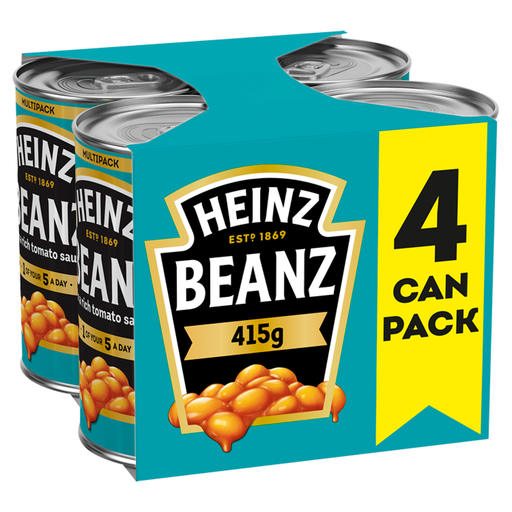 No image available
Four tins are an option for an initial cupboard stock. The product description labels these beans suitable for vegans and vegetarians; check the pack for ingredients and follow its instructions for refrigerating leftovers after opening.
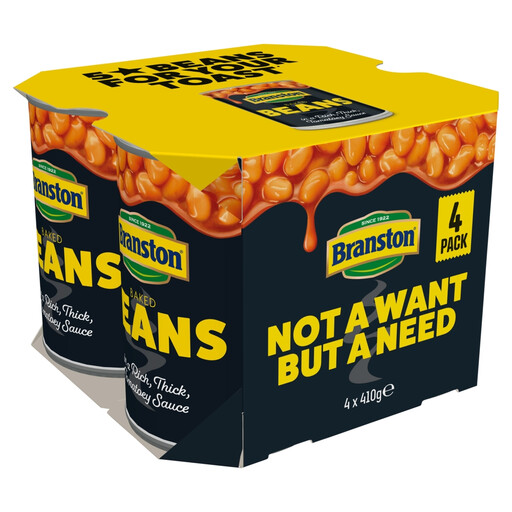 No image available
This four-tin standard-bean pack keeps the starting stock smaller than a six-tin pack. Its product description labels the beans gluten-free and vegetarian; check the physical pack if either detail matters to you.
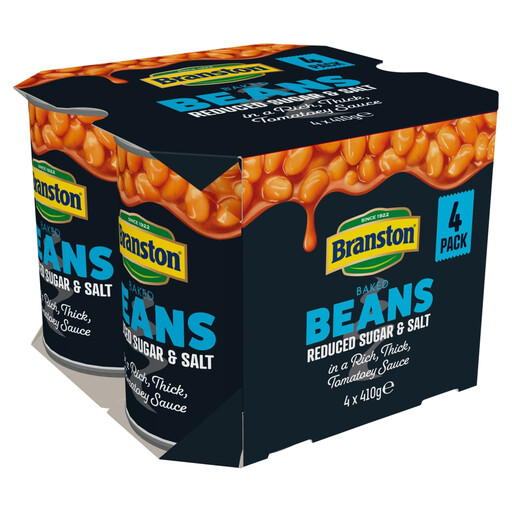 No image available
This four-tin pack offers a reduced-sugar-and-salt recipe rather than Branston’s standard beans. Compare the exact nutrition and ingredient label with the standard variant, and follow the pack’s preparation and leftover-storage instructions.
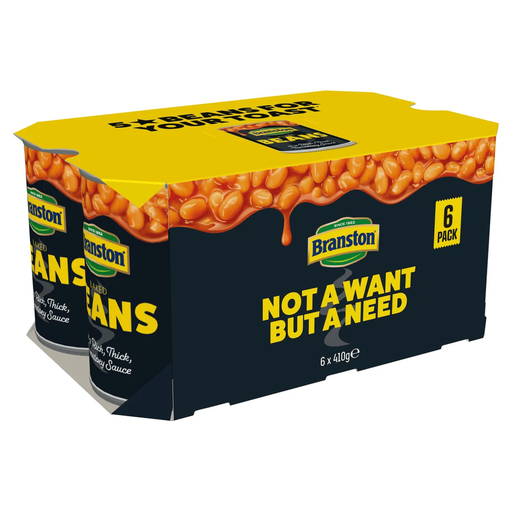 No image available
Six tins provide a larger starting stock than the four-tin options, so consider how often you will use them and where they will fit. The product description includes ingredient and leftover-storage information; follow the exact pack instructions after opening.
Start with four if you are unsure how much cupboard space you will have or how regularly you will eat them. Six or eight tins make more sense when you expect to use the larger stock and have somewhere to keep it; the checked retailer listings include all three pack counts.
Check the exact product: the checked Heinz standard baked-bean listing and M&S baked-bean product carry vegan and vegetarian labelling, but that does not cover every bean-based recipe. Beans with sausages are a different product, so read the physical pack’s ingredients and dietary information.
Transfer unused beans to a suitable covered non-metallic container and refrigerate them, following the time limit on your pack. The checked Heinz no-added-sugar instructions say within two days; the checked M&S instructions say within three.
A best-before date concerns quality rather than being the same as a use-by safety deadline, according to GOV.UK student food-safety guidance for England, Northern Ireland and Wales. Check the tin’s condition and its instructions; do not disregard damaged packaging because of the date label.
Yes—check the exact pack whenever an allergen matters to you, because variants can have different ingredients and labels can change. The checked Heinz beans with Richmond pork sausages, for instance, list wheat, soya and sulphites; that information should not be transferred to plain beans.