Students planning cupboard dinners
Several unopened tins give you ingredients for dinners on different days. Check the can count and size against how often you expect to use them, and make sure you have somewhere to store the pack.


A four-pack is a practical starting point for student dinners if you have limited cupboard space or are unsure how often you will eat baked beans; choose a larger pack when you expect to use all the unopened tins before their best-before dates. If salt or sugar matters to your choice, compare the figures on the current labels rather than assuming a larger pack or a reduced variant meets your needs.
Several unopened tins give you ingredients for dinners on different days. Check the can count and size against how often you expect to use them, and make sure you have somewhere to store the pack.
Choose a product with instructions that suit your available equipment. Sainsbury's gives hob and microwave directions for its four-pack; its microwave method requires transferring the beans to a microwaveable dish.
Check the serving size alongside the nutrition figures, particularly if baked beans are a regular meal component. Branston labels a reduced-sugar-and-salt variant in comparison with its standard beans, but the word “reduced” does not describe the amount in a serving.
Start with the number and size of tins you can use, then check preparation, leftovers and the current label for any dietary requirements.
| Priority | What to check | Your needs |
|---|---|---|
| Pack size | Compare the can count and weight of each tin. Check the best-before dates and the cupboard space the pack will take. | Four tins may be enough if I eat beans occasionally; six make more sense if I expect to use them regularly. |
| Preparation | Read the tin's hob or microwave directions. For microwave heating, check what dish and covering the instructions require. | I need a method that works with the cooking equipment and dishes available to me. |
| Leftovers | Check the instructions for transferring, refrigerating and using beans after opening. The period can differ between products. | If one tin makes more than one portion, I need a way to refrigerate and use what remains. |
| Salt and sugar | Compare nutrition figures using the same stated amount, such as per 100g or per half can. Check what a “reduced” claim is compared with. | I want to know what is in my usual portion, not rely on the variant name alone. |
| Dietary suitability | Read the current ingredients, allergen information and any vegetarian, vegan or gluten-free declaration on the exact product. | A previous tin's label is not enough if ingredients or allergen suitability matter to me. |
A larger multipack only helps with meal planning if you have space for it and expect to use its unopened tins before their best-before dates.
Choose the can count around your likely meals and storage space, rather than treating a larger pack as the automatic choice.
Branston's reduced-sugar-and-salt claim compares that variant with standard Branston beans. Its listed salt figure is still 0.79g per half can, according to Tesco Groceries.
Read the nutrition panel for the amount you plan to eat and check the stated comparison behind any reduced claim.
Sainsbury's says to transfer unused beans to a non-metallic container, refrigerate them and use them within two days. The M&S 400g product gives a three-day period, so one product's directions should not be applied to another.
Plan for the remaining portion before opening a tin and follow that tin's storage instructions.
A declaration on one baked-bean product does not establish the ingredients or allergen status of another, and recipes can change.
Check the current tin's ingredients, allergen information and dietary declarations before use.
These examples show different pack sizes and labelling details; they do not establish that every product in a brand's range is the same.
Tesco Groceries lists an own-brand baked-bean four-pack containing 4 x 420g tins.
Sainsbury's lists an own-brand 4 x 400g pack with hob and microwave preparation directions.
Tesco Groceries lists Heinz Baked Beans in Tomato Sauce as a 4 x 415g pack.
The M&S 400g baked-bean listing provides nutrition and post-opening storage information.
Waitrose & Partners lists Essential baked beans in a 420g tin alongside branded multipacks.
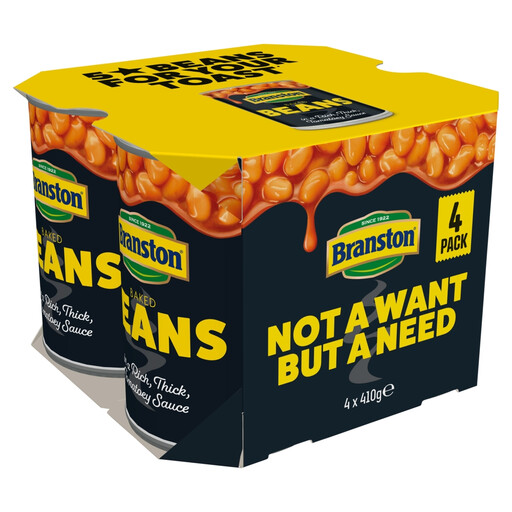
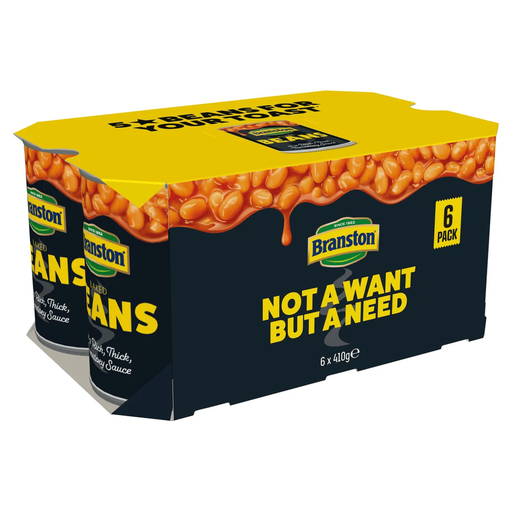
These Branston four- and six-tin packs are options for planning repeat student dinners. Choose between them by how many tins you expect to use and the space you have to store them.
 No image available
Four 410g tins provide separate cans for dinners on different days. Check the current tin's preparation and leftover-storage instructions before use.
 No image available
Six 410g tins suit repeated cupboard dinners if you have room for the pack and expect to use the tins. Check the current tin for preparation and post-opening storage directions.
Choose a larger pack when you have space to store it and expect to use its unopened tins before their best-before dates. If you eat beans less often, start by comparing a smaller pack or individual tins with the meals you actually plan to make.
No. Sainsbury's directions for its four-pack say to transfer the beans to a microwaveable dish and cover it before heating. Follow the preparation instructions on your exact tin.
Transfer and refrigerate leftovers according to that product's label. Sainsbury's specifies a non-metallic container and use within two days for its four-pack, while the M&S 400g product specifies a non-metallic container and three days.
Do not assume so across products. Tesco Groceries labels the listed Heinz 4 x 415g pack suitable for vegetarians and vegans and gluten free; check the current declaration, ingredients and allergen information on any exact product you choose.
It describes a comparison, not an absence of sugar or salt. Tesco Groceries states that Branston Reduced Sugar and Salt beans contain 30% less of each than standard Branston beans and lists 0.79g salt per half can; compare the serving figures on the current labels.