What should you check before choosing a pack?
Start with the number of meals you expect, then compare recipes and the instructions on the tins you might actually buy.
| Priority |
What to check |
Your needs |
| Pack quantity |
Count tins and compare total weight: Sainsbury’s lists 4 x 400g, while Tesco lists a Heinz 8 x 415g pack. Check the best-before dates and available cupboard space. |
Will four tins cover our planned meals, or are enough people eating beans regularly to use a larger pack? |
| Portion size |
Compare full-size tins with smaller portions. Waitrose lists Heinz No Added Sugar snap pots as 4 x 200g and says a heated pot should be eaten at once, without reheating. |
For a meal for one, I would rather open a portion I expect to finish than leave part of a full-size tin. |
| Salt and sugars |
Read both values per 100g and consider the amount you will serve. Sainsbury’s lists 0.58g salt per 100g for standard beans and 0.29g per 100g for its separate Reduced Sugar & Salt beans. |
When choosing between recipes, I want figures I can compare on the same per-100g basis, not just a claim on the front of the pack. |
| Guests and leftovers |
Check the exact tin’s ingredient and allergen statements. Follow its after-opening instructions: Sainsbury’s says to move leftover beans to a non-metallic container, refrigerate them and use them within two days. |
If guests have dietary requirements, I need to check the product they will be served. For a small meal, I also need a plan for any opened tin. |
Which brand and retailer ranges are relevant?
These ranges illustrate different pack and recipe choices; check the particular product rather than assuming every tin under a name has the same format or ingredients.
Heinz
Heinz classic beans appear in 4 x 415g and 8 x 415g retailer listings. Its No Added Sugar snap pots are a separate 4 x 200g format.
- The four- and eight-tin classic packs offer different quantities of full-size tins.
- Snap pots contain less food per pack than those full-size multipacks; compare their recipe and portion instructions separately.
Sainsbury’s
Sainsbury’s lists standard baked beans as a 4 x 400g multipack and its Reduced Sugar & Salt recipe as a separate 400g tin.
- The standard four-pack provides 1.6kg across four tins.
- The cited reduced sugar and salt product is a single tin, not the same four-pack with a different recipe.
M&S
M&S lists a standard 400g baked-bean tin, rather than a multipack in the product information used here.
- Its product information gives dietary and after-opening storage statements for the standard tin.
- Although listed as vegan and vegetarian, that tin is also marked unsuitable for people with milk or egg allergy.
Waitrose
Waitrose lists both a Heinz 4 x 415g classic pack and smaller Heinz four-packs containing 200g portions.
- The listings let shoppers distinguish full-size tins from smaller portion formats.
- A four-pack of 200g portions does not provide the same total quantity as a four-pack of 415g tins.
Baked-bean multipacks on Joybuy
These Joybuy options are four- and six-tin baked-bean packs for planning several meals, including one reduced sugar and salt recipe. Match the quantity and recipe to your plans, and check the product page and physical label before buying or serving.
 No image available
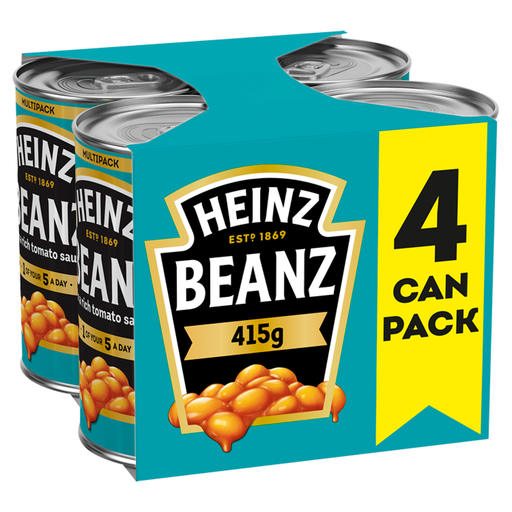
Heinz Baked Beans in Tomato Sauce 4 x 415g
Four full-size tins provide 1.66kg for meals across the Christmas period. Check the current ingredients and allergen label if serving guests, and make sure you have space for the pack.
View on Joybuy
 No image available
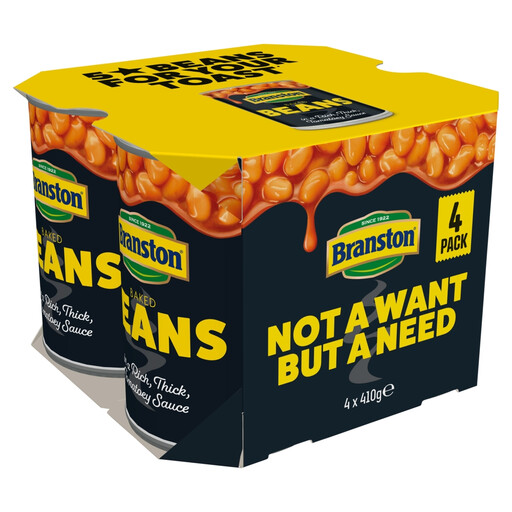
Branston Baked Beans 4 x 410g
Four 410g tins provide 1.64kg when a four-pack fits your expected meals. Compare the current nutrition and ingredient label with any other recipe you are considering.
View on Joybuy
 No image available
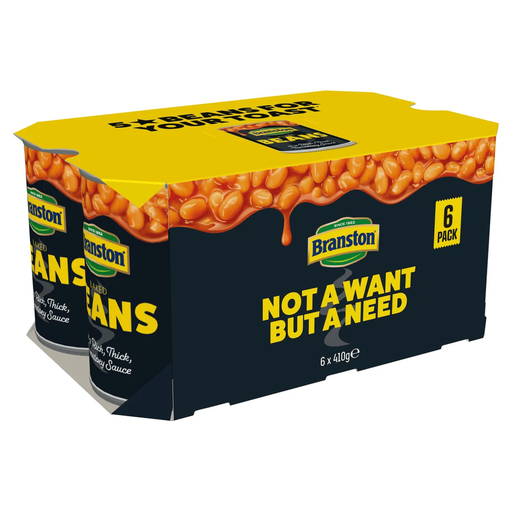
Branston Beans in Tomato Sauce 6 x 410g
Six 410g tins provide 2.46kg for repeated meals. Before choosing the larger quantity, consider how often you will serve beans and whether the pack fits in your cupboard.
View on Joybuy
 No image available
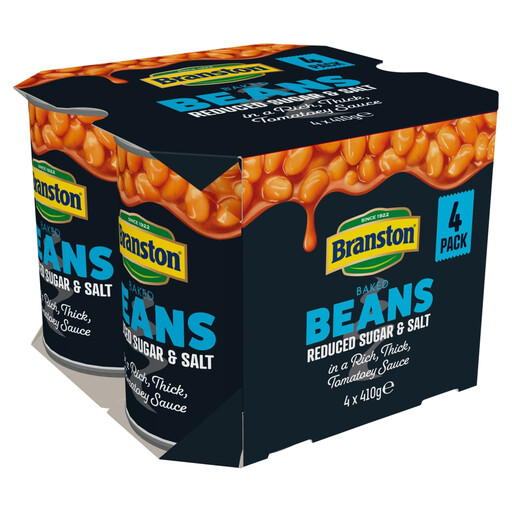
Branston Reduced Sugar & Salt Baked Beans 4 x 410g
This four-tin, 1.64kg pack combines a multipack format with Branston’s reduced sugar and salt recipe. Compare its current per-100g figures with the standard recipe, and check the ingredients if sweeteners matter to your household.
View on Joybuy
Christmas baked-bean questions
How many tins should I buy for Christmas?
Base the pack size on the meals you expect to make, not simply the largest pack on offer. A 4 x 400g pack gives you four separate tins; an 8 x 415g pack is a substantially larger cupboard supply. Check that you have room and are likely to use the quantity before its best-before date.
Does a reduced sugar and salt recipe contain less salt?
Sainsbury’s lists 0.29g salt per 100g for its Reduced Sugar & Salt baked beans, compared with 0.58g per 100g for its standard beans. That comparison applies to those two Sainsbury’s recipes; read current labels when comparing other products or brands.
What should I do with beans left after opening a tin?
Follow the instructions for the tin you opened. Sainsbury’s directs shoppers to transfer leftovers to a non-metallic container, refrigerate them and use them within two days; M&S gives a three-day refrigerated period for its standard beans.
Can I serve baked beans to vegan guests?
Check the exact tin: Waitrose lists Heinz 4 x 415g beans as suitable for vegetarians and vegans, and M&S lists its standard beans as vegan and vegetarian. Vegan labelling does not settle every allergy question; M&S also marks its standard beans unsuitable for people with milk or egg allergy.
What does the best-before date mean when buying ahead?
Check each tin’s date and storage instructions before adding it to the Christmas shop. The UK Food Standards Agency’s guidance explains that a best-before date concerns quality rather than safety; once a tin is opened, follow that product’s separate storage and use instructions.


