First-time cupboard stockers
A four-pack gives you separate tins for several planned meals. Check the number and size of the tins before choosing a larger pack for your first shop.


If you expect to use baked beans across several meals, a four-pack of separate tins gives you a starting quantity without opening them all at once. Check how much you will use from each tin, compare sugars and salt on the nutrition labels, and plan to refrigerate any leftovers according to the pack instructions. A six-pack makes more sense only if you expect to use the extra tins.
The useful quantity depends less on the number of tins in the pack than on how often you expect to open one.
A four-pack gives you separate tins for several planned meals. Check the number and size of the tins before choosing a larger pack for your first shop.
A 400g–415g tin may cover more than one meal. Choose that format if you can refrigerate opened beans and use them within the period stated on the label.
Standard, reduced-sugar-and-salt and no-added-sugar products have different recipes. Compare the declared amounts per 100g and the portion you expect to eat, rather than relying on the range name alone.
Start with the number of tins you are likely to use, then compare nutrition and storage instructions for the specific products on your shortlist.
| Priority | What to check | Your needs |
|---|---|---|
| Pack quantity | Compare tin count and weight per tin, such as 4 × 400g and 4 × 415g. Consider whether you will use a six-tin pack. | I want separate tins for several meals, but do not need more cupboard stock than I expect to use. |
| Sugars and salt | Read both figures per 100g and calculate the amount for your intended portion. Check which standard product a reduction claim uses as its comparison. | If I am comparing recipes, I want the figures on the tins themselves; a reduced claim does not compare the product with every other brand. |
| Portions and storage | Check how much is in one tin and read its after-opening instructions. Sainsbury's and Heinz four-pack labels instruct shoppers to transfer leftovers to a non-metallic container, refrigerate them and use them within two days. | Will I finish a tin at one meal, or can I make use of the remainder within the label's stated period? |
| Ingredients and fibre | Read the ingredient list for your requirements and compare fibre on the same per-100g basis. Sainsbury's lists 4.2g fibre per 100g for its standard 4 × 400g beans. | I may use beans on toast or with a jacket potato, and want to know what the particular tin contains. |
Branston's reduced-sugar-and-salt claim compares that recipe with standard Branston beans. Heinz's no-added-sugar range uses standard Heinz as the basis for its lower-salt claim. Neither claim ranks the products against all other baked beans.
Compare sugars and salt per 100g on the tins you are actually considering, then check the figures for the portion you expect to eat.
The unopened tins in a multipack stay separate, but opened beans have different storage instructions. The Sainsbury's and Heinz four-pack labels direct shoppers to transfer leftovers from the tin, refrigerate them and use them within two days.
Plan another meal for the remainder or choose a smaller tin if a full tin is unlikely to be used in time.
These examples show why the exact pack and recipe matter; a brand name alone does not establish the tin size or nutrition figures.
Heinz has standard baked beans and a separate No Added Sugar variant in 4 × 415g formats.
Sainsbury's lists an own-label standard baked bean pack of four 400g tins.
Branston has standard and Reduced Sugar & Salt baked bean multipacks in 4 × 410g formats.
M&S describes its Only 7 Ingredients Baked Beans as a 1.6kg four-pack.
Waitrose lists Essential Baked Beans in Tomato Sauce as an individual 420g tin.
These options include four-tin Heinz and Branston packs and a larger six-tin Branston pack. Choose by the quantity and recipe you expect to use.
 No image available
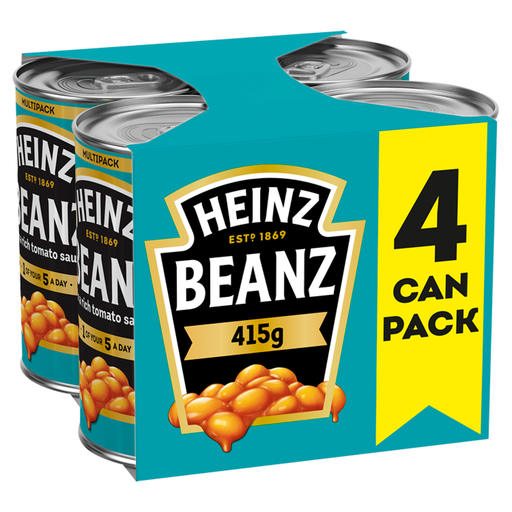
Four separate tins suit meals planned across several days. The Heinz product instructions say to transfer unused beans to a non-metallic, airtight container after opening, refrigerate them and use them within two days.
 No image available
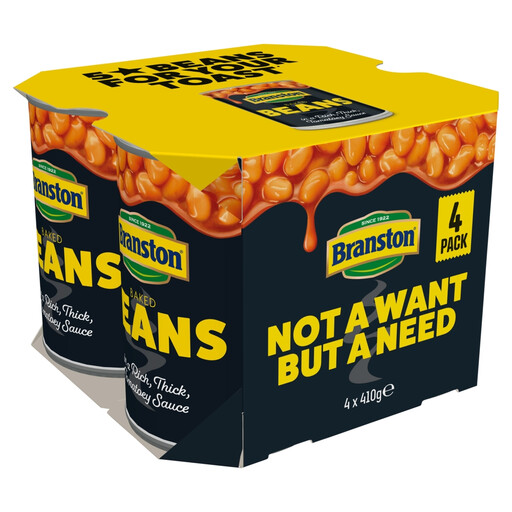
This standard Branston four-pack provides separate 410g tins for meals on different days. Check its nutrition panel and after-opening directions when comparing it with another recipe.
 No image available
This four-pack is worth comparing if sugars and salt are important to your choice. Joybuy lists 2.8g sugars and 0.39g salt per 100g; Branston's reduction claim uses standard Branston beans as its comparison.
 No image available
Six separate 410g tins suit a cupboard plan that calls for more beans than a four-pack provides. Consider whether you expect to use the additional tins before choosing the larger pack.
Choose a four-pack if you expect to use beans in several meals and have room to store the unopened tins. Individual tins let you try a recipe or choose a smaller quantity before committing to more of it.
Start with salt per 100g, then check the amount for the portion you plan to eat. For example, Sainsbury's lists 0.58g per 100g for its standard 4 × 400g beans, while Joybuy lists 0.39g per 100g for Branston Reduced Sugar & Salt. The NHS advises adults to have no more than 6g of salt a day, including salt already in food.
Follow the instructions on that product. Sainsbury's and Heinz four-pack labels say to transfer unused beans to a non-metallic container, refrigerate them and use them within two days; Heinz specifies an airtight container.
Transfer the beans to a microwaveable dish rather than heating them in the tin. Sainsbury's instructions say to cover the dish, follow the heating directions and ensure the beans are piping hot before serving.
No. The Food Standards Agency distinguishes best-before dating from use-by dating, which applies where food is likely to present a danger to health after expiry. Read the date and storage instructions on the particular tin, including the separate directions for its contents once opened.