Households stocking simple dinners
Several tins can cover separate meals such as beans on toast, jacket potatoes or a side dish. Compare the number of tins and their individual sizes with how you normally serve them.


Choose a standard four- or six-can multipack if you want tomato beans ready for several simple dinners. If sugar or salt figures influence your choice, compare recipes per 100g and check the ingredients: a no-added-sugar recipe can still contain sugars and may use sweetener. Check each tin’s allergen and leftover-storage instructions too.
A multipack makes most sense when you expect to use several full-size tins and can follow the storage instructions for any leftovers from an opened tin.
Several tins can cover separate meals such as beans on toast, jacket potatoes or a side dish. Compare the number of tins and their individual sizes with how you normally serve them.
Standard and reduced recipes have different label figures. Compare sugars and salt on the same per-100g basis, then read the ingredients if sweeteners matter to you.
Own-label four-packs come in different tin sizes. Check both the tin count and the stated weight before deciding how many meals a pack will cover.
Start with the number and size of tins you will use, then compare recipe labels and the instructions that apply after opening.
| Priority | What to check | Your needs |
|---|---|---|
| Pack size | Check tin count and weight per tin. The Waitrose & Partners listings show Heinz six-packs of 415g tins; other listed multipacks contain four tins of 400g or 410g. | I want enough tins for several dinners, but a four-pack may be sufficient if I use beans less often. |
| Sugars and salt | Compare figures per 100g, as well as any serving figures you use. Waitrose & Partners lists standard Heinz Beanz at 4.3g sugars and 0.6g salt per 100g, and Heinz No Added Sugar Beanz at 1.9g sugars and 0.4g salt per 100g. | If I’m considering a different recipe, I want to see its actual label figures rather than judge it by the words on the front of the pack. |
| Ingredients and allergens | Read the exact product’s ingredients and allergen statement. Some no-added-sugar recipes list steviol glycosides; vegetarian or vegan wording does not settle allergy suitability. | I may prefer a recipe without sweetener, or need to check an allergen statement before serving the beans. |
| Leftovers | Follow the tin’s instructions for transferring, covering and refrigerating unused beans, including its stated use-within period. | When one tin is more than I need for a meal, I want to know how to store the remainder. |
A reduced-sugar-and-salt recipe can still contain sugars and salt. Waitrose & Partners lists Heinz No Added Sugar Beanz at 1.9g sugars and 0.4g salt per 100g, and its description identifies the product as containing sweetener.
Compare the per-100g figures and ingredient lists of the particular recipes you are choosing between.
These labels answer different questions: Marks & Spencer describes its 400g baked beans as vegetarian and vegan, but states that they are not suitable for people with a milk or egg allergy.
If an allergy affects your choice, check the current pack’s allergen statement for the exact product.
Instructions for unused beans apply once a tin is opened. The Branston four-pack listing and Essential Waitrose tin listing both specify refrigerated storage and use within two days.
Transfer leftovers to a suitable covered container and follow the use-within instructions on your tin.
These examples show different pack formats and recipes; a brand name alone does not establish the ingredients or instructions of every product in its range.
Waitrose & Partners lists standard and no-added-sugar Heinz baked beans in six-packs of 415g tins.
Tesco Groceries lists baked beans across own-label and branded products, including Tesco Organic 420g tins and a Heinz 8 x 415g multipack.
Sainsbury’s lists a standard own-label 4 x 400g pack and a separate reduced-sugar-and-salt 400g product.
ASDA Groceries lists a reduced-salt-and-no-added-sugar own-label pack containing four 410g tins.
Marks & Spencer lists a 400g own-label tin, an individual-tin option for this dinner scenario.
Waitrose & Partners lists Essential baked beans in individual 420g tins alongside branded multipacks.
These Joybuy options are four- and six-tin baked-bean multipacks for stocking several simple dinners. The selection includes standard tomato-sauce beans and one reduced-sugar-and-salt recipe.
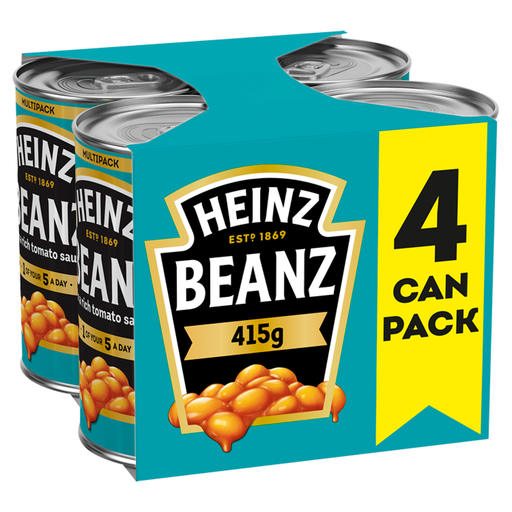 No image available
Four 415g tins of tomato-sauce baked beans for dinners on separate occasions. Check the tin’s instructions if you plan to keep leftovers from an opened can.
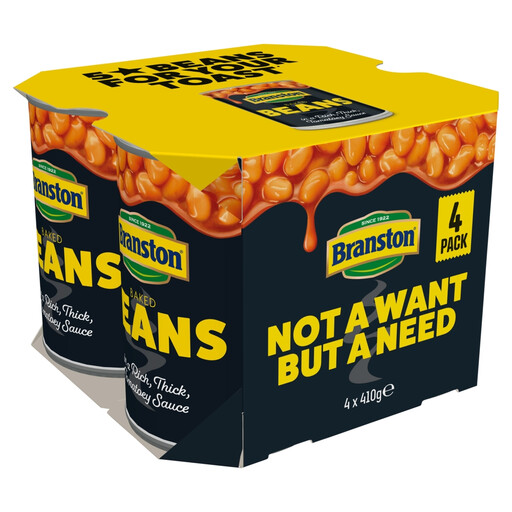 No image available
Four 410g tins for separate meals. The ASDA Groceries listing for this same pack gives 5.9g fibre, 4.6g protein and 0.60g salt per 100g; compare those figures with other recipes on the same basis.
 No image available
Four 410g tins offer a reduced-sugar-and-salt recipe for several dinners. Read the ingredient list and per-100g figures if sweetener or the amount of salt affects your choice.
 No image available
Six 410g tins suit households planning bean-based meals on several occasions. Follow the individual tin’s preparation and leftover-storage directions.
No. Waitrose & Partners lists Heinz No Added Sugar Beanz at 1.9g sugars and 0.4g salt per 100g, and describes it as containing sweetener. Compare the per-100g and serving information on the exact recipe you intend to use.
Suitability depends on the exact recipe. The standard Heinz listing identifies its beans as vegetarian and vegan, while ASDA identifies its reduced-salt-and-no-added-sugar beans as vegetarian. Check allergens separately: Marks & Spencer describes its 400g beans as vegetarian and vegan but states that they are not suitable for people with a milk or egg allergy.
Follow that product’s pack instructions rather than using one storage period for every brand. The Branston 4 x 410g and Essential Waitrose listings instruct shoppers to transfer leftovers to a suitable container, refrigerate them and use them within two days.
Compare the nutrition figures on the same basis, particularly sugars and salt per 100g, and read the ingredients and allergen statement. GOV.UK guidance explains that front-of-pack traffic-light labels, where present, can help compare nutrients; also check the pack size and storage instructions for the particular tins you buy.