Households making regular winter meals
Four- and six-tin packs can suit repeated breakfasts, jacket potatoes, beans on toast and quick sides. Check the number and size of tins against how often your household actually uses them.


Choose a four- or six-tin multipack if baked beans feature regularly in your winter meals and you have room to store the unopened tins. If you are trying a different recipe or use beans only occasionally, start with fewer tins; for a reduced-sugar-and-salt recipe, compare the ingredients and per-100g label rather than assuming that all variants mean the same thing.
The useful pack size depends on how often you open a tin, how much cupboard space you have and whether you already know you like the recipe.
Four- and six-tin packs can suit repeated breakfasts, jacket potatoes, beans on toast and quick sides. Check the number and size of tins against how often your household actually uses them.
A multipack is easier to plan around when you have space for every tin and expect to use them within their labelled dates. A larger pack is not automatically the more practical one for a small cupboard or occasional meals.
Reduced-sugar-and-salt and no-added-sugar beans need separate label checks. Look at sugars and salt per 100g, the ingredients list and the standard recipe named in any reduction claim.
Start with a pack size you can use, then compare the exact recipe and its storage instructions.
| Priority | What to check | Your needs |
|---|---|---|
| Pack size | Check tin count, grams per tin and total pack weight. Consider whether a four- or six-tin pack matches how often you cook with beans. | I use beans for several meals, so I want enough tins on hand without taking up more cupboard space than I need. |
| Recipe | Compare sugars and salt per 100g on the exact variants. Read the ingredients for sweeteners, and check which standard product a stated reduction refers to. | If I choose a reduced-sugar-and-salt recipe, I want to know what differs from the regular beans and whether its ingredients suit me. |
| Storage | Read the unopened storage directions and best-before date. After opening, follow that can’s instructions for transferring, refrigerating and using leftovers. | I need room to keep the tins as directed, and I may not use a whole tin in one meal. |
| Dietary details | Check the current can for ingredients, allergen information and any vegetarian or vegan statement; do not transfer a claim from another variant. | When an ingredient or allergen matters to me, I need the information for the precise recipe and pack I am buying. |
Waitrose & Partners says its Essential Reduced Salt & Sugar beans contain 30% less sugar and salt than regular Essential beans. Its Heinz No Added Sugar listing names steviol glycosides as a sweetener and states 25% less salt than standard Heinz Beanz. These claims use different recipes and comparators.
Compare the per-100g panels and ingredients of the exact tins you are considering.
Unopened tins need the storage conditions shown on their labels, while opened beans have a much shorter refrigerated storage period. A multipack does not change the instructions for an opened tin.
Check cupboard space and dates before stocking up. Transfer leftovers to a covered, non-metallic container and follow the open-life instruction on the can.
Standard and reformulated beans may have different ingredients. A dietary statement does not replace the allergen information for the exact product.
Read the physical can label when changing brand, recipe or pack size, particularly if an allergen affects your choice.
These ranges illustrate different pack formats and recipes; a brand name alone does not tell you what is in a particular tin.
Heinz appears in the supplied retailer listings in standard 415g tins and four- and six-tin packs, alongside a separate No Added Sugar recipe.
Sainsbury's lists a standard 4 x 400g own-label pack as well as individual tins and a reduced-sugar-and-salt range.
The cited Essential listings provide regular and Reduced Salt & Sugar recipes in 420g tins, making them useful for comparing recipes before buying more.
M&S lists standard 400g baked beans and an Only 7 Ingredients baked-beans product in a 1.6kg format.
These four- and six-tin baked-bean packs cover standard tomato-sauce recipes and one labelled reduced-sugar-and-salt variant. Choose a tin count you can use, then check the current label for recipe and storage details.
 No image available
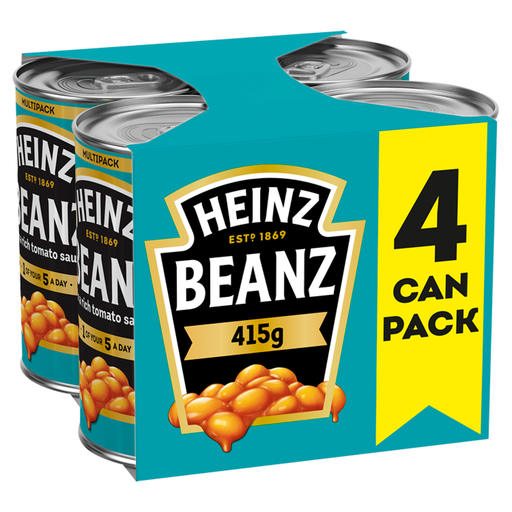
Four 415g tins suit meals spread across several days or weeks. Compare the current can’s ingredients and per-100g panel if recipe details affect your choice, and follow its directions for opened leftovers.
 No image available
Six 410g tins give a larger cupboard stock for households that use beans repeatedly. Make sure you have space for the pack and check the exact cans for ingredients and storage directions.
 No image available
This four-tin Branston pack offers a smaller stock than the six-tin Branston option above. Check the current label for the recipe, dietary details and instructions for any beans left after opening.
 No image available
Four 410g tins offer a labelled reduced-sugar-and-salt Branston recipe for shoppers who want that variant in a multipack. Read its own per-100g panel and ingredients, including the sweetener declaration, rather than treating it as the standard recipe.
Choose the count you expect to use and can store as directed. A six-tin pack suits repeated meals if you already know the recipe; four tins may be easier to accommodate if you use beans less often.
Follow the pack’s storage instructions; the cited Sainsbury's, Waitrose & Partners and M&S product pages specify a cool, dry place. Check each can’s date when planning your cupboard stock. GOV.UK’s food guidance explains that a best-before date concerns quality: food may be eaten after it, although it may not taste as good.
Transfer the unused beans to a covered, non-metallic container and refrigerate them. The cited Sainsbury's and Waitrose & Partners products specify use within two days, while the cited M&S 400g product specifies three days; follow the instruction on your own can.
No. Waitrose & Partners lists steviol glycosides in Heinz No Added Sugar beans and states 25% less salt than standard Heinz Beanz. Its Essential Reduced Salt & Sugar beans state 30% less sugar and salt than regular Essential beans. Compare each product’s ingredients and per-100g panel.
Check the exact can instead, especially when an allergen matters. Ingredients and dietary statements can differ between recipes, and product information may change; read the ingredient and allergen information together before use.