Households using beans across several meals
Four-, six- or eight-tin packs are worth considering when you have plans for the tins across meals or savoury bakes. The pack size does not change the storage instructions for a tin once opened.


A multipack makes sense if your household regularly uses baked beans for meals or savoury bakes and can use each opened tin within the period on its label. For conventional sweet biscuits, buy the ingredients in your recipe instead; if you are comparing bean packs, check tin size, ingredients and nutrition per 100g rather than assuming they are alike.
Four-, six- or eight-tin packs are worth considering when you have plans for the tins across meals or savoury bakes. The pack size does not change the storage instructions for a tin once opened.
If a full-size tin is usually more than you need, compare smaller tins with multipacks before buying. Marks & Spencer lists a 220g baked-bean option alongside larger tins.
Baked beans can be considered for a savoury bake: Marks & Spencer gives examples including a bean-and-lentil bake and a savoury pastry melt. For ordinary sweet biscuits, follow the biscuit recipe’s ingredient list instead.
Start with the recipe, then choose a tin size your household can use and compare the labels of the packs that fit.
| Priority | What to check | Your needs |
|---|---|---|
| Recipe fit | Check whether the recipe is savoury and calls for baked beans. Marks & Spencer’s baked-bean recipes include savoury bakes, not conventional sweet biscuit dough. | For sweet biscuits, I’ll buy the ingredients the recipe specifies. For a savoury bake, I can check how many tins it calls for. |
| Pack size | Compare the number of tins and their weight. ASDA lists Branston 4 x 410g as two labelled servings per tin; Tesco lists Heinz 8 x 415g packs. | A multipack suits meals I have planned across several days; if I rarely finish a full-size tin, I’ll consider a smaller format. |
| Nutrition and ingredients | Compare sugars and salt per 100g, then read the ingredients and any allergy information on the exact product. ASDA lists 4.3g sugars and 0.6g salt per 100g for standard Heinz 4 x 415g, versus 1.9g sugars and 0.4g salt per 100g for its Heinz No Added Sugar 4 x 415g; the latter contains steviol glycosides. | If sugars, salt, sweeteners or allergens matter to me, I want to compare the actual tins rather than rely on the pack name. |
| Opened tins | Read the storage instructions for the product you buy. ASDA says opened Branston 4 x 410g contents should be covered, refrigerated and used within two days; Marks & Spencer lists three days for its 400g beans. | If I usually use only part of a tin, I need a plan for the remainder that follows its label. |
ASDA’s Branston 4 x 410g listing says to refrigerate opened contents and use them within two days. Extra unopened tins do not extend that period for a partly used tin.
Consider a smaller tin if you often need less than a full-size one, or plan another savoury use within the period stated on the label.
ASDA’s Heinz No Added Sugar listing includes steviol glycosides and gives separate sugars and salt values per 100g.
Read both the nutrition panel and ingredient list when comparing it with standard beans.
The baked-bean recipes cited by Marks & Spencer are savoury dishes. A family pack will not meet a sweet biscuit recipe’s ingredient list merely because both involve baking.
Check the recipe before shopping; reserve the beans for a savoury dish if the biscuits do not call for them.
A branded option with standard and No Added Sugar multipacks in the cited ASDA and Tesco listings.
A full-size multipack option represented by a 4 x 410g listing from ASDA.
An own-label range in which Marks & Spencer lists both 220g and 400g baked-bean tins.
An own-label option in Waitrose & Partners’ baked-bean category.
A supermarket own-label reference for shoppers comparing a 410g tin with other formats.
These baked-bean multipacks are options to consider for planned meals or savoury baking, rather than ingredients for conventional sweet biscuits.
 No image available
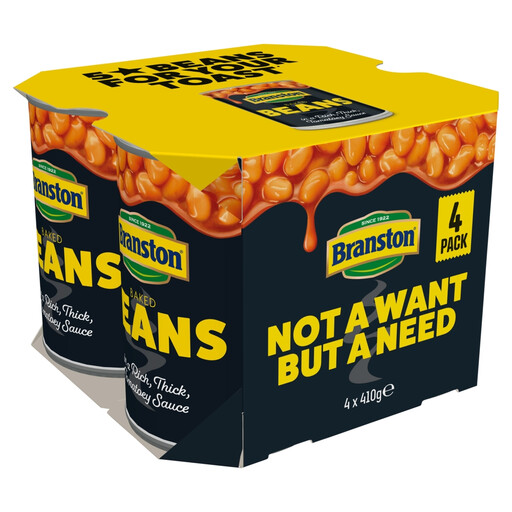
Four 410g tins are a format to consider if you use beans across meals or savoury recipes. Check the ingredient list if sweeteners matter to you, and follow the tin’s instructions for storing opened contents.
 No image available
This four-tin pack suits a plan involving repeated meals or a savoury bake. ASDA labels the same 4 x 410g product as two servings per tin and instructs shoppers to refrigerate opened contents and use them within two days.
 No image available
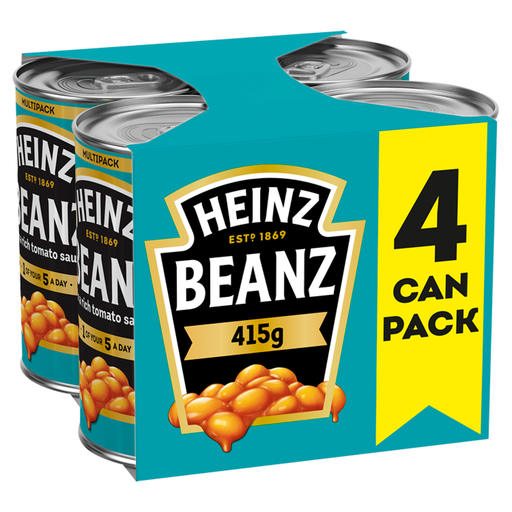
Four 415g tins give you a multipack for planned meals or savoury baking. For this standard Heinz format, ASDA lists 4.3g sugars and 0.6g salt per 100g; compare the purchased label if those figures affect your choice.
 No image available
Six 410g tins are worth considering if your household uses beans regularly and has room to store the unopened pack. Decide whether you can use that quantity, and follow the label when storing any opened remainder.
Buy the ingredients specified by your biscuit recipe instead. Marks & Spencer’s cited baked-bean recipes use them in savoury dishes, including a bean-and-lentil bake and a pastry melt.
ASDA labels this Branston pack as two servings per tin, or eight labelled servings across its four tins. Use the label as a planning reference; the amount your household serves may differ.
Follow the instructions on the exact tin. ASDA says to cover and refrigerate opened Branston 4 x 410g contents and use them within two days, while the cited Marks & Spencer 400g beans say to refrigerate leftovers and eat them within three days.
Compare the nutrition figures per 100g, then check the serving size. ASDA lists 4.3g sugars and 0.6g salt per 100g for standard Heinz 4 x 415g, compared with 1.9g sugars and 0.4g salt per 100g for Heinz No Added Sugar 4 x 415g; its ingredient list also includes steviol glycosides.