Bonfire Night hosts feeding several people
Beans might be a jacket-potato topping, go on toast or sit alongside other food. Work out how many portions you intend to serve before choosing between single tins and a multipack.


For a Bonfire Night meal, choose single tins if you are unsure how many guests will want beans; a multipack makes more sense when you expect to use several tins. If sugar or salt is a priority, compare nutrition for the same serving size and check the ingredients, as a reduced recipe may differ in other ways.
Beans might be a jacket-potato topping, go on toast or sit alongside other food. Work out how many portions you intend to serve before choosing between single tins and a multipack.
Standard own-label tins and multipacks come in different weights. Compare like-for-like baked beans and choose a quantity you expect to use, rather than assuming a larger pack fits every gathering.
Check the nutrition panel per serving and the ingredient list. A reduced-sugar-and-salt recipe can differ from a standard tin in more than its listed sugar and salt figures.
Start with the role beans will play in the meal, then compare pack quantities, serving guidance and the exact recipe.
| Priority | What to check | Your needs |
|---|---|---|
| Quantity | Check each tin’s weight, the number of tins and the stated servings. Sainsbury’s describes its 4 × 400g pack as eight half-can servings. | Beans will be a main topping, so I need to plan for more than a small side portion. |
| Pack format | Choose between a single tin and a multipack according to how many tins you expect to use for the event or afterwards. Pack formats need not contain the same weight per tin. | I know several tins will be used; otherwise I would rather choose the quantity closer to my meal plan. |
| Sugar and salt | Compare figures for the same serving size and read the ingredients. ASDA lists 3.1g sugars and 0.70g salt per half can for its reduced-salt-and-no-added-sugar beans, alongside steviol glycosides in the ingredients. | I’m comparing the beans served with other foods, so the per-serving figures matter more to me than the recipe name alone. |
| Guest suitability | Check the precise variant and its current dietary and allergen information. Sainsbury’s beans with sausages contain pork sausages in beef casing, unlike plain vegetarian-labelled beans. | Some guests want a vegetarian side, so I’ll check that the tins I serve are the plain variant. |
Serving figures differ between the cited products: Sainsbury’s standard beans list 1.16g salt per half can, while ASDA’s reduced-salt-and-no-added-sugar beans list 0.70g per half can. The recipes and tin sizes are not identical.
Compare the current panels using the same serving basis, especially when beans are one part of a larger meal.
A beans-with-sausages variant can contain meat even when it sits alongside plain baked beans. Sainsbury’s describes its version as containing pork sausages in beef casing.
Check the exact product name, ingredients and dietary label before setting aside a vegetarian option.
Tesco warns that food ingredients, nutrition and dietary information can change when products are reformulated.
Use the label on the tin you receive for the final ingredient, allergen and nutrition check.
These ranges include different pack formats and recipes; check the particular variant rather than treating a brand name as a description of every tin.
Heinz standard baked beans appear in 415g tins and multipacks in the cited Waitrose listings.
Tesco lists standard 420g own-label beans alongside other recipe variants.
Sainsbury’s cited range includes standard 400g tins, a four-pack and beans with sausages.
ASDA’s cited products include Just Essentials 410g beans and a reduced-salt-and-no-added-sugar four-pack.
M&S lists several baked-bean recipes, including an Only 7 Ingredients variant.
Waitrose lists Essential standard and Essential Reduced Salt & Sugar beans in 420g tins.
These four- and six-tin baked-bean packs are options for a gathering where several tins may be used. One is labelled reduced sugar and salt; check serving guidance and ingredients for the pack you choose.
 No image available
Consider this four-tin format when several tins are planned and a reduced-sugar-and-salt recipe is relevant. Check the current pack’s serving guidance and ingredients before serving.
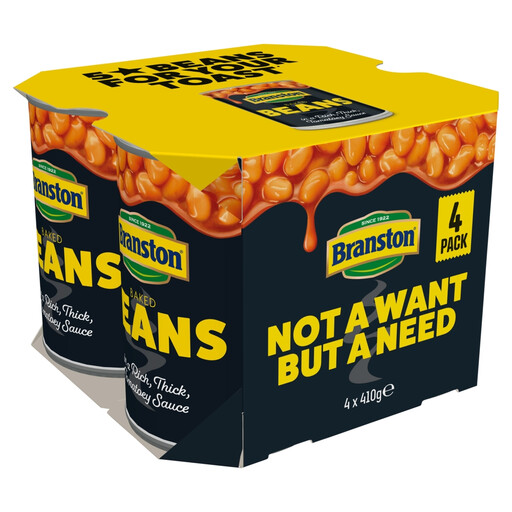 No image available
Four 410g tins suit a plan to serve beans to several people or use the tins across more than one meal. Check the pack’s stated servings when deciding how many portions to prepare.
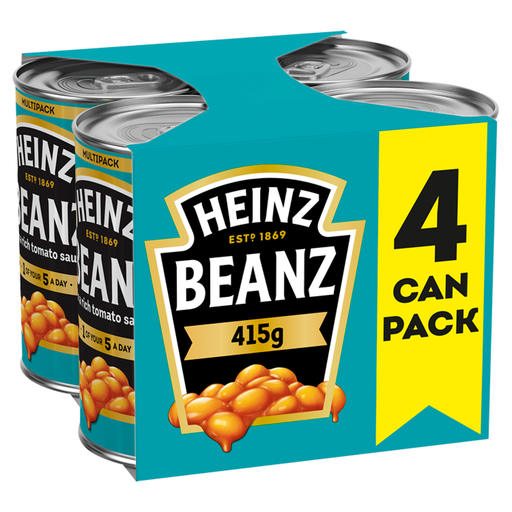 No image available
This four-tin pack is an option when beans will be served to a group. Use the current pack’s serving information to judge how many tins the meal calls for.
 No image available
Six 410g tins are worth considering when you expect to use several tins at the gathering or afterwards. Check the current label for serving guidance and guest suitability.
Start with the pack’s stated servings and decide whether beans will be a main topping or a side. ASDA suggests two servings for its 410g Just Essentials tin, while Sainsbury’s states eight half-can servings across its 4 × 400g pack; adjust your plan to the food you intend to serve alongside them.
The listed nutrition and ingredients can differ from a standard recipe. ASDA’s reduced-salt-and-no-added-sugar beans list 3.1g sugars and 0.70g salt per half can, compared with 7.4g sugars and 0.88g salt for its Just Essentials beans; the reduced product also lists a stevia-derived sweetener. Compare the current packs on the same serving basis.
No. ASDA lists its plain Just Essentials beans as suitable for vegetarians, but Sainsbury’s beans with sausages contain pork sausages in beef casing. Check the exact tin’s ingredients and dietary label before serving it.
Avoid buying a visibly damaged tin. Reading Borough Council advises against buying damaged cans because dented, damaged or incorrectly processed cans may cause mould.