Households that use beans regularly
A multipack can suit a cupboard-stock order if you have room for the tins and expect to use them before their best-before dates. Check the tin count and total net weight against your usual consumption.


Choose a multipack that fits your cupboard and the number of tins you expect to use before their best-before dates; a larger pack is not automatically the right choice. If sugar, salt or dietary labelling matters, compare the exact recipe rather than relying on the brand or pack size, and set substitution preferences before placing a delivery order.
A multipack can suit a cupboard-stock order if you have room for the tins and expect to use them before their best-before dates. Check the tin count and total net weight against your usual consumption.
If sugar, salt or ingredients affect your choice, compare the per-100g panel and ingredient list on the exact standard, reduced or no-added-sugar variant you intend to order.
When a particular recipe, dietary label or pack quantity matters, set your substitution preferences before checkout and check the label on any alternative offered at delivery.
Start with how many tins you will use, then check the recipe and decide whether a substitute would still meet your needs.
| Priority | What to check | Your needs |
|---|---|---|
| Pack quantity | Check the tin count, weight per tin and total net weight. Compare the best-before dates with how quickly you expect to use the pack. | I want enough tins for regular meals without filling the cupboard with more than I am likely to use. |
| Recipe and label | Compare sugars and salt per 100g on the exact variants. Read the ingredients, including any sweetener, and check dietary and allergen statements. | A reduced-sugar-and-salt or no-added-sugar recipe matters to me, but I still want to know what is in the tin. |
| Substitutions | Set acceptable alternatives or decline substitutions before checkout. Check any replacement tin’s recipe, label and pack quantity at handover. | If my chosen multipack is replaced, I need the delivered product to meet the same requirements that shaped my order. |
| Storage after opening | Follow the tin’s opened-product instructions, including its container, refrigeration and use-by guidance after opening. | I may use only part of a tin at one meal, so I need to be able to store the remainder as directed on the label. |
Four, eight and twelve tins of 415g beans represent quite different cupboard commitments. A larger pack may be awkward to store or finish.
Check the total net weight, available cupboard space and best-before dates before adding it to the order.
Sainsbury’s lists 4.5g sugars and 0.58g salt per 100g for its standard 400g beans, against 2.8g sugars and 0.29g salt per 100g for its named reduced-sugar-and-salt 400g variant. Those figures describe these two products, not every baked-bean recipe.
Compare the per-100g panels and ingredients on the exact variants you are considering.
An alternative can change the recipe or number of tins you receive. Tesco says customers can leave substitution preferences when ordering.
Specify what you will accept before checkout. Tesco says an unwanted substitute can be handed back to the driver or Click+Collect colleague for a refund.
The Waitrose Essential baked-beans instructions say to transfer opened contents to a non-metallic container, cover and refrigerate them, then use them within two days. Instructions can differ between products.
Follow the storage and opened-life directions on the tin you receive.
These examples illustrate pack formats and recipe differences; they do not indicate which products are in a particular delivery basket.
Tesco lists Heinz 415g baked beans in eight- and twelve-tin formats, while Waitrose lists a no-added-sugar four-pack.
Branston has a standard 410g tin and a named reduced-sugar-and-salt 4 x 410g multipack in the supplied product listings.
Sainsbury’s lists standard and reduced-sugar-and-salt own-label beans in 400g tins.
Waitrose lists Essential baked beans in a standard 420g tin and a separate reduced-salt-and-sugar variant.
The M&S catalogue includes Only 7 Ingredients baked beans in 220g and 400g tins, alongside a 1.6kg product and a separate no-added-sugar recipe.
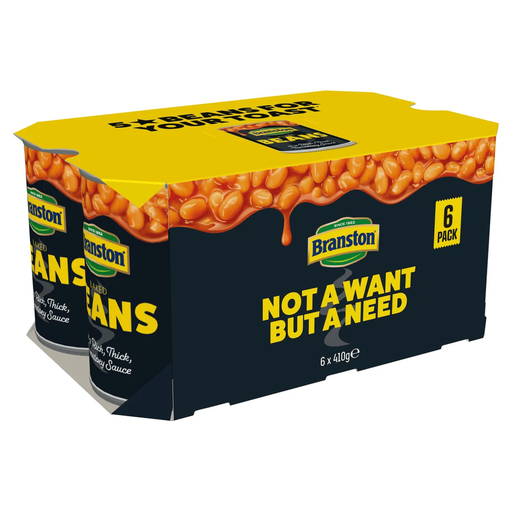
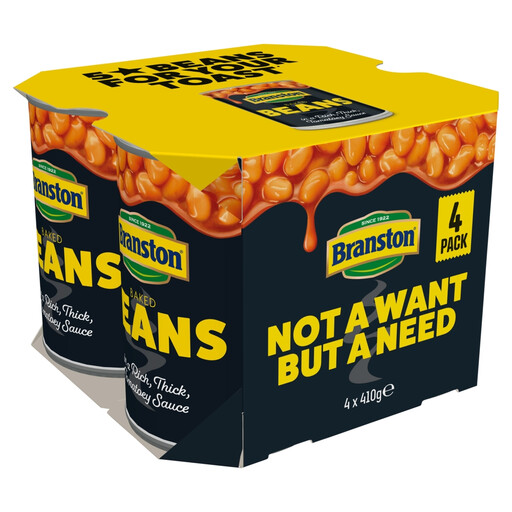
These Branston standard-recipe multipacks offer a choice between four and six 410g tins for cupboard stocking. Check the pack that suits your storage space and expected use.
 No image available
The six-tin format provides a defined quantity for a household planning cupboard stock. Check that the tins fit your storage space and that you expect to use them before their best-before dates.
 No image available
The four-tin format is an option when six tins would be more than you expect to use. Check the best-before dates and the exact recipe if an alternative is offered with your order.
Choose the larger pack if you have room for it and expect to use the tins before their best-before dates. Check the tin count and total net weight: a larger pack is not automatically a better fit for your household.
Do not assume so from the words “no added sugar” alone. The Waitrose listing for Heinz No Added Sugar 4 x 415g states 0.4g salt per 100g and, according to the Heinz product listing, 25% less salt than its standard range. Check the exact variant’s panel when comparing it with another recipe.
Check the substitute’s pack size, ingredients and label before accepting it if the exact product matters. Tesco says customers can leave substitution preferences when ordering and can hand an unwanted substitute back to the driver or Click+Collect colleague for a refund.
Follow the instructions on that product’s label. Waitrose says its Essential baked beans should be transferred to a covered non-metallic container, refrigerated and used within two days of opening; Food Standards Scotland likewise advises checking the label for opened-product storage instructions.
Yes, if your choice depends on the exact formulation, read the label on the tin delivered rather than relying on the product you originally selected. A replacement may be a different recipe or variant.