Households sharing a side
If two or more diners want beans, consider a full-size tin and check its serving information before deciding how much to open.


For a shared Chinese takeaway, a 400–420g tin makes sense if everyone wants beans or you have a plan for the remainder; a smaller tin may suit one diner who would otherwise leave beans unused. Check the exact tin’s salt, ingredients, allergen wording and opened-storage instructions before choosing a standard or alternative recipe.
The useful tin size depends on how many people want beans with the takeaway and whether any will be left over.
If two or more diners want beans, consider a full-size tin and check its serving information before deciding how much to open.
A smaller tin may be easier to finish when there is no plan to use opened beans another day.
If salt, sugar or an allergen matters for the meal, compare the exact product labels rather than assuming standard and alternative recipes are alike.
Start with the amount you expect to serve, then check the recipe and what its label says about any remainder.
| Priority | What to check | Your needs |
|---|---|---|
| Tin size | Compare net weights and any stated servings. Decide whether a 220g tin or a roughly 400–420g tin fits the number of diners. | If I’m eating alone, I may prefer less in one tin; when others want beans too, I can consider a larger one. |
| Recipe and salt | Read salt and sugars per 100g and the serving information on the exact tin. Ocado lists 0.53g salt per 100g for M&S standard beans and 0.43g per 100g for its no-added-sugar recipe. | I want to know what the beans add to a meal that also includes takeaway dishes and sauces. The NHS identifies takeaways as one possible source of salt. |
| Allergens | Check the current ingredients and allergen wording, including any may-contain statement; do not rely on a vegan-recipe description alone. | When serving someone with a milk or egg allergy, I need to check their specific tin. Ocado says the listed M&S standard and no-added-sugar beans may contain milk and egg. |
| Opened storage | Read the product’s transfer, refrigeration and use-within instructions before opening more than you need. Ocado lists three days after opening for M&S standard beans and two for its no-added-sugar beans. | If beans will be left over, I need a plan to store and use them within the period on that tin. |
Separate tins can be useful for later meals, but a larger pack does not change how much you need for this takeaway.
Check the number and size of tins, then choose a pack you expect to use.
The beans still contribute to the meal: Ocado lists 1.06g salt per half-can serving of M&S standard baked beans. The NHS also identifies takeaway food as a possible salt source.
Compare salt per serving on the exact tin alongside the other food you plan to serve.
Ocado’s listings for M&S standard and no-added-sugar beans include may-contain warnings for egg and milk despite their vegan-recipe descriptions.
For a guest with an allergy, read the current ingredients and allergen statement on the specific tin.
Instructions differ between products: Ocado lists three days after opening for M&S standard beans and two days for its no-added-sugar beans.
Choose an amount you can use, and transfer, refrigerate and finish any remainder as the product label directs.
These ranges illustrate choices in tin size and recipe; check the specific product rather than applying one variant’s label to the whole brand.
Tesco Groceries lists 420g standard and reduced-sugar-and-salt baked beans, alongside Stockwell & Co 420g beans.
Waitrose lists Essential baked beans in 220g and 420g tins.
Ocado lists M&S standard 400g and no-added-sugar 390g baked beans with different nutrition and opened-storage instructions.
Heinz baked beans appear in single-tin and multipack formats in the supplied product listings.
Branston’s listed options include standard beans in tomato sauce and a reduced-sugar-and-salt variant.
These standard baked-bean options include one smaller tin and three multipacks of separate tins. Choose according to how much you expect to use, and check the exact product label for dietary needs.
 No image available
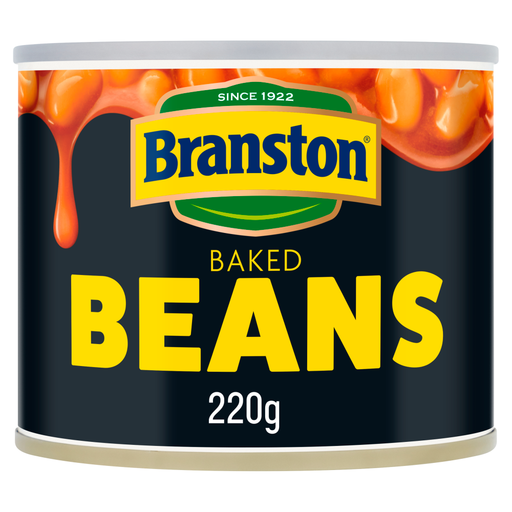
The 220g tin is an option when one diner wants beans and a larger tin would leave a remainder. Follow the product’s storage instructions if you open it; its stated opened life is two days.
 No image available
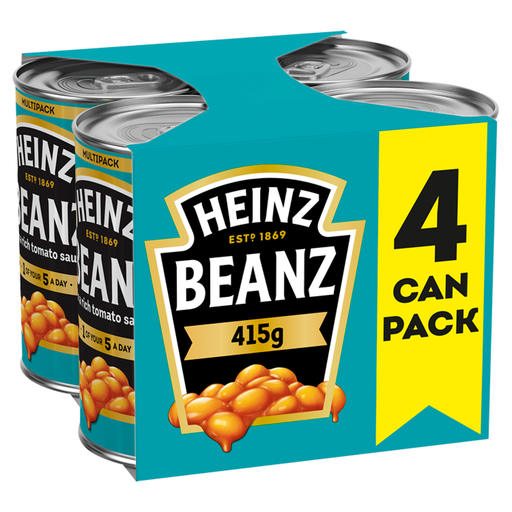
Four separate 415g tins suit a plan to serve beans on more than one occasion. Refrigerate unused contents after opening a tin and consume them within the listed two days.
 No image available
Six separate 410g tins are worth considering if beans are planned for several meals, not just one takeaway. Refrigerate any unused contents from an opened tin and consume them within the stated two days.
 No image available
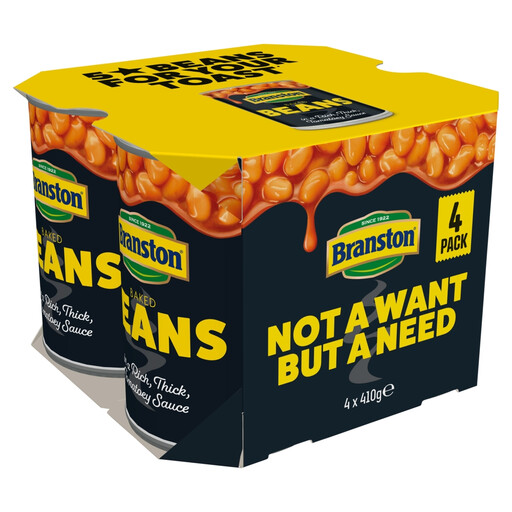
Four separate 410g tins allow you to open one for the takeaway and keep the others for later. The product information says to refrigerate unused beans and consume them within two days of opening.
No. A roughly 400–420g tin suits diners who expect to share it or use the remainder, while a smaller tin may suit one person with no leftover plan. Check the stated servings and opened-storage instructions for the product you choose.
Choose by comparing the exact labels if you want to account for the beans’ salt and sugar alongside the rest of the meal. The NHS identifies takeaway food as a possible salt source, and standard, reduced-sugar-and-salt and no-added-sugar bean recipes need not have the same nutrition or ingredients.
No. Read the ingredients and allergen wording on the specific tin: Ocado’s M&S standard and no-added-sugar bean listings say the products may contain milk and egg and are not suitable for people with those allergies.
Follow that tin’s transfer, refrigeration and use-within instructions. Ocado says to move unused M&S standard beans to a non-metallic container, refrigerate them and eat them within three days; its no-added-sugar beans have a two-day opened-life instruction. Food Standards Scotland advises checking each food label for its opened-storage directions.