For an ordinary easy-chew meal, consider baked beans only if the prepared beans are soft and break apart easily, then compare tins by unit price, pack size and the nutrition label. A reduced-salt-and-sugar option may suit someone comparing those declared values, but neither a tin label nor a brand name establishes suitability for a prescribed swallowing diet.
Who is this choice for?
People planning ordinary easy-chew meals
If tender foods are easier to manage and no swallowing-texture level has been prescribed, check how the prepared beans break apart before serving them. Imperial College Healthcare NHS Trust advises checking for a soft, tender texture, but its easy-chew leaflet also cautions against beans with skins or husks.
Households using baked beans regularly
Compare the unit price and the amount you are likely to use. A multipack may fit repeated meals, while a smaller tin may mean fewer leftovers from one meal.
People comparing salt or sugar labels
Read the per-100g figures on the exact tin and check what a reduced-salt or reduced-sugar claim is compared with. Pack size and serving size matter when comparing what goes into a meal.
What should you check?
For baked beans in an easy-chew meal, texture is the first check; unit price, the amount needed and the nutrition label then help distinguish suitable tins.
| Priority | What to check | Your needs |
|---|
| Prepared texture |
Check whether the prepared beans are soft and break apart easily with the side of a fork or spoon. If a swallowing-texture level is prescribed, follow the individual clinical advice rather than judging suitability from the tin. |
I need food that is manageable to chew. If there is a prescribed swallowing plan, the prepared beans must also meet that person’s specific instructions. |
| Pack value |
Compare unit prices on the same weight basis, then check tin size, multipack quantity and likely leftovers. Sainsbury’s lists two servings for its 400g plain tin. |
For regular meals, I want enough beans without choosing a larger pack than I can use or store as directed. |
| Salt and sugar |
Compare the exact tins per 100g and per intended serving. Waitrose & Partners states that its Essential Reduced Salt & Sugar beans contain 30% less of each than its regular Essential beans; the reduced product lists 0.30g salt per 100g. |
If I am comparing salt or sugar, I want the figures for the recipe I am buying, not an assumption based on the brand or front-of-pack wording. |
| Leftovers |
Follow the tin’s heating and after-opening instructions. Sainsbury’s directs shoppers to move unused beans to a non-metallic container, refrigerate them and use them within two days; the checked M&S standard tin specifies three days. |
A smaller tin appeals when one meal would otherwise leave more beans than I expect to use within the label’s storage period. |
Buying pitfalls
-
Assuming every tin suits a prescribed easy-chew diet
NHS guidance differs on beans: East Lancashire Hospitals NHS Trust includes baked beans among Level 7 easy-chew meal ideas, while Imperial College Healthcare NHS Trust cautions against beans with skins or husks. A general meal example cannot settle suitability for an individual with swallowing difficulties.
Follow the person’s speech-and-language therapist or dietitian’s instructions. For ordinary easy-chew planning, check the prepared texture and do not serve beans that the person struggles to manage.
-
Judging value by tin size alone
A larger tin or multipack changes how much food you buy, but may also leave unused beans after a meal.
Compare unit prices between comparable products, then choose an amount you expect to use or store according to the label.
-
Assuming “reduced” answers every buying question
Waitrose & Partners compares its Essential Reduced Salt & Sugar beans with its own regular Essential recipe. That claim does not describe every other tin, and it does not establish the prepared texture.
Compare the per-100g panels of the specific products you are considering, alongside pack size and texture.
-
Overlooking the after-opening instructions
Storage directions differ between the checked tins: Sainsbury’s specifies use within two days after refrigeration, while the checked M&S standard tin specifies three days.
Check the current label, transfer unused beans to a non-metallic container and follow that tin’s refrigeration and use-within directions.
Brand and product-line references
These label details describe specific UK product lines, not every baked-bean recipe sold under each name.
Sainsbury’s
Sainsbury’s lists plain baked beans in a 400g tin and a 4 × 400g pack.
- The 400g plain tin lists two servings and 0.58g salt per 100g.
- Its grocery label does not establish whether the prepared beans suit an individual swallowing-texture plan.
Waitrose Essential
The Essential range includes regular and Reduced Salt & Sugar baked beans in 420g tins, as well as smaller formats.
- Waitrose & Partners states that the reduced variant contains 30% less salt and sugar than its regular Essential beans; it lists 0.30g salt per 100g.
- The reduced recipe still needs an individual prepared-texture check.
Heinz
Heinz Beanz in Tomato Sauce is a branded standard-beans option available in different pack formats.
- Tesco’s listing for the 415g tin gives 0.6g salt per 100g.
- A description of beans as tender is not a check of the prepared texture for a prescribed diet.
M&S
M&S lists a 400g standard tin and a 220g Only 7 Ingredients variant.
- The 220g Only 7 Ingredients label lists seven ingredients and 0.50g salt per 100g.
- Check the recipe and prepared texture of the particular tin rather than treating the smaller format as an easy-chew guarantee.
Joybuy four-tin options
These tomato-sauce baked-bean multipacks are options for repeated meals: one is a standard Heinz recipe and the other is labelled Reduced Sugar & Salt by Branston. Check the prepared texture for the person eating them and compare current unit prices before deciding on value.
 No image available
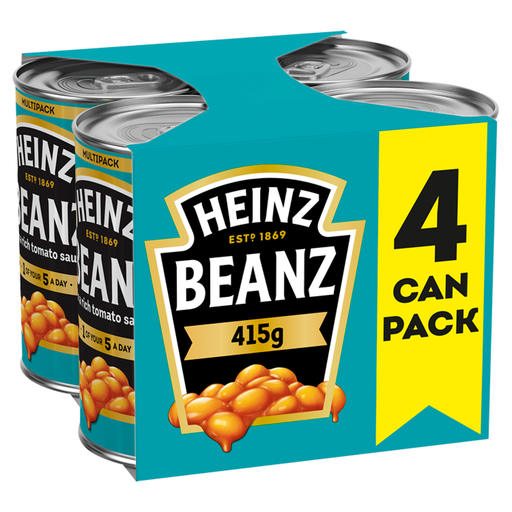
HEINZ Baked Beans in Tomato Sauce 4 × 415g
The four-tin pack may suit repeated meals where the Heinz tomato-sauce recipe is wanted. Check the beans after preparation: a product description calling them tender does not establish suitability for a prescribed swallowing texture.
View on Joybuy
 No image available
Branston Reduced Sugar & Salt Baked Beans 4 × 410g
This four-tin pack offers a reduced-sugar-and-salt recipe to compare with standard beans. Read the exact pack’s nutrition panel and check the prepared texture; the reduced label alone does not establish easy-chew suitability.
View on Joybuy
Common questions
Are baked beans automatically suitable for an easy-chew diet?
No. East Lancashire Hospitals NHS Trust includes baked beans in Level 7 easy-chew meal ideas, but Imperial College Healthcare NHS Trust cautions against beans with skins or husks. For a prescribed swallowing diet, follow the person’s individual speech-and-language therapy advice rather than relying on a tin label or a general meal example.
How can I check the beans’ texture before serving?
Check whether the prepared beans are soft and break apart easily with the side of a fork or spoon, as described in Imperial College Healthcare NHS Trust’s easy-chew guidance. That check does not replace individual clinical instructions where swallowing difficulties or a prescribed texture level are involved.
What does Waitrose Essential Reduced Salt & Sugar compare with?
Waitrose & Partners states that this recipe has 30% less salt and sugar than its regular Essential baked beans; the reduced variant lists 0.30g salt per 100g. Check the exact pack label when comparing it with another brand or recipe.
How should I keep beans left after opening a tin?
Follow the instructions on that tin. Sainsbury’s directs shoppers to transfer unused beans to a non-metallic container, refrigerate them and use them within two days; the checked M&S standard tin specifies three days.


