Families tracking energy and sugars
A multipack can provide several household meals, but the figures per 100g and for the amount served are more useful than the pack name when comparing recipes.


Choose a baked-bean family pack by comparing energy, sugars and salt per 100g, then checking what your usual portion would contain; the number of cans does not determine a serving size. If salt matters alongside sugars, compare both figures rather than relying on a “no added sugar” or “reduced” claim, and choose a can size your household can use while following the storage instructions.
A multipack can provide several household meals, but the figures per 100g and for the amount served are more useful than the pack name when comparing recipes.
A reduced-sugar recipe is not necessarily the answer to a salt comparison. Check salt per 100g and for the portion you expect to eat.
Can size and can count matter when different numbers of people will eat the beans. Consider whether an opened can can be used within the storage period stated on its label.
Start with the nutrition panel for a like-for-like comparison, then check the portion and pack format against how your household will use the beans. The NHS notes that food labels can help people compare products.
| Priority | What to check | Your needs |
|---|---|---|
| Energy and portions | Compare kcal per 100g across different can sizes. Check the labelled serving weight and calculate the figures for the amount you intend to serve. | When serving beans to several people, I want to know what each portion contains, not treat a can or multipack as a suggested serving. |
| Sugars and salt | Read both values per 100g and per serving. Check what a “reduced” claim is compared with; a “no added sugar” label does not mean sugar-free. | Even if I am looking at a reduced-sugar recipe, salt may still affect which pack I choose. |
| Fibre and protein | Compare the listed amounts on the same per-100g basis, then consider the portion you will use. Judge the beans as one part of the meal rather than by a single label figure. | I may want to compare these nutrients, while keeping the rest of the meal and the serving size in view. |
| Pack size and leftovers | Check the number and size of cans. Read the opened-can instructions before planning to use the remainder for another meal. | Four smaller cans may fit my household differently from larger cans or a six-can pack, particularly when a whole can will not be used at once. |
A multipack describes how the cans are sold, not how much one person should serve. Eating more than the labelled serving changes the energy, sugars and salt in that portion.
Choose the amount you expect to serve and use the per-100g panel to work out its figures.
Asda Groceries lists 0.9g salt for a half-can serving of the checked Heinz No Added Sugar pack. A sugar-related claim does not describe the salt in your serving.
Compare sugars and salt separately, using the same portion size for each product.
Sainsbury’s describes its reduced pack against Sainsbury’s standard beans, while Tesco compares its reduced pack with Tesco standard beans. Those claims do not directly compare the two reduced packs.
Use the actual per-100g nutrition figures when comparing products from different ranges.
The checked Tesco and Sainsbury’s packs instruct shoppers to transfer leftovers to a non-metallic container, refrigerate them and use them within two days.
If a can will cover more than one meal, plan when the remainder will be used and follow the instructions on the pack you buy.
These are references for comparing recipes and pack formats, not a list of products all sold by Joybuy.
Heinz No Added Sugar baked beans are listed in a 4 x 415g multipack, as well as a smaller 4 x 200g format.
Tesco lists Reduced Sugar & Salt baked beans in a 4 x 420g multipack.
Sainsbury’s lists Reduced Sugar & Salt baked beans in a 4 x 400g multipack.
Asda Groceries lists the Heinz No Added Sugar 4 x 415g multipack.
Waitrose & Partners lists Essential Reduced Salt & Sugar baked beans as a 420g option and Heinz No Added Sugar as a 4 x 415g pack.
The M&S tinned-beans range includes Eat Well No Added Sugar Baked Beans in a 390g can.
These four- and six-can baked-bean packs offer household formats to compare. Use their labels and your planned portions to decide whether a reduced-sugar-and-salt recipe or another listed pack fits your needs.
 No image available
The four 410g cans suit a household comparing a reduced-sugar-and-salt recipe. Check sugars and salt for the amount you plan to serve; the reduction claim is relative to standard Branston beans, not every other brand.
 No image available
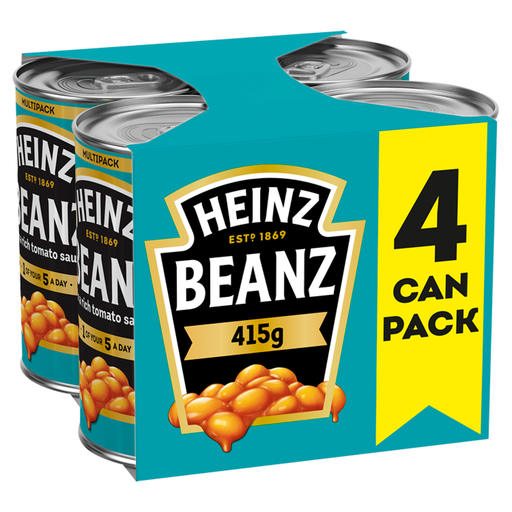
For a household considering four 415g cans, compare the nutrition panel with reduced-recipe alternatives on a per-100g basis. Work out the figures for your intended portion rather than assuming that half a can is what you will serve.
 No image available
Six 410g cans may fit a household planning repeated meals. Compare sugars and salt for the portion you intend to serve, and follow the pack’s instructions for any leftovers from an opened can.
 No image available
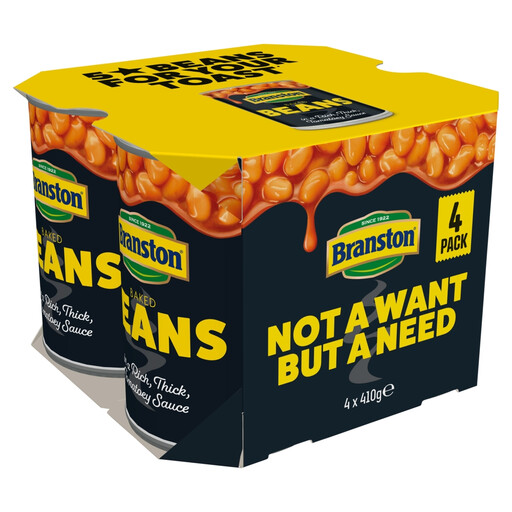
This four-can, 410g-per-can format offers a different household pack size from the six-can Branston listing. Compare the nutrition figures for the serving you expect to use, particularly if salt is a deciding factor.
Compare per 100g first because can sizes differ, then check the figures for the portion you expect to eat. The checked Sainsbury’s pack labels a 200g half-can serving, while the checked Tesco pack uses 210g, so their per-serving figures do not describe identical amounts.
No. Asda Groceries lists 1.9g sugars per 100g for the checked Heinz No Added Sugar pack, which contains naturally occurring sugars. Read the ingredient list as well if you want to check for sweeteners.
For the checked Tesco and Sainsbury’s packs, transfer leftovers to a non-metallic container, cover, refrigerate and use within two days. Follow the instructions on the particular can you buy.