For one plate of fish and chips, a 200–220g tin offers a smaller amount to open; for two smaller sides or planned leftovers, compare 410–420g tins. If the recipe matters more than tin size, compare sugar and salt on a per-100g basis and read the ingredients: reduced recipes can differ in both their declared reductions and their use of sweeteners.
Who is each tin size for?
Cooking for one
If beans are a side for one plate, compare compact tins before opening a larger one. Waitrose & Partners lists a 200g Heinz Single Serve tin, while M&S describes its 220g tin as single-serve. Check whether either amount suits the portion you want.
Sharing or planning leftovers
A standard tin makes sense when you will serve beans to two people or use the remainder. ASDA presents its 410g tin as two servings; its instructions say to refrigerate opened leftovers in a non-metallic container and use them within four days. Follow the directions on the tin you buy, as storage instructions differ.
Comparing sugar and salt
ASDA and Waitrose Essential list reduced sugar-and-salt recipes, but their claims use different regular-bean comparisons. Read the per-100g nutrition panel and ingredients as well as the reduction claim: ASDA’s reduced recipe contains steviol glycosides.
What should you check before buying?
Decide how much you will serve first, then compare recipes and the instructions for any beans left after opening.
| Priority | What to check | Your needs |
|---|
| Tin size |
Compare the stated weight and serving guidance. Waitrose & Partners lists Heinz Single Serve at 200g; M&S calls its 220g tin single-serve, while ASDA suggests two servings for its standard 410g tin. |
I only want beans alongside one plate of fish and chips, or I can share a larger tin and plan for any remainder. |
| Sugar and salt |
Read both values per 100g, then check what any reduction claim is compared with. ASDA states 60% less sugar and 30% less salt than a standard equivalent for its reduced 410g recipe; Waitrose Essential states 30% less of each than its regular Essential beans for its 420g recipe. |
The declared sugar and salt values matter to my choice, and I want to know whether a reduced recipe contains a sweetener. ASDA lists steviol glycosides. |
| Ingredients and allergens |
Read the current can’s ingredients, allergen information and dietary declarations for the exact recipe. M&S says its 220g Only 7 Ingredients beans are not suitable for people with milk or egg allergy. |
I need to check the particular tin against my dietary requirements rather than assuming every baked-bean recipe has the same declarations. |
| Leftover storage |
Check the opened-tin instructions before relying on a second meal. ASDA’s standard 410g listing says to refrigerate leftovers in a non-metallic container and use them within four days; Sainsbury’s Branston 410g listing says to refrigerate opened contents and use them within two days. |
If I choose a larger tin, I need a plan for storing and using what remains. |
Common buying mistakes
-
Opening a standard tin for one plate without a leftover plan
ASDA presents its 410g standard tin as two servings, whereas the Heinz and M&S compact examples are 200g and 220g respectively. Choosing the larger format can leave beans to store after the meal.
Compare the amounts you would serve, and choose the larger tin for a solo meal only if you can follow its instructions for the remainder.
-
Assuming all reduced recipes have the same ingredients
ASDA’s reduced 410g recipe claims 60% less sugar and 30% less salt than a standard equivalent and contains steviol glycosides. Waitrose Essential’s reduced 420g recipe claims 30% less of each than its regular Essential beans.
Compare sugar and salt per 100g and read the ingredients, rather than treating the front-of-pack claims as interchangeable.
-
Treating a website description as the final allergy check
An allergy declaration applies to the particular recipe. M&S states that its 220g Only 7 Ingredients beans are not suitable for people with milk or egg allergy.
Check the current physical can’s ingredients and allergen information for the exact product before serving it to someone with an allergy.
Brands and recipes to compare
These product examples illustrate different tin sizes and recipes; a brand name alone does not establish the contents of every tin it makes.
Heinz
Waitrose & Partners lists Heinz baked beans in both a 415g tin and a 200g Single Serve tin.
- The 200g format gives one diner a smaller amount to open.
- Check the precise tin’s serving, dietary and storage information rather than applying one size’s details to the other.
ASDA
ASDA lists a standard 410g tomato-sauce recipe and a 410g Reduced Salt & No Added Sugar recipe.
- The standard tin suggests two servings; the reduced recipe states its sugar and salt reductions against a standard equivalent.
- The reduced recipe contains steviol glycosides, so check its ingredients if you prefer to avoid sweeteners.
Waitrose Essential
The 420g Reduced Salt & Sugar tin is a standard-sized option with a reduction claim relative to regular Waitrose Essential baked beans.
- Waitrose & Partners lists 2.0g sugars and 0.30g salt per 100g for this recipe.
- Its stated 30% reductions describe a comparison with regular Essential beans, not with every other brand.
M&S
M&S describes its 220g Only 7 Ingredients Baked Beans as a small single-serve tin.
- The listed recipe contains haricot beans, tomatoes, water, agave syrup, cornflour, salt and paprika.
- M&S states that this product is not suitable for people with milk or egg allergy.
Tesco
Tesco’s referenced baked beans are listed as a 4 × 420g multipack, rather than an individual-tin listing.
- The multipack listing declares 4.6g sugars and 0.49g salt per 100g for its recipe.
- Check an individual tin’s own listing and label if buying a single can; the multipack format does not establish its individual-tin details.
A compact tin on Joybuy
This 220g Branston tin is an option to consider if you want a smaller amount of baked beans alongside one plate of fish and chips. Check the can’s serving guidance to decide whether the amount suits you.
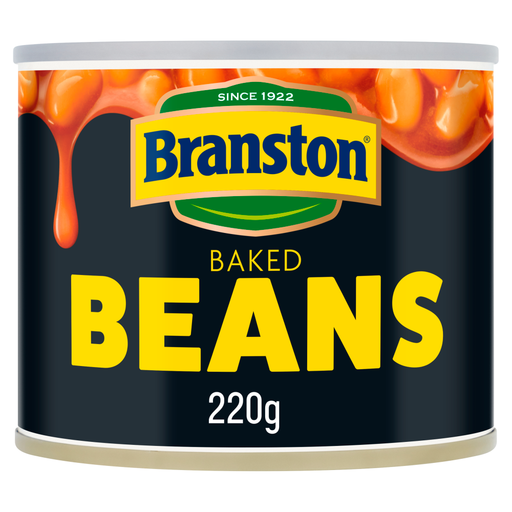 Image unavailable
Branston Baked Beans in Tomato Sauce 220g
The 220g can offers a smaller amount to open for a fish-and-chips side than the standard 410–420g tins discussed above; check its serving guidance against the portion you want. After opening, transfer unused contents to a suitable container, refrigerate and use within two days. Check the current can label if you need a vegan or gluten-free declaration.
View on Joybuy
Questions about serving and storage
How much baked beans should I buy for one plate of fish and chips?
A compact tin is worth considering if you do not want to manage much leftover food: Waitrose & Partners lists Heinz Single Serve at 200g, and M&S describes its 220g tin as single-serve. Compare the stated weight with the portion you want; if you choose a larger tin, plan how to store the remainder.
Does no added sugar mean no sweeteners?
No. ASDA lists steviol glycosides in its Reduced Salt & No Added Sugar 410g baked beans. Read the full ingredients list if sweeteners affect your choice.
How long can I keep baked beans after opening the tin?
Follow the instructions on the exact tin, because periods differ. ASDA’s standard 410g listing says to refrigerate leftovers in a non-metallic container and use them within four days; Sainsbury’s Branston 410g listing says to refrigerate opened contents and use them within two days.
Can I assume baked beans are suitable for my dietary requirements?
No; check the current label for the exact recipe. For example, Waitrose & Partners lists vegan suitability for its referenced Heinz tins, while M&S states that its 220g Only 7 Ingredients beans are not suitable for people with milk or egg allergy. One product’s declaration does not apply to every baked-bean tin.


