Solo diners avoiding leftovers
If you normally use all the beans at once, a 200g to 220g tin may be more convenient than opening a can intended for two servings. Check the serving declaration against the amount you actually want.


Choose a 200g to 220g tin if you usually eat the beans in one meal and would rather not store a remainder. A larger tin can suit one person who plans to use a second portion: Asda describes its 410g baked-bean tin as two servings. If you prefer a reduced-sugar or reduced-salt recipe, compare the nutrition panel and ingredients as well as the tin size.
A smaller tin is mainly a portion-planning choice; its weight alone does not tell you whether it will make a complete meal.
If you normally use all the beans at once, a 200g to 220g tin may be more convenient than opening a can intended for two servings. Check the serving declaration against the amount you actually want.
A compact tin can still leave you choosing between standard, reduced-sugar-and-salt and no-added-sugar recipes. Compare salt and sugars on the same label basis, and read the ingredients if sweeteners matter to you.
If you will use the remainder, a tin described as two servings may work for two separate meals. Check its storage instructions before deciding whether that plan is practical.
Start with the amount you expect to eat, then compare recipes and the instructions for any remainder.
| Priority | What to check | Your needs |
|---|---|---|
| Portion fit | Compare the net weight with the pack’s serving declaration. Tesco lists a 220g tin, Sainsbury's a 215g tin and Asda describes its 410g tin as two servings. | I would rather finish a smaller tin than store half of a larger one. If I plan two meals, the serving declaration helps me decide whether to split a can. |
| Recipe | Compare salt and sugars per 100g or on the same serving basis. Check the ingredients too: Waitrose lists a 200g Heinz No Added Sugar tin with sweetener and a 220g Essential Reduced Salt & Sugar tin. | Salt, sugars or sweeteners may affect which recipe I choose; the front-of-pack wording alone does not give me the full comparison. |
| Storage | Read the chosen tin’s instructions for unused contents, including the container and refrigeration directions. Do this before relying on a second meal from a larger can. | I can use a larger tin if I have a realistic plan to store and eat the remainder. |
| Meal planning | Look at the nutrition information for the amount you intend to eat and consider what else is in the meal. The NHS says beans and pulses count only once per day towards 5 A Day, even if you eat more. | A small tin may be one part of my meal, rather than everything I intend to eat. |
Asda describes its 410g baked-bean tin as two servings. Opening a similar-size can for one meal can leave a remainder to store.
Check the serving declaration. Choose a smaller tin if you are unlikely to use the remainder; otherwise plan when you will eat it.
“No added sugar” and “reduced salt and sugar” describe different recipe claims. They do not, by themselves, tell you the full salt and sugars values or whether a sweetener is present.
Compare nutrition values on the same basis and read the ingredient lists of the particular tins you are considering.
The NHS says beans and pulses count only once per day towards 5 A Day, even if you eat more than one serving.
If you are planning the rest of the meal around 5 A Day, count beans once rather than treating a second helping as another portion.
These examples show the formats and recipe labels to look for; serving and nutrition details should be checked on the particular product you choose.
Waitrose lists Heinz standard and No Added Sugar baked beans in 200g single-serve tins.
Tesco lists 220g own-label baked beans in standard and Reduced Sugar & Salt recipes.
Sainsbury's lists 215g standard and reduced-sugar-and-salt baked-bean tins.
Asda describes its 410g own-label baked-bean tin as providing two servings.
M&S lists Only 7 Ingredients Baked Beans in a 220g small single-serve tin.
Waitrose lists a 220g Essential Reduced Salt & Sugar tin alongside branded 200g Heinz single-serve options.
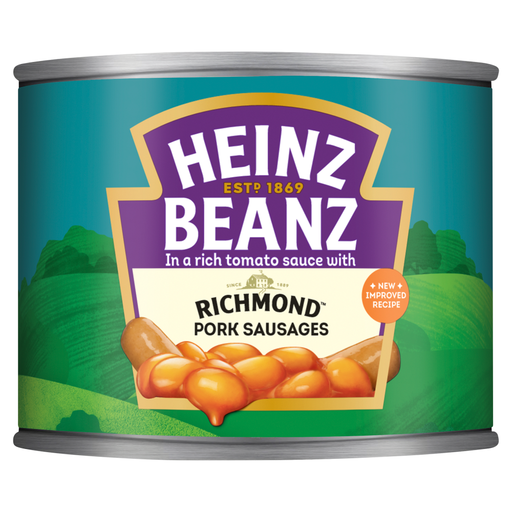
These compact tins include plain baked beans and a beans-and-sausages recipe. The latter is a different choice if you want plain beans.
 No image available
This 220g plain baked-bean tin is an option if you want a smaller can for one meal. Check the pack’s serving declaration against the amount you intend to eat.
 No image available
This 200g tin combines beans and sausages, so choose it only if you want that combination rather than plain baked beans. Check the ingredients and serving declaration for your meal.
Not necessarily. The smaller format can help you avoid leftovers, but whether it is enough depends on how much you intend to eat and what else is in the meal. Check the nutrition information for the amount you will use.
Consider that recipe if salt and sugars matter to your choice, then compare its nutrition panel with the standard version on the same basis. Read the ingredients too: a no-added-sugar recipe and a reduced-sugar-and-salt recipe are not interchangeable labels.
Yes, baked beans in tomato sauce can count, according to the NHS. Beans and pulses count only once per day towards 5 A Day, even if you eat more than one serving.
Follow the storage directions for that product and plan when you will use the remainder. Joybuy’s Heinz Baked Beans 200g listing, for example, instructs shoppers to transfer unused contents to a suitable sealed container, refrigerate them and consume them within two days; check your own tin rather than applying those instructions to every recipe.