Households planning quick family meals
A cupboard supply is useful when meals need little planning. Match the number and size of tins to portions you expect to serve, especially if an opened tin will leave unused beans.


Choose a tin size your household is likely to use, rather than assuming a multipack or a smaller tin will always be the better choice. If beans might be shared with a baby starting solids, compare the exact recipe as well as the pack: the NHS lists beans and pulses as foods suitable from around 6 months, but cautions against giving babies much salt. A reduced-salt-and-sugar label alone does not establish that a particular tin is suitable.
A cupboard supply is useful when meals need little planning. Match the number and size of tins to portions you expect to serve, especially if an opened tin will leave unused beans.
The NHS lists beans and pulses among foods suitable from around 6 months, when a baby is ready for solids. Check the particular baked-bean recipe and prepare food in a texture appropriate to the baby’s stage; the NHS also cautions against giving babies much salt.
If baked beans are a regular purchase, compare salt and sugars per 100g across the tins you are considering. For a reduced-sugar or no-added-sugar recipe, read the ingredients too, including any sweetener.
Begin with the portions you expect to use, then compare recipes and the storage instructions for any beans left after opening.
| Priority | What to check | Your needs |
|---|---|---|
| Pack size | Check the weight of each tin, the number of tins and whether you will use opened portions within the labelled storage period. A 220g tin and a 4 x 410g pack serve different plans. | I would rather open one smaller tin for a modest serving than repeatedly leave part of a larger one unused. |
| Recipe | Compare salt and sugars per 100g on the current labels. Check the ingredients of reduced-sugar recipes for sweeteners; a front-of-pack claim does not describe the whole recipe. | If beans may be shared with a baby starting solids, I need to assess the particular tin, not assume a reduced recipe is baby food. The NHS cautions against giving babies much salt. |
| Leftovers | Read the opened-tin instructions before choosing a format. Follow the stated container, refrigeration and time-limit directions for that product. | On days when we will only use part of a tin, I need a realistic plan for the rest. |
A reduced recipe can still contain salt or sugar, and a no-added-sugar recipe may contain a sweetener. The NHS lists beans and pulses as suitable foods from around 6 months but cautions against giving babies much salt.
Read the full label and consider the baby’s readiness and serving texture rather than relying on the claim on the front of the tin.
A multipack is only useful if its tins fit meals you expect to make. A large opened tin also needs a plan for any remaining beans.
Count likely servings before choosing between a small tin, a standard tin and a multipack.
Storage directions can differ: the checked Heinz listing says to refrigerate and use opened beans within 2 days, while the checked M&S tin says within 3 days.
Follow the instructions on the tin you open. The M&S directions specify transferring unused contents to a non-metallic container.
These examples show recipe and format differences worth checking; a brand name alone does not settle the choice for a family meal or for a baby starting solids.
Tesco lists standard baked beans in 420g tins and 4 x 420g packs, as well as a no-added-sugar 420g recipe.
Sainsbury's lists standard baked beans in a 4 x 400g pack and a reduced sugar-and-salt variant.
The Essential range includes a regular baked-bean tin and a reduced salt-and-sugar recipe.
Heinz offers regular baked beans in single tins and multipacks for households that prefer its recipe.
M&S lists a standard 400g baked-bean tin alongside other recipes in its tinned-beans range.
These tins cover a smaller serving, standard multipacks and one reduced-sugar-and-salt multipack for planned household meals. Compare each current label if beans might also be served to a baby starting solids.
 No image available
A four-tin option if your household wants to compare a reduced recipe with its usual beans. Check the current ingredients and nutrition panel; “reduced” does not establish suitability for a baby.
 No image available
The 220g tin is worth considering when a smaller serving is more likely to be finished than a 400–420g tin. Read the recipe and any opened-tin directions before serving or storing it.
 No image available
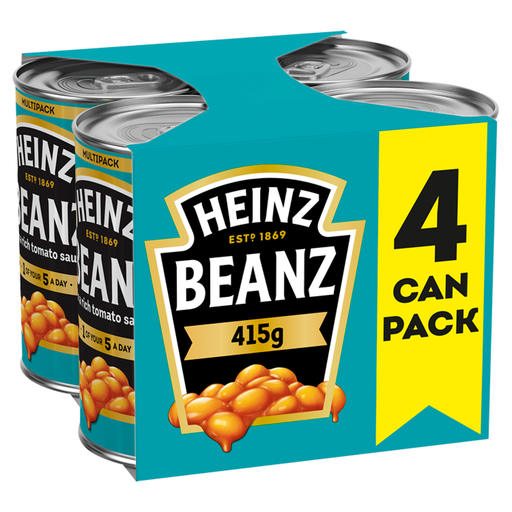
Four 415g tins suit a household planning several meals with the regular Heinz recipe. Consider whether an opened tin will be finished or stored according to its label; do not assume the recipe is baby-specific.
 No image available
Six 410g tins fit a plan for repeated household meals better than an occasional serving. Check that the tin size suits your portions, and follow the label for any beans left after opening.
 No image available
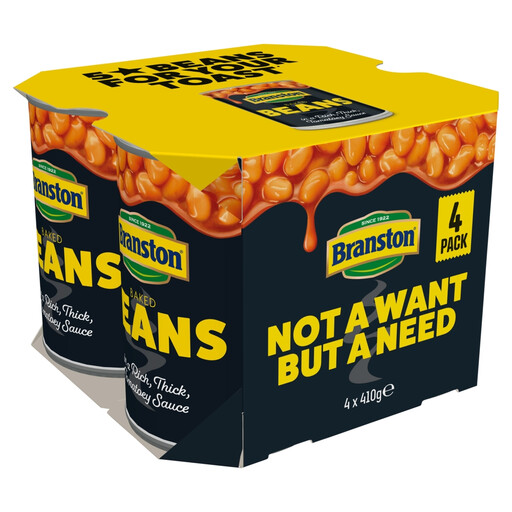
This four-tin standard pack offers 410g portions for meals planned across several occasions. Compare its current recipe with a reduced variant if salt and sugars matter to your household, and plan for opened leftovers.
The NHS lists beans and pulses as foods suitable from around 6 months, when a baby is ready for solids, but that does not establish that every tinned baked-bean recipe is suitable. The NHS cautions against giving babies much salt; check the particular tin and serve food in a texture appropriate to the baby’s stage.
No. Waitrose & Partners states that its Essential reduced recipe has 30% less salt and sugar than its regular Essential beans, but the claim is a comparison between those recipes, not a baby-feeding designation. Read the full ingredients and nutrition panel; Tesco’s no-added-sugar baked beans, for example, list steviol glycosides.
Follow the directions on the particular tin. The checked Heinz listing says to refrigerate opened beans and use them within 2 days; the checked M&S tin specifies a non-metallic container, refrigeration and use within 3 days.
Choose a multipack when you expect to use its separately sealed tins for planned meals. If portions are usually small, compare the tin size with what your household finishes and consider a smaller tin to limit opened leftovers.