Families serving frequent holiday lunches
If beans on toast or jacket potatoes appear regularly, consider the total amount in a pack alongside the space available to store unopened tins.


For repeated school-holiday lunches, choose a multipack by the amount your household will use, not tin count alone. A standard, reduced-sugar-and-salt or no-added-sugar recipe may suit different preferences; check the exact tin’s ingredients, nutrition panel and instructions for leftovers before stocking up.
If beans on toast or jacket potatoes appear regularly, consider the total amount in a pack alongside the space available to store unopened tins.
A reduced-sugar-and-salt pack offers a different recipe from that retailer’s standard beans. Read its stated comparison, nutrition panel and ingredients, including any sweetener.
Smaller tins or pots may be worth considering when fewer people turn up for lunch or a full-size tin would leave more beans than the household plans to use.
Start with the quantity you expect to use, then compare the exact recipes and plan for any beans left after opening.
| Priority | What to check | Your needs |
|---|---|---|
| Pack quantity | Compare tin size, number of tins and total pack weight. Tesco lists a 4 × 420g pack; Sainsbury’s lists a 4 × 400g pack. | We serve beans at several lunches, but I want a pack we can realistically use and store. |
| Recipe | Compare the nutrition panel and ingredients on the exact variant. Sainsbury’s says its reduced-sugar-and-salt 4 × 400g beans contain 30% less sugar and 30% less salt than its own standard beans; the recipe contains steviol glycosides from stevia. | I’m looking for a particular sugar-and-salt formulation, so the comparison with the standard recipe matters more than the wording on the front of the pack. |
| Portions and leftovers | Consider how much you will serve at once and follow the tin’s instructions after opening. Sainsbury’s standard 4 × 400g pack says to transfer leftovers to a non-metallic container, refrigerate and use within two days. | Lunch numbers vary in our household; a smaller tin could be easier to use when we do not need a full-size one. |
| Ingredients and allergens | Read the physical pack’s ingredients and allergen information for the exact recipe before serving it to someone with a dietary requirement. | Someone at our table needs an ingredient check, so I’ll use the tin we actually bought rather than relying only on an online description. |
Sainsbury’s stated sugar-and-salt reduction compares its reduced 4 × 400g beans with its own standard beans, not with every other brand. That recipe also contains a stevia sweetener.
Check the comparison named on the pack, then read its nutrition panel and ingredients if a particular formulation matters to you.
Leftovers need handling within the product’s stated open-life. Sainsbury’s standard beans instruct buyers to refrigerate opened contents in a non-metallic container and use them within two days.
Match tin size to the portions you expect to serve, and follow the instructions on the tin you open.
The ingredients relevant to an allergy must be checked against the product that will be served, particularly when choosing between recipes.
Read the physical tin’s ingredients, highlighted allergens and any precautionary wording before serving someone with an allergy.
These ranges illustrate different pack sizes and recipes; the products in the Joybuy section are a separate, narrower selection.
Tesco lists standard and reduced-sugar-and-salt own-label baked beans in 4 × 420g packs.
Sainsbury’s lists standard and reduced-sugar-and-salt own-label 4 × 400g packs.
Heinz appears in the cited retailer listings in full-size multipacks and a no-added-sugar 4 × 415g variant.
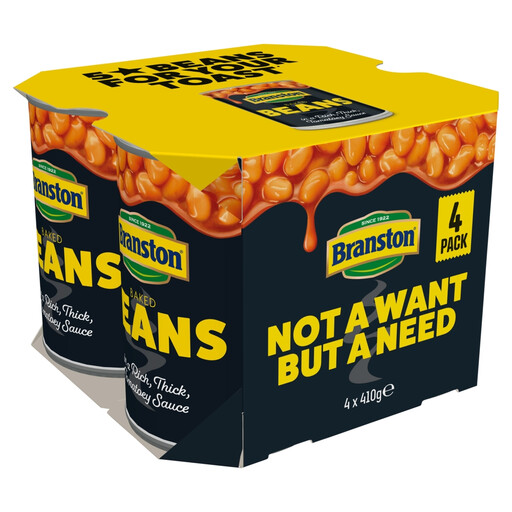
Branston baked beans appear in 4 × 410g and 6 × 410g multipack formats in the cited retailer listings.
Waitrose lists Essential baked beans in individual 420g tins, including a reduced-salt-and-sugar variant.
The M&S range listing includes a 1.6kg “Only 7 Ingredients” baked-bean product and smaller no-added-sugar and standard variants.
These Branston options are four- and six-tin packs for planned lunches, including a reduced-sugar-and-salt recipe. Compare the quantity and the label of the exact variant you choose.
 No image available
For several planned lunches, this pack contains six 410g tins of beans in tomato sauce. Check how much you expect to serve at a time, along with the tin’s ingredients and instructions for leftovers.
 No image available
This four-tin pack is an option when you are planning fewer bean-based lunches than a six-tin pack would cover. Each tin contains 410g; check the exact label for ingredients and after-opening instructions.
 No image available
This four-tin pack is for households considering a reduced-sugar-and-salt recipe for planned lunches. Each tin contains 410g; read the exact nutrition panel, ingredients and stated comparison rather than assuming it matches another brand’s reduced recipe.
No. For school-holiday lunches, compare the size of each tin and the total amount with the portions you expect to serve. A smaller pack may be easier to use when lunch numbers vary.
Sainsbury’s states that its reduced-sugar-and-salt 4 × 400g beans contain 30% less sugar and 30% less salt than its own standard baked beans. Its label lists 5.5g sugars and 0.59g salt per half can and includes a stevia sweetener; the stated reduction does not describe other brands.
Follow that tin’s storage instructions. Sainsbury’s standard 4 × 400g pack says to transfer leftovers to a non-metallic container, refrigerate and use within two days; check other products for their own instructions.
Check the physical tin before serving. Read the ingredients, highlighted allergens and any precautionary wording on the exact recipe you have bought rather than using an online description as your final check.
GOV.UK says how long canned food remains acceptable after a best-before date depends on the product, its storage conditions and the brand. Follow the manufacturer’s instructions, including its guidance for food after opening, rather than applying one rule to every tin.