What should you check?
Start with the amount the recipe requires, then compare the exact tin's label and heating instructions.
| Priority | What to check | Your needs |
|---|
| Recipe quantity |
Read the net weight and measure the amount specified. Standard Tesco, Sainsbury's and ASDA tins are 420g, 400g and 410g respectively; Waitrose lists a 200g Heinz single serve. |
If I'm making a small batch, a smaller tin may leave less unused. For a recipe written around a conventional tin, I'll use its stated quantity rather than substitute a smaller can unchanged. |
| Salt and sugar |
Compare salt and sugars per 100g on the exact pack, then consider how much goes into the bake. ASDA lists 0.47g salt and 4.2g sugars per 100g for its standard 410g tin; reduced-formulation variants need their own label check. |
Cheese, pastry or other ingredients may also contribute salt, so I want to assess the whole recipe. NHS Healthier Families gives maximum daily salt amounts of 3g for children aged 4–6 and 5g for ages 7–10. |
| Ingredients |
Read the current ingredient and allergen information, especially when choosing a flavoured or no-added-sugar variant. Tesco and M&S advise checking the pack because product information can change. |
I want ingredients that suit the household's dietary requirements and the flavour planned for this bake, not just a familiar brand name. |
| Heating and storage |
Follow the tin's heating directions. Sainsbury's instructs microwave users to transfer the beans to a microwaveable dish, stir during heating and allow standing time. Follow the pack's opened-product storage instructions too. |
An adult will manage hot food and containers while children take part in non-heating steps. For cooked leftovers, GOV.UK advises refrigeration within two hours and eating them within 48 hours or freezing them. |
Brand and retailer references
These examples show single-tin formats and label details worth comparing; each point applies to the named product or range, not every tin from that brand.
Heinz
Waitrose lists a 200g Heinz No Added Sugar Single Serve alongside conventional Heinz tins.
- The 200g format can match a recipe needing less than a conventional tin.
- Waitrose describes it as containing sweetener and having 25% less salt than standard Heinz Beanz; that comparison does not describe every Heinz variant.
Tesco
Tesco lists a standard 420g tin and a reduced sugar and salt 420g alternative.
- The two listed formats allow a formulation choice without changing the stated tin weight.
- Tesco advises reading the pack label because ingredients and nutrition information may change.
Sainsbury's
Its baked beans in tomato sauce come in a 400g tin with published microwave directions.
- The directions specify transferring the contents to a microwaveable dish, stirring and allowing standing time.
- Check the current pack for the ingredients and nutrition relevant to your recipe.
ASDA
ASDA lists both a standard 410g tin and a reduced-salt, no-added-sugar 410g tin.
- The standard tin's published figures include 0.47g salt and 4.2g sugars per 100g when hob-heated.
- Those standard-tin figures must not be applied to the reduced-formulation product; check that variant's label separately.
M&S
M&S lists a seven-ingredient baked-bean recipe and a separate no-added-sugar product.
- M&S names haricot beans, tomatoes, water, agave syrup, cornflour, salt and paprika for its seven-ingredient product.
- The seven-ingredient description is product-specific. M&S advises checking the pack because product information can change.
Waitrose
Waitrose lists Essential standard and reduced salt and sugar baked beans in 420g tins, as well as a 200g Heinz single serve.
- The listed formats give a choice between conventional and smaller recipe quantities.
- Check the exact product and weight before substituting one tin for another in a measured recipe.
Joybuy single-tin options
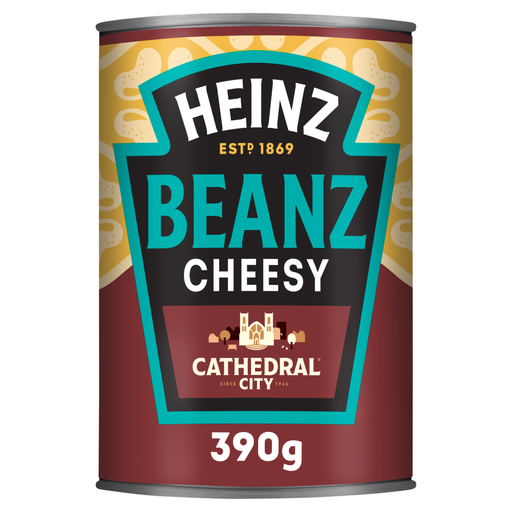
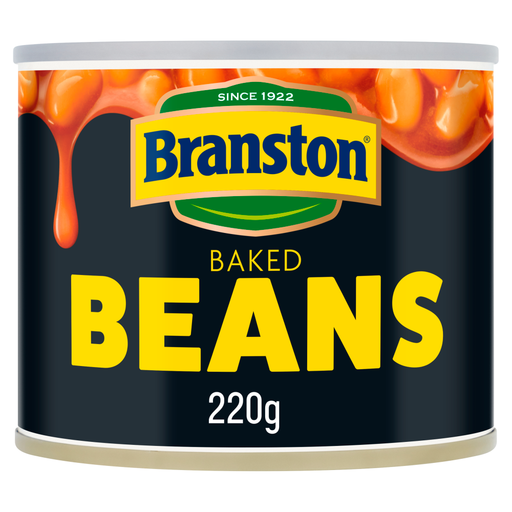
These tins offer two different recipe quantities: a 390g cheese-flavoured option for a bake where that flavour fits, and a 220g tomato-sauce option for a smaller batch. Compare each weight with your recipe before choosing.
 No image available
Heinz Beanz Cheezy 390g
The 390g tin is close to, but smaller than, the 400–420g conventional tins: measure it for a precisely scaled recipe. Choose its cheese flavour only if it suits the bake; the product contains milk, so check the label against household dietary requirements.
View on Joybuy
 No image available
Branston Baked Beans in Tomato Sauce 220g
The 220g tin is an option when a small-batch recipe calls for less than a conventional tin. It will not replace a 400–420g tin without adjusting quantities; check the pack's heating directions before an adult prepares it.
View on Joybuy
Questions about baking with beans
Should I use a whole standard tin in the recipe?
Use the whole tin only if its net weight matches the recipe quantity. Tesco, Sainsbury's and ASDA list standard tins of 420g, 400g and 410g respectively, so measure the beans when a recipe is precisely scaled.
Does a reduced-salt or no-added-sugar tin suit every bake for children?
No single formulation suits every recipe. Compare the exact tin's nutrition and ingredients with the other components of the bake; NHS Healthier Families gives maximum daily salt amounts of 3g for ages 4–6 and 5g for ages 7–10.
Can the beans go into the microwave in their tin?
Transfer them to a microwaveable dish rather than heating them in the tin. Sainsbury's directions also specify covering the dish, stirring halfway through, checking that the food is piping hot and allowing it to stand for one minute; an adult should manage the hot food and container.
How should cooked leftovers be stored?
GOV.UK advises cooling cooked leftovers, refrigerating them within two hours and eating them within 48 hours or freezing them. Also check the particular tin's instructions for storing its contents after opening.
Do I need to check the label when buying a familiar brand?
Yes, particularly if ingredients, allergens or nutrition affect your choice. Tesco and M&S advise reading the pack because product information can change.


