Households planning a Bonfire Night meal
If beans are going alongside toast, jacket potatoes or breakfast, think about how many tins the meal needs and whether the rest of a multipack will be used later.


For Bonfire Night meals, choose a tin size that fits the number of people eating: a multipack can cover several meals, while a smaller tin may leave less to store after opening. If salt or sugar matters to your choice, compare the figures per 100g on the exact cans rather than relying on a reduced-sugar or reduced-salt claim alone. Check the current label for ingredients, allergens, heating and storage instructions before serving.
If beans are going alongside toast, jacket potatoes or breakfast, think about how many tins the meal needs and whether the rest of a multipack will be used later.
Standard and reduced recipes need to be compared using the nutrition information on the exact cans. The per-100g figures provide a consistent basis even when tin sizes differ.
A smaller tin may suit one eater when the rest of a larger opened tin is unlikely to be used within its stated refrigerated storage period.
Start with the amount you expect to serve, then compare nutrition and dietary information on the specific variants you are considering.
| Priority | What to check | Your needs |
|---|---|---|
| Salt | Compare salt per 100g across the exact tins. For a reduced-salt claim, check its named comparator and the nutrition panel. | I want to compare recipes on the same basis, then consider how much of the tin will be served. |
| Sugars | Read the sugars figure per 100g and the ingredients. A reduced-sugar claim is a comparison, not a statement that the beans contain no sugar. | If sugars affect my choice, the figure on the can matters more than the wording on the front. |
| Tin size | Compare the weight of each tin and the number of tins in a multipack. Check the instructions for storing and using leftovers. | A smaller tin may suit one meal; for several eaters or meals, I may use more than one tin. |
| Ingredients and allergens | Read the current ingredients, allergen statement and any dietary label on the exact variant. Do not extend one product’s claims to a whole brand. | When an ingredient or allergen matters, I need to check the can that will actually be served. |
| Preparation and storage | Follow the can’s heating and after-opening instructions. Transfer unused beans out of an opened tin and refrigerate them. | I want to serve the beans on the night and know what to do if any remain. |
Recipes and tin sizes vary, so a smaller can does not by itself indicate a different salt or sugars content per 100g.
Compare the nutrition panels of the exact tins, then consider the amount each person is likely to eat.
Unused beans need to be transferred out of the opened tin, refrigerated and used within the product’s stated open-life.
Choose a smaller tin if it better matches the meal, or plan when you will use the remainder of a larger one.
Leftovers that are not used within the stated open-life may have to be discarded.
Ingredients and allergen statements are product-specific and may change. Marks & Spencer’s standard 400g baked-bean page, for example, says that product is not suitable for people with milk or egg allergy.
For an allergy or other dietary requirement, check the current physical label of the exact can before serving.
These examples show different pack and recipe choices; a brand name alone does not establish the details of every variant.
Heinz offers standard baked beans in tomato sauce as well as smaller-tin and no-added-sugar variants.
Tesco’s own-label range includes standard baked beans and a reduced-sugar-and-salt recipe.
M&S has standard and alternative baked-bean recipes in its Foodhall range.
The Essential range includes a 220g reduced-salt-and-sugar baked-bean option.
These options cover standard tomato-sauce beans in smaller tins and multipacks, plus a reduced-sugar-and-salt Branston multipack. Match the tin size and the current label to your planned meal.
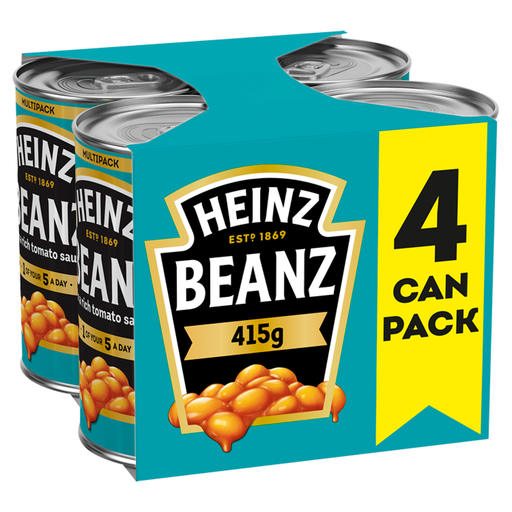 Image unavailable
Four 415g tins can be used across several meals or served to a larger group. The product information includes salt and sugars per 100g and hob and microwave heating directions. After opening, transfer unused beans to a non-metallic container, refrigerate and use within two days.
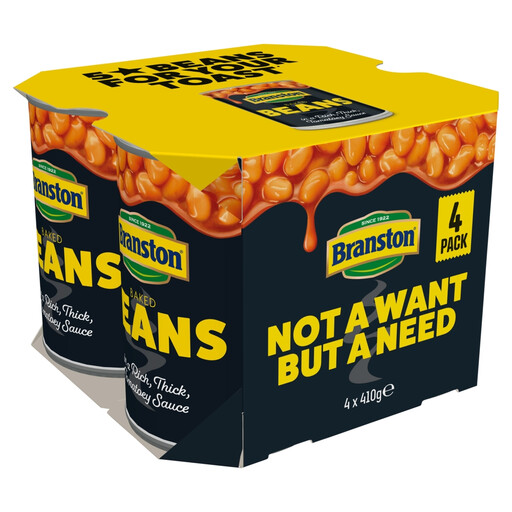 Image unavailable
This four-tin pack is an option when beans are planned for more than one meal. Product information includes salt and sugars per 100g plus hob and microwave directions. Transfer leftovers to a covered container, refrigerate and use within two days of opening.
 Image unavailable
Six 410g tins suit a plan involving several meals. The product information includes ingredients and salt and sugars per 100g; check the can for heating directions. Transfer unused beans to a covered container, refrigerate and use within two days of opening.
 Image unavailable
The 220g tin may be easier to match to a smaller meal than a large opened can. Compare salt and sugars per 100g, and check the current can before relying on portion figures or preparing it. Refrigerate any leftovers in a separate container and use within two days.
 Image unavailable
This four-tin pack provides a reduced-sugar-and-salt Branston option for several meals. Branston’s stated 30% reduction in sugar and salt is against standard Branston Baked Beans, not every competing tin; check the current per-100g figures and ingredients. Follow the can’s heating directions, and refrigerate transferred leftovers for use within two days.
Compare salt per 100g on the exact cans first, then consider how much you intend to serve. The NHS explains that nutrition information is given per 100g, which lets you compare recipes even when tin sizes differ. If a product says reduced salt, check both its nutrition panel and the product used for that claim.
No. Reduced sugar describes a comparison, not an absence of sugars. Waitrose & Partners, for example, compares its Essential reduced-salt-and-sugar beans with regular Essential Waitrose Baked Beans. Read the sugars figure and ingredients on the exact tin you are buying.
Transfer unused beans to a covered container rather than storing them in the opened tin, and refrigerate them. Follow the open-life on your product’s label; the storage period can differ between recipes.
No single dietary statement applies to every baked-bean product. Waitrose & Partners lists a Heinz product as suitable for vegans, while Marks & Spencer says its standard 400g baked beans are not suitable for people with milk or egg allergy. Check the current label of the exact variant before serving it to someone with a dietary requirement.
A best-before date concerns quality rather than safety, according to the Food Standards Agency’s home food guidance. Store the tin as directed and inspect its condition; the date alone does not tell you whether a damaged can is suitable to use.