Home workers planning repeat lunches
If you usually eat around half a large tin, consider whether you will use the other portion within the pack’s opened-storage period.


A standard 400g-plus tin suits repeat lunches if you will use both portions and can refrigerate any leftovers according to the label. A smaller tin may suit one occasional lunch, while a reduced-sugar-and-salt recipe is worth considering when those label values matter to you; compare the portion you actually eat and check the exact pack’s ingredients and storage instructions.
If you usually eat around half a large tin, consider whether you will use the other portion within the pack’s opened-storage period.
For beans on toast or a jacket potato, compare salt and sugars for the amount you expect to eat rather than assuming tomato-sauce recipes have the same values.
A smaller tin may be more convenient when you want one portion and do not expect to use refrigerated leftovers promptly.
Start with the portion you will use, then compare the exact variant’s nutrition label and instructions for anything left after lunch.
| Priority | What to check | Your needs |
|---|---|---|
| Portion size | Check the net quantity and number of servings. Decide whether an opened tin will provide another lunch you can use within its stated storage period. | A large tin works for me if I will eat the remainder; for an occasional single portion, I may prefer a smaller can. |
| Salt and sugars | Compare values for the amount you will eat, not unlike serving sizes. Tesco Groceries lists 1.03g salt per half can for its standard 420g beans; Sainsbury’s lists 1.16g per half can for its 400g standard beans. | If I am comparing standard and altered recipes, the salt and sugars on the exact pack matter more than the range name. |
| Preparation and leftovers | Follow the pack’s heating directions. Transfer any unused beans as directed, refrigerate them and observe that product’s opened-storage period. | I want lunch to fit a short break, but I also need a plan for any beans left in the tin. |
| Ingredients and allergens | Read the current pack’s ingredient and allergen information. Check dietary claims on the exact variant rather than applying them to every product from the brand. | Where an ingredient or allergen matters to me, I need the details for the tin I am buying. |
Salt and sugars can differ between recipes and serving sizes. For example, Tesco Groceries lists 1.03g salt per half can for its standard beans, while Sainsbury’s lists 1.16g per half can for its standard product.
Compare the current labels using the portion you expect to eat, particularly when choosing between standard and reduced-sugar-and-salt variants.
Opened-storage directions differ: ASDA Groceries says to use its standard beans within four days, while Tesco Groceries says to use its Everyday Value beans within two days.
Transfer leftovers to a suitable non-metallic container, cover and refrigerate them, then follow the period on the product you bought.
The observed range includes standard beans, smaller tins and a no-added-sugar multipack.
Tesco lists standard and Everyday Value baked beans in 420g tins.
Its range includes standard beans and a reduced-sugar-and-salt option.
The observed range includes Just Essentials and standard own-label tins alongside branded variants.
M&S lists standard and other recipe variants, including no-added-sugar beans.
Waitrose & Partners lists Essential standard beans and an Essential Reduced Salt & Sugar variant in 420g tins.
These tins cover repeat lunches, a smaller portion and a reduced-sugar-and-salt recipe. Choose a pack size you will use and check the exact variant’s label before deciding.
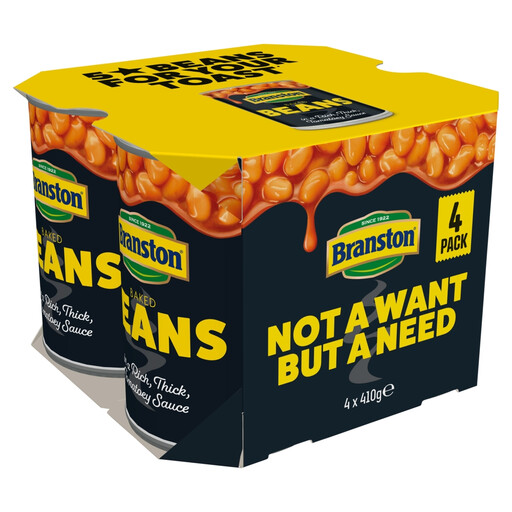 No image available
Four 410g tins give you separate cans for repeat lunches. The listing includes hob and microwave directions; transfer opened leftovers to a container, refrigerate and use within two days.
 No image available
This four-tin variant is an option when you want to compare a reduced-sugar-and-salt recipe with standard beans. Its listed ingredients include steviol glycosides; check the current label for serving values and refrigerate opened beans for use within two days.
 No image available
The 220g tin offers a smaller quantity for an occasional lunch. Check the pack’s preparation directions; refrigerate any remainder and use it within two days.
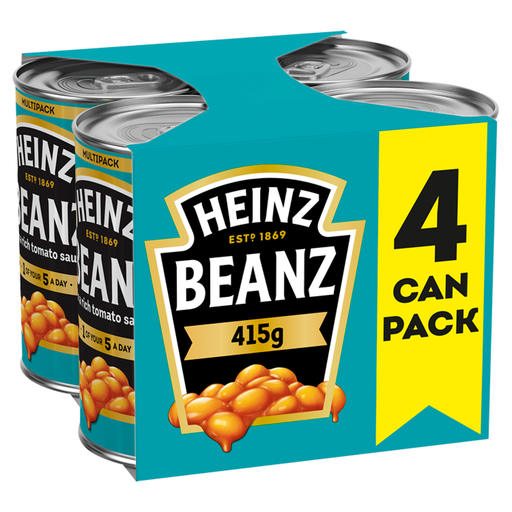 No image available
Four 415g tins provide separate cans for repeat lunches. The listing gives hob and microwave directions and nutrition per 100g; check your serving quantity and follow the pack’s opened-storage instructions.
 No image available
Six 410g tins suit lunches planned across several days. The listing gives nutrition per 100g; check the physical pack for heating directions, and refrigerate opened leftovers for use within two days.
No. A larger tin suits you when you will use both portions and can store any remainder as directed; a smaller tin may be more convenient for an occasional single portion.
Check the serving size as well as the number: Tesco Groceries lists 1.03g salt per half can for its standard 420g beans, while Sainsbury’s lists 1.16g per half can for its standard 400g beans. Use the current label for the tin you choose.
No-added-sugar wording alone does not tell you the salt content. ASDA Groceries lists 3.9g sugars and 0.9g salt per half can for the observed Heinz No Added Sugar variant; check both values on any other recipe you are considering.
Follow the instructions on your tin, including its opened-storage period. ASDA Groceries directs buyers to transfer unused standard beans to a covered, non-metallic container, refrigerate and use within four days; Tesco Groceries specifies two days for its Everyday Value beans.
Read the ingredient and allergen information on the physical pack of the exact variant you are buying. Do not assume that a previous purchase or another product in the same brand range has the same recipe.