Regular home workers
If baked beans are a repeat lunch ingredient, compare can and multipack sizes alongside the nutrition figures for the portion you expect to eat.


For regular working-from-home lunches, choose a can size you can use and compare salt and sugars on the same serving basis; a reduced-sugar-and-salt label alone does not settle the choice. A smaller can can mean fewer leftovers, while a multipack suits repeat lunches if its format fits your plans and you follow the opened-can storage instructions.
If baked beans are a repeat lunch ingredient, compare can and multipack sizes alongside the nutrition figures for the portion you expect to eat.
Reduced-sugar-and-salt and no-added-sugar recipes can have different nutrition figures and ingredients. Read the serving panel and ingredient list on the particular can.
A smaller can may better match one lunch. With a larger can, consider whether you can refrigerate and use the remainder within its stated open-life.
Start with the portion you will use, then compare recipes on the same nutrition basis and check what happens to any leftovers.
| Priority | What to check | Your needs |
|---|---|---|
| Salt and sugars | Compare figures for the same stated serving size, as well as any per-100g figures. Sainsbury's lists 0.59g salt per half can for its reduced recipe; ASDA Groceries lists 0.70g per half can for its reduced-salt, no-added-sugar recipe. | I want to compare what my lunch portion contains, rather than assume two reduced-labelled recipes have the same figures. |
| Ingredients | Read the ingredient and allergen information on the exact pack. Check for sweeteners if they affect your choice; no added sugar does not mean sugar-free. | The recipe matters to me as much as the wording on the front of the can. |
| Can and pack size | Match the can size to the amount you expect to use. Waitrose & Partners lists smaller 150–220g formats alongside larger cans; multipacks provide several cans for repeat lunches. | A smaller can may suit one lunch, or I may use several cans over successive workdays. |
| Opened-can storage | Read the pack's refrigeration and open-life instructions. Food Standards Scotland advises following those instructions; Tesco's cited reduced-bean can specifies using refrigerated leftovers within two days. | If I open a larger can, I need a workable plan for the remainder. |
| The rest of lunch | Compare declared fibre and protein on a consistent serving basis. The NHS Eatwell Guide places beans and pulses among protein foods and includes starchy foods and fruit and vegetables across the diet. | I'm choosing beans as one part of lunch, not assuming a can describes the whole meal. |
Reduced claims refer to a comparison with a particular standard recipe, not one shared salt figure. Sainsbury's lists 0.59g salt per half can for its reduced beans, while ASDA Groceries lists 0.70g for its reduced-salt, no-added-sugar beans.
Compare the stated serving sizes and salt figures on the cans you are considering.
Open-life instructions differ: the cited Tesco reduced-bean can says to use refrigerated leftovers within two days, while the M&S baked-bean listing says three days. Food Standards Scotland advises checking the food's own label.
Follow the exact pack's instructions for transferring, covering and refrigerating unused beans.
ASDA Groceries lists 3.1g sugars per half can for its no-added-sugar baked beans. Its recipe also includes steviol glycosides.
Check both the sugars figure and ingredient list if either affects your choice.
Tesco lists standard and reduced-sugar-and-salt own-label baked beans, including a 420g reduced-recipe can.
Sainsbury's lists standard, reduced-sugar-and-salt and smaller 215g baked-bean formats.
Asda lists a reduced-salt, no-added-sugar 4 × 410g baked-bean pack alongside standard options.
Heinz baked beans appear in standard and smaller-can formats in the cited supermarket listings.
M&S lists a 400g baked-bean can among its Food products.
Waitrose & Partners lists Essential, branded and smaller baked-bean formats.
These standard and reduced-recipe cans include multipacks for repeat lunches and a 220g can to consider when you want a smaller portion.
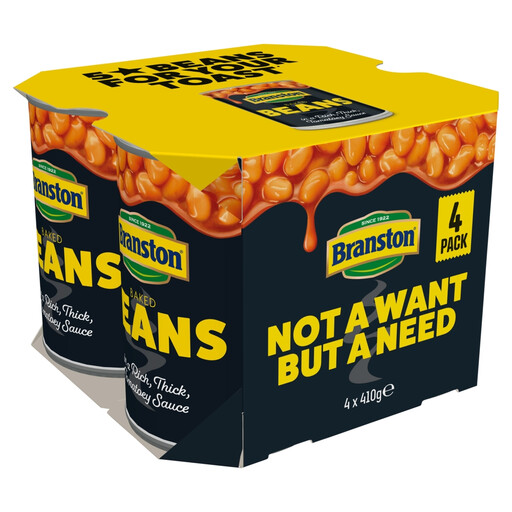 No image available
Four cans suit plans involving repeat lunches. Compare the salt and sugars for the amount you will eat, and follow the pack's instructions if you keep leftovers.
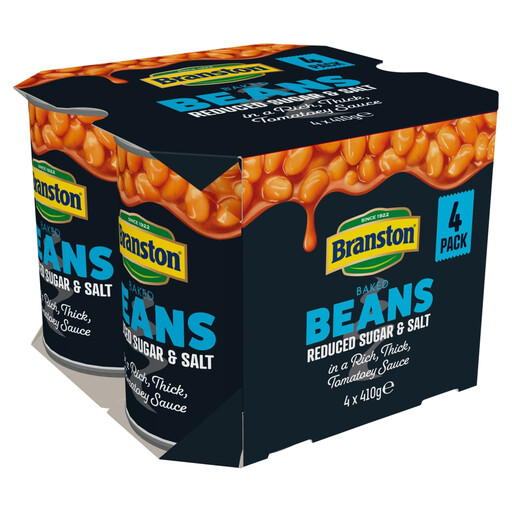 No image available
A four-can reduced-recipe option for repeat lunches. The reduced claim compares this recipe with standard Branston beans; check the nutrition panel and ingredients, including steviol glycosides, against your preferences.
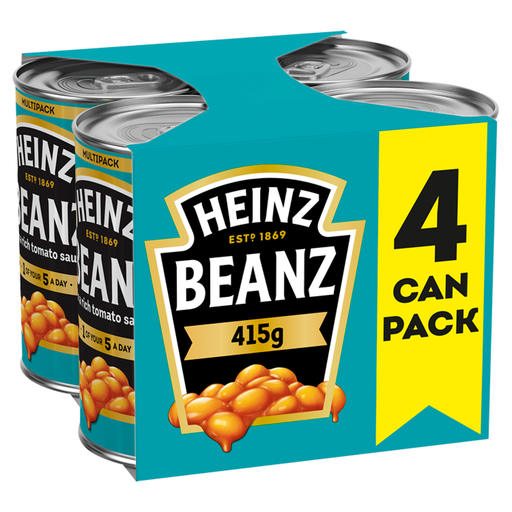 No image available
This four-can standard recipe is an option for keeping several lunches in the cupboard. If comparing it with a reduced recipe, use the current pack's salt and sugars figures on the same portion basis.
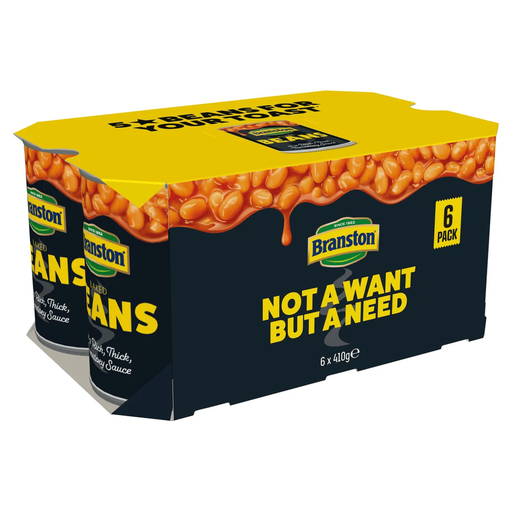 No image available
Six cans provide a standard-recipe format for successive lunches. Check how much of each can you will use and read the pack's serving and opened-can instructions.
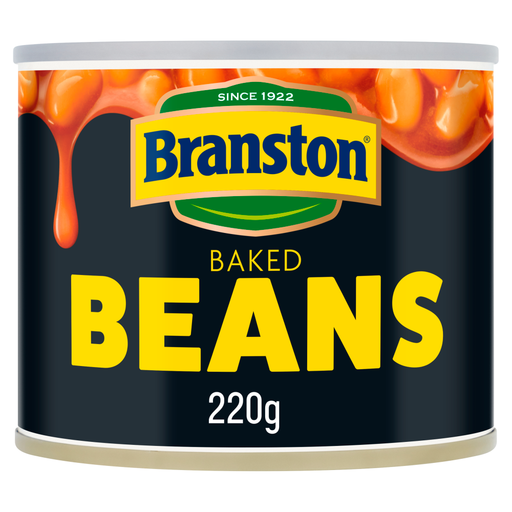 No image available
The 220g can is worth considering when a smaller amount fits your lunch plans. Decide whether that amount suits you rather than assuming the whole can is your preferred serving.
Treat them as one meal component rather than assuming a can describes the whole lunch. The NHS Eatwell Guide places beans and pulses among protein foods and also includes starchy foods and fruit and vegetables across the diet.
Choose by the nutrition panel and ingredients, not the wording alone. Sainsbury's lists 0.59g salt per half can for its reduced recipe; ASDA Groceries lists 0.70g for its no-added-sugar, reduced-salt recipe, which contains steviol glycosides.
Follow the particular pack's storage and open-life instructions. Food Standards Scotland advises checking the label: the cited Tesco reduced-bean can instructs users to transfer and refrigerate leftovers and use them within two days, while the M&S listing specifies a non-metallic container, refrigeration and three days.
Check the physical pack before eating if an allergy or ingredient restriction matters to you. This is especially important for the cited M&S beans, whose online dietary and milk-and-egg allergy statements could be confusing.
Suitability is recipe-specific, so check the current pack. Tesco Groceries labels its cited Heinz standard beans suitable for vegans, but that statement should not be applied to every baked-bean product or variant.