Households serving beans on toast regularly
If beans feature on several weekday mornings, compare the number of tins and the weight of each tin with how quickly your household uses them.


For repeated weekday breakfasts, choose a tin count your household can use and compare the exact recipes rather than assuming all multipacks are alike. A standard recipe makes sense if you prefer its flavour; if you want a reduced-sugar-and-salt option, compare sugars and salt per 100g and read the ingredients, as “No Added Sugar” does not mean sugar-free.
If beans feature on several weekday mornings, compare the number of tins and the weight of each tin with how quickly your household uses them.
Read the figures per 100g for the exact recipe. The Sainsbury’s standard 4 x 400g pack lists 4.5g sugars and 0.58g salt per 100g; a different recipe needs its own label check.
Choose a tin size that fits the portions you serve. The checked Sainsbury’s and Branston labels instruct shoppers to refrigerate transferred leftovers and use them within two days.
Start with the pack format, then compare recipes and the instructions you will use on a weekday morning.
| Priority | What to check | Your needs |
|---|---|---|
| Pack format | Check the number of tins and the weight of each one. Decide whether you can use that quantity at your usual breakfast frequency. | Beans are a regular breakfast in my household, so I want enough tins without buying more than we are likely to use. |
| Recipe and nutrition | Compare sugars and salt per 100g on the exact packs. Read the ingredients as well as any front-of-pack wording. | If I prefer a reduced-sugar-and-salt recipe, I want to know what is in it rather than assume that “No Added Sugar” means sugar-free. |
| Preparation and leftovers | Follow the pack’s hob or microwave directions. Check its instructions for transferring, refrigerating and using any opened contents. | On a busy morning, clear heating instructions help; with a partly used tin, I need to plan for the leftovers. |
| Cupboard planning | Check storage instructions and the date marking on each pack. GOV.UK distinguishes best-before dates, which concern quality, from use-by dates, which concern safety. | I stock tins for future breakfasts and want to rotate them according to their labels. |
A larger pack also means more cupboard stock, and tin sizes can differ between products.
Check the tin count and individual weight, then choose a quantity that fits how often your household serves beans.
The checked Heinz No Added Sugar recipe still lists naturally occurring sugars. The wording alone does not describe every nutritional difference between recipes.
Compare the per-100g nutrition panels and ingredients lists of the exact packs you are considering.
The checked Sainsbury’s and Branston labels give post-opening storage instructions and a two-day use period.
Choose a tin size that suits your portions. For those checked products, transfer unused beans to a non-metallic container and refrigerate them as instructed.
STV News reported a Which? blind baked-bean taste test in September 2024. A tasting result does not establish the ingredients or nutrition of the pack in front of you.
If a tasting result prompts you to try another recipe, check that product’s current ingredients and nutrition label before making it a regular purchase.
These examples describe specific baked-bean ranges and pack formats; they do not imply that every product mentioned is listed on Joybuy.
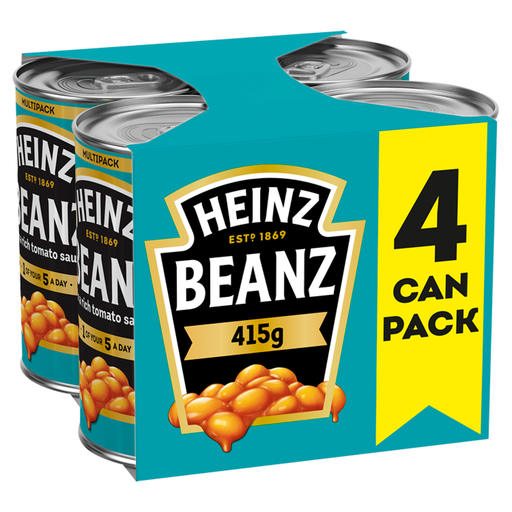
Heinz has standard 415g baked-bean tins in multipacks and a separate No Added Sugar variant.
Tesco lists own-label standard and Reduced Sugar & Salt baked beans in four-tin formats.
The Sainsbury’s own-label standard multipack contains four 400g tins.
Waitrose lists Essential standard and Reduced Salt & Sugar baked beans as individual 420g tins.
The checked M&S own-label baked beans come as a 400g single tin.
These branded four- and six-tin packs cover standard baked-bean recipes and one reduced-sugar-and-salt variant for repeat breakfasts. Compare each pack’s tin count, ingredients and label instructions for your household.
 No image available
Four 415g tins offer a standard Heinz recipe for repeated breakfasts. Follow the product’s hob or microwave directions and its instructions for storing opened contents.
 No image available
This four-tin standard recipe is another pack format for regular breakfasts. Its product information gives ingredients, per-100g nutrition, heating directions and guidance for opened contents.
 No image available
Choose this four-tin variant if you specifically want to compare a reduced-sugar-and-salt recipe with standard beans. The ingredient information includes steviol glycosides; check the exact label if sweeteners matter to you. Follow its heating and post-opening storage instructions.
 No image available
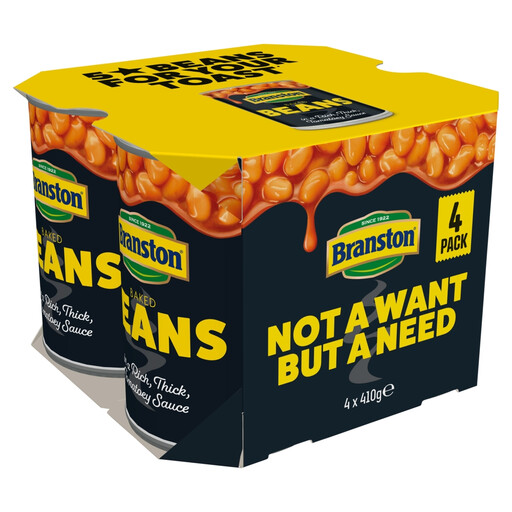
Six 410g tins suit a household planning more repeated servings, provided it can use the cupboard stock. Check the pack’s heating directions before preparation and follow its instructions for refrigerating opened contents.
Check both the number of tins and their individual weights, then consider how often your household serves beans. A larger pack is useful only if its quantity fits the breakfasts you plan to make.
No. The checked Heinz No Added Sugar product lists naturally occurring sugars. Read its nutrition panel and ingredients list if you are comparing it with another recipe.
Follow the instructions for the exact product. The checked Sainsbury’s and Branston labels say to transfer leftovers to a non-metallic container, refrigerate them and use them within two days.
No. GOV.UK explains that best-before dates concern quality, whereas use-by dates concern safety. Store unopened tins as instructed and check their condition and quality before using them.
Read the ingredient and allergen information on the exact pack before buying or serving it. Recipes can change, so an older online description or a different product in the same range is not a substitute for that label.