Students planning several lunches
A four-tin pack lets you keep unopened tins for separate meals, provided you have room to store and carry the pack.


A four-tin pack makes sense if you have room to store it and expect to use several tins. Choose the recipe by checking the sugar and salt figures on the can, and consider whether you can refrigerate and use any leftovers within that product’s stated time limit.
A four-tin pack lets you keep unopened tins for separate meals, provided you have room to store and carry the pack.
Standard and reduced-sugar-and-salt multipacks give you different recipes to consider. Compare the sugar and salt figures on the exact cans rather than relying on the range name.
Unopened tins can be kept according to their storage instructions. If you will eat only part of a tin, check how you will refrigerate the rest: Tesco’s cited four-pack instructs shoppers to transfer leftovers to a non-metallic container and use them within two days.
Start with how many tins you will use, then check the recipe and what you will do with an opened tin between lectures.
| Priority | What to check | Your needs |
|---|---|---|
| Pack and portions | Check the number of tins, grams per tin and the serving information on the pack. Consider where you will keep and carry the unopened tins. | I want enough tins for several lunches without taking up more cupboard space than I can spare. |
| Opened-tin storage | Read the exact can’s instructions for transferring, covering and refrigerating unused beans, and note its stated time limit. | If I eat only part of a tin at lunch, I need somewhere suitable to keep the rest and a plan to use it in time. |
| Sugar and salt | Compare both figures per 100g on the nutrition panels, then consider the portion you expect to eat. NHS guidance explains that food labels can help you compare products. | A standard or reduced-sugar-and-salt recipe may fit what I am looking for, but I want to compare the actual labels before choosing. |
| Ingredients and allergens | Check the current can’s ingredients, allergen information and dietary labelling for the specific recipe. | For a vegan, vegetarian or allergy-related requirement, I need to check this tin rather than assume every product from a brand is alike. |
A multipack does not change what you need to do once an individual tin is open. The cited Tesco and Branston four-packs both instruct shoppers to refrigerate unused contents and use them within two days.
If one tin is more than you need for lunch, plan another portion and follow the storage directions on that can.
“No added sugar” and “reduced salt” describe particular recipe features; they do not tell you every nutrition value for the portion you will eat.
Compare the sugar and salt entries per 100g on the products you are choosing between, as well as any serving information.
Dietary and allergen information belongs to the exact recipe. For example, the cited M&S baked beans page warns that its product is unsuitable for people with a milk or egg allergy.
Check the current label on the can you intend to eat, particularly when an ingredient or allergen matters to you.
These examples show why pack format and recipe need checking separately; a brand name alone does not identify the tin you need.
Tesco lists a standard 4 x 420g pack and a separate reduced-sugar-and-salt recipe.
ASDA lists its Reduced Salt & No Added Sugar baked beans as a 4 x 410g pack.
Sainsbury’s lists both standard and reduced-sugar-and-salt own-label baked beans in 4 x 400g packs.
The cited ASDA listing identifies a Heinz standard baked-bean pack of 4 x 415g.
The cited ASDA listing identifies Branston baked beans in a 4 x 410g pack.
The cited M&S baked beans are an individual 400g tin, rather than a multipack example.
These four- and six-tin baked-bean packs are options for keeping several lecture-lunch portions in the cupboard. Check the individual recipe and opened-tin instructions before choosing.
 No image available
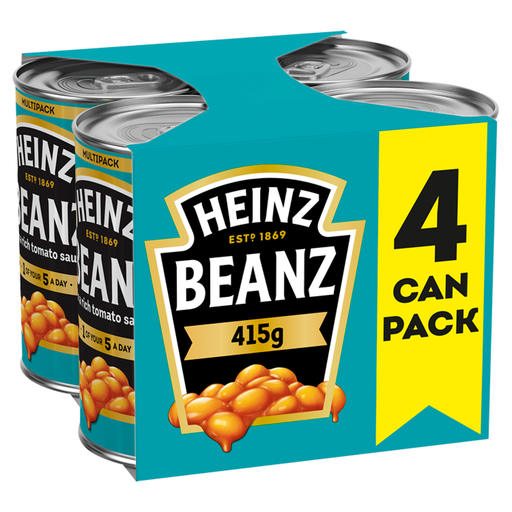
Four 415g tins give you separate tins for several lunches. The cited listing for this Heinz pack labels it suitable for vegetarians and vegans; check the current can if either requirement matters to you. Refrigerate opened leftovers in a suitable container and use them within two days.
 No image available
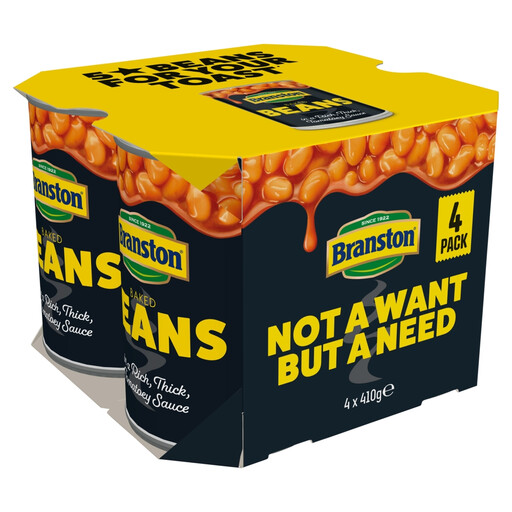
This four-tin pack suits a plan to use individual 410g tins across separate lunches. The cited listing labels this Branston product suitable for vegetarians and gluten free. Its opened-tin instructions say to cover and refrigerate unused contents and use them within two days.
 No image available
This four-tin recipe gives you an alternative to standard Branston beans when comparing sugar and salt labels. Check its current ingredients if you avoid the listed steviol glycosides sweetener. Refrigerate opened leftovers in a suitable container and use them within two days.
 No image available
Six 410g tins suit a plan for more separate lunches if you have room for the larger pack. After opening a tin, refrigerate unused beans in a covered container and use them within two days.
It can be if you have cupboard space and expect to use several tins. Check the serving information on the pack and plan for any beans left after opening a tin, particularly if you cannot refrigerate them between lectures.
Compare the sugar and salt figures per 100g on the exact products, then consider how much of a tin you will eat. NHS guidance explains that nutrition labels help shoppers compare foods; a recipe name alone does not give you the full comparison.
Follow that product’s storage instructions. The cited Tesco four-pack says to transfer unused beans to a non-metallic container, cover, refrigerate and consume within two days; the cited M&S product also requires a non-metallic container and refrigeration but states three days.
Do not assume suitability across recipes. The cited Heinz four-pack is labelled suitable for vegans, while the cited M&S product warns that it is unsuitable for people with a milk or egg allergy. Check the current label on the exact can before relying on either statement.