Households making regular full English breakfasts
Four-packs of standard-sized tins let you open one tin for a breakfast for two and keep the remaining tins unopened for another day. Adjust the amount to the other food on each plate.


For repeated full English breakfasts, a multipack of roughly 400–420g tins is a useful starting point: listings that use a half-can serving suggest one tin for two plates, depending on appetite and the rest of the meal. Choose the pack size for the number of breakfasts you plan to make, then compare the exact recipe, ingredients and allergy information on the cans rather than assuming standard and reduced-sugar versions are interchangeable.
Four-packs of standard-sized tins let you open one tin for a breakfast for two and keep the remaining tins unopened for another day. Adjust the amount to the other food on each plate.
Compare the ingredients on the exact variant. A no-added-sugar recipe can use a sweetener rather than matching the standard recipe ingredient for ingredient.
Read the label on the can you buy, particularly when changing recipes. M&S marks its Only 7 Ingredients multipack as unsuitable for people with milk or egg allergy despite its vegan and vegetarian descriptions.
Start with how many breakfasts the pack needs to cover, then check the recipe and label details that matter to your household.
| Priority | What to check | Your needs |
|---|---|---|
| Portions and pack size | Check the number of tins, each tin’s net weight and the serving size used on the label. Four-packs in the retailer examples contain 400g, 415g or 420g tins. | I’m serving beans on two plates or planning several breakfasts, so I need enough tins without opening more than I will use. |
| Recipe | Compare the standard and reduced-sugar variants by their ingredients and nutrition panels. Check whether a sweetener is listed. | A no-added-sugar label matters to me, but I do not want to assume it means the same formulation as my usual beans. |
| Ingredients and allergies | Read the ingredients and allergy statement on the exact can. M&S marks its Only 7 Ingredients multipack as unsuitable for people with milk or egg allergy. | Someone eating breakfast with me needs the current can label checked; a vegan or vegetarian description alone will not answer an allergy question. |
| Leftovers | Check the tin’s instructions for storing beans after opening and the stated period for using them. | When one tin is more than we will serve, I need a plan for the portion left over. |
Heinz No Added Sugar and standard Heinz Beanz are different formulations; the no-added-sugar version lists a sweetener.
Check the ingredients on the exact four-pack before switching from your usual recipe.
M&S describes its Only 7 Ingredients beans as vegan and vegetarian but marks them unsuitable for people with milk or egg allergy.
If an allergy matters, use the ingredients and allergy statement on the can in hand rather than a dietary description alone.
A half-can breakfast serving leaves beans to store if you open a full-sized tin.
Transfer leftovers to a covered non-metallic container, refrigerate them and follow the use-by-opening instructions on that product’s label.
These examples show how pack formats and recipes differ; a brand reference is not a substitute for checking the exact product label.
Standard and No Added Sugar Beanz are listed in 4 x 415g packs.
Tesco’s own-label baked beans are listed in a 4 x 420g tomato-sauce multipack.
Sainsbury's lists an own-label 4 x 400g multipack.
M&S lists Only 7 Ingredients baked beans in a four-tin pack.
Waitrose essential baked beans are listed in a 420g single tin.
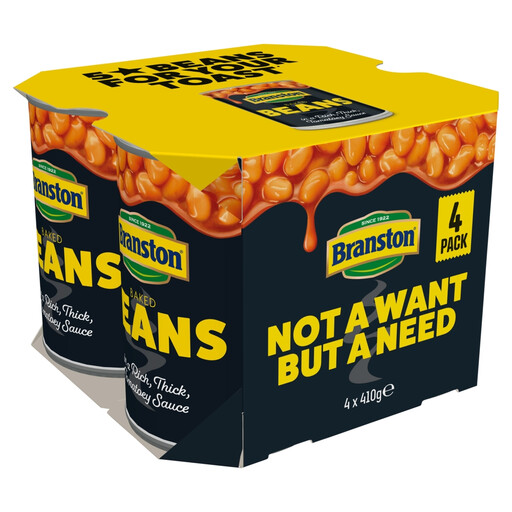
These Branston four- and six-tin packs are options for keeping baked beans on hand for repeated breakfasts. Compare the standard and reduced-sugar-and-salt variants by their exact labels.
 No image available
Four 410g tins suit breakfasts spread across several days. This is the reduced-sugar-and-salt variant, not a no-added-sugar product; check the can’s ingredients if sugar or sweeteners affect your choice.
 No image available
Four 410g tins provide a standard-recipe multipack for repeated breakfasts. Check the can’s serving and storage instructions when deciding how much to open.
 No image available
Six 410g tins give a household more unopened tins for later breakfasts than a four-tin pack. Check the can’s ingredients and directions for any beans left after serving.
Where the label uses half a standard-sized tin as one serving, four tins provide eight labelled portions: a starting estimate of four breakfasts for two people. The amount you serve may differ with appetite and the rest of the meal.
No. Heinz No Added Sugar Beanz uses a different formulation from standard Heinz Beanz, including a sweetener. Compare the ingredients and nutrition panels on the exact packs rather than treating the names as the only difference.
No. M&S marks its Only 7 Ingredients beans as unsuitable for people with milk or egg allergy despite describing them as vegan and vegetarian. Check the allergy statement and ingredients on the exact can.
Transfer leftovers to a covered non-metallic container and refrigerate them. Follow the storage period printed on the product you opened, as instructions can differ between recipes.