Compare the amount you expect to eat as well as the nutrition per 100g: a standard, reduced sugar and salt, or no-added-sugar tin is not automatically the better choice for a weight-management meal. Check the exact recipe’s energy, sugars and salt, then consider the rest of the plate and whether the pack size suits how you use beans. Reduced claims describe a comparison with that maker’s standard recipe, not a ranking across brands.
Who is this comparison for?
The useful comparison depends on whether your main concern is the portion on your plate, the recipe in the tin or the amount you can use after opening it.
Shoppers planning meal portions
If beans are a regular part of breakfast, lunch or a quick dinner, compare the serving you will eat rather than judging the tin in isolation. NHS guidance on eating while trying to lose weight focuses on an approach that fits everyday life; the other foods in the meal matter too.
Shoppers comparing recipe claims
If you are choosing between standard, reduced sugar and salt, and no-added-sugar beans, read the figures on the exact product. A reduction against one brand’s regular recipe does not establish how it compares with another brand’s tin.
Shoppers comparing own-label tins and pack sizes
If you are weighing up a single tin and a multipack, consider how many servings you will use and how you will store leftovers. Compare nutrition on the same per-100g basis before letting a different can size decide the choice.
What should you compare on the tin?
Start with the quantity you expect to serve, then compare recipe claims against the nutrition panel. Pack size and storage instructions help you decide whether that choice works for your routine.
| Priority | What to check | Your needs |
|---|
| Serving and meal |
Compare energy per 100g and for the quantity you plan to eat. Account for accompaniments such as toast, spread, cheese or oil. |
I want to know what the beans contribute to my whole meal, rather than choosing by can size alone. |
| Recipe and nutrition |
Read sugars, salt and energy per 100g, then compare equivalent servings. For a reduced claim, identify the maker’s stated standard recipe used as the comparison. |
When sugar or salt matters to me, I want the actual figures for this tin. Sainsbury’s, Waitrose Essential and Branston each describe their reduced recipe relative to their own standard beans, according to their retailer listings. |
| Traffic-light labelling |
Use any traffic-light colours alongside the nutrition figures and serving information; a recipe name alone does not show all of these values. |
I check the traffic-light label when comparing foods. In the Food Standards Agency and Ipsos Northern Ireland’s 2024 survey, 49% of 611 Northern Ireland adults interviewed actively used the system when shopping for food; the survey did not measure baked-bean choices. |
| Pack and leftovers |
Check the can size, the number of cans and the opened-can storage instructions. Plan around the amount you can use within the stated time. |
A multipack may fit meals I have planned, while a smaller tin may leave less to store after opening. |
| Ingredients and allergens |
Read the ingredient list when avoiding sweeteners, and check the current allergen declaration on the exact product. |
I need the recipe to fit my ingredient requirements, not just its nutrition figures. Ocado’s listing for M&S No Added Sugar Baked Beans warns that the product may contain milk and egg. |
What can make a comparison misleading?
-
Assuming no added sugar means fewer calories
The phrase describes added sugar, not the product’s energy or salt. Waitrose & Partners lists Heinz No Added Sugar at 66 kcal per 100g, while Ocado lists M&S No Added Sugar at 75 kcal per 100g; these are figures for two specific recipes.
Compare energy, sugars and salt on the exact tins and for the amount you will serve. Include the rest of the meal when considering its total energy.
-
Treating every reduced claim as the same comparison
Retailer listings for Sainsbury’s, Waitrose Essential and Branston describe reductions against each maker’s own standard beans. Those claims do not, by themselves, order the three recipes by their final sugar or salt content.
Use the claim to identify a recipe you want to examine, then compare the nutrition panels per 100g and for comparable servings.
-
Overlooking allergens and opened-can instructions
Ocado’s M&S No Added Sugar listing says the recipe may contain milk and egg because those allergens are present in the production environment. Storage directions also matter when a tin lasts beyond one meal.
Check the current can if an allergen is relevant, and follow that product’s directions for transferring, refrigerating and using leftovers.
Which brand recipes are useful references?
These are references for comparing particular recipes and pack formats, not judgements about every product made by each brand.
Heinz
The Heinz No Added Sugar 415g recipe listed by Waitrose & Partners is a reference for shoppers comparing no-added-sugar beans.
- The listing gives 66 kcal, 1.9g sugars and 0.4g salt per 100g.
- These figures describe that recipe, not every Heinz tin or its position against every competing product.
Tesco
Tesco Groceries lists standard and Reduced Sugar & Salt own-label baked beans in single-tin and multipack formats.
- The listed formats include 220g and 420g tins and 4 x 420g packs.
- Compare the current label of the particular recipe before drawing a nutrition conclusion from its name or pack size.
Sainsbury’s
Sainsbury’s Reduced Sugar & Salt Baked Beans provide an own-label example of a reduction stated against the retailer’s standard recipe.
- Sainsbury’s states 30% less sugar and 30% less salt than its standard beans; the listing gives 70 kcal, 2.8g sugars and 0.29g salt per 100g.
- The percentage reductions do not establish the product’s ranking against other brands.
M&S
M&S No Added Sugar Baked Beans, listed by Ocado, are another recipe to compare when avoiding added sugar.
- Ocado lists 75 kcal, 1.2g sugars and 0.43g salt per 100g.
- The listing says the product may contain milk and egg because those allergens are present in the production environment.
Waitrose Essential
Waitrose Essential Reduced Salt & Sugar Baked Beans are an own-label reduced-recipe reference.
- Waitrose & Partners states 30% less sugar and 30% less salt than its regular Essential beans, and lists 77 kcal, 2.0g sugars and 0.30g salt per 100g.
- The reductions apply to the named regular Essential recipe, not to baked beans generally.
Branston
Branston Reduced Sugar & Salt Baked Beans offer a branded reduced-recipe reference alongside its standard beans.
- Sainsbury’s lists the 410g reduced recipe at 85 kcal, 2.8g sugars and 0.39g salt per 100g, with 30% less sugar and salt than standard Branston beans.
- That stated reduction is a comparison within Branston’s recipes, not a cross-brand nutrition ranking.
Baked-bean options on Joybuy
These tins cover a Branston reduced-sugar-and-salt recipe and standard Branston and Heinz recipes in different pack sizes. Compare their current labels and the portions you plan to use; this selection does not represent every recipe discussed above.
 No image available
Branston Reduced Sugar & Salt Baked Beans 4 x 410g
Four 410g cans suit meals planned around a reduced-sugar-and-salt recipe. Branston’s stated reduction is against its own standard beans; compare the current per-100g label and your intended serving with any other tin.
View on Joybuy
 No image available
Branston Baked Beans 4 x 410g
This four-can pack is a standard-recipe option for planned meals. Use the exact tin’s per-100g and serving figures when comparing it with the reduced Branston recipe, and follow its instructions for opened contents.
View on Joybuy
 No image available
Branston Beans in Tomato Sauce 6 x 410g
Six 410g cans offer a standard-recipe format for repeated use. Decide whether that quantity fits your planned meals, then compare the nutrition for the portion you expect to serve rather than treating a larger pack as a reason to serve more.
View on Joybuy
 No image available
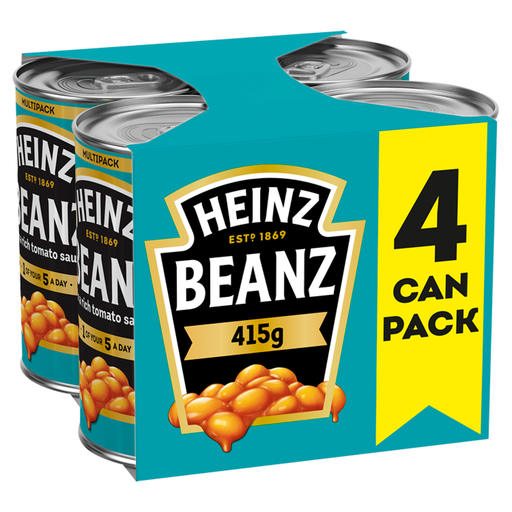
HEINZ Baked Beans in Tomato Sauce 4 x 415g
This four-can pack contains the standard tomato-sauce recipe. If comparing it with Heinz No Added Sugar or another variant, check the nutrition on each exact tin and base your meal calculation on the amount you will eat.
View on Joybuy
 No image available
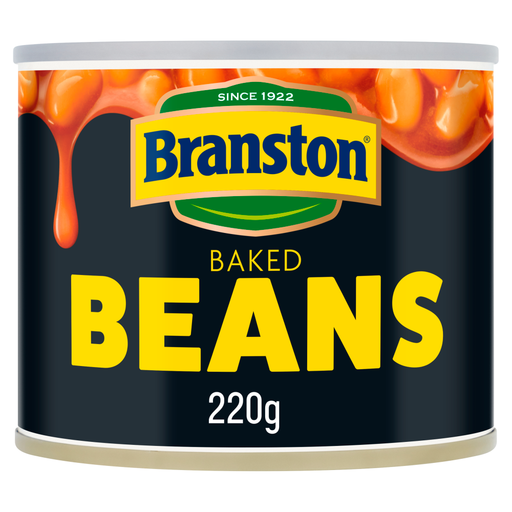
Branston Baked Beans in Tomato Sauce 220g
The single 220g can is an alternative when a smaller stated pack fits your planned portion. Compare its per-100g nutrition with larger tins, and check the current can for serving information and leftover-storage directions.
View on Joybuy
Questions about portions and recipes
Do baked beans count towards 5 A Day?
Yes. The NHS says three heaped tablespoons of baked beans count as one portion, but beans and pulses count as a maximum of one 5 A Day portion however much you eat. That measure does not tell you the energy in your serving or the rest of your meal.
Are no-added-sugar beans always lower in calories?
No. “No added sugar” does not rank tins by energy or salt. Waitrose & Partners lists Heinz No Added Sugar at 66 kcal per 100g, while Ocado lists M&S No Added Sugar at 75 kcal per 100g; compare the current label and the amount you plan to eat.
Should I choose reduced sugar and salt or no added sugar?
Choose by the distinction that matters to you, then check the figures on the exact tin. A reduced-sugar-and-salt claim compares a recipe with its maker’s stated standard version; a no-added-sugar claim describes added sugar, but does not settle its total sugars, energy or salt relative to another product.
How should I store beans left in an opened tin?
Follow the instructions on that tin. Waitrose & Partners’ Heinz No Added Sugar listing directs shoppers to refrigerate the opened product and use it within two days; check whether your chosen product also directs you to transfer leftovers to another container.
What should I check if milk or egg is an allergen for me?
Check the current allergen declaration on the exact can before eating it. Ocado’s M&S No Added Sugar listing says the product may contain milk and egg because those allergens are present in the production environment, despite the recipe being prepared as vegan.


