Parents packing regular primary-school lunches
For planning where beans fit alongside other foods. Bedfordshire Community Health Services advises choosing foods from different food groups for a balanced packed lunch.


Choose baked beans as one part of a school packed lunch, alongside a starchy food and fruit or vegetables, rather than as the whole meal. A smaller can can simplify portions for one child; a larger can makes more sense when you can plan for the leftovers. Compare sugars and salt for the amount the child will eat, and check whether their school expects lunch to arrive ready to eat.
For planning where beans fit alongside other foods. Bedfordshire Community Health Services advises choosing foods from different food groups for a balanced packed lunch.
For choosing between standard and reduced recipes by reading the nutrition panel per 100g and considering the portion that will be eaten.
For deciding whether a smaller can suits lunch better than a family can that will leave beans to store and use later.
Start with the lunch you can actually pack and serve, then compare the can size and recipe for that plan.
| Priority | What to check | Your needs |
|---|---|---|
| The whole lunch | Plan foods from different groups alongside the beans, including a starchy food and fruit or vegetables. Bedfordshire Community Health Services advises variety across food groups in a packed lunch. | I want beans to be one part of lunch, not the only food in the lunchbox. |
| Sugars and salt | Compare nutrition values per 100g, then consider how much will be eaten. Read the ingredients as well as wording such as “reduced sugar” or “no added sugar”; some recipes include steviol glycosides. | If I buy beans regularly, I want to compare the actual recipes rather than assume every reduced-sugar label means the same thing. |
| Can size and leftovers | Check the serving guidance against the child’s planned portion. For a larger can, follow that product’s directions for transferring, refrigerating and using leftovers. | A smaller can may suit a lunch for one child; I can choose a family can when I have a plan for the remainder. |
| Serving at school | Ask whether the school or club permits the packed format and whether lunch must be ready to eat. Check its allergy-related rules and the current pack’s allergen statement. | I need a lunch my child can eat as packed, without relying on staff to reheat it. |
A 410g ASDA reduced-recipe can is labelled as two servings, while Sainsbury’s 215g and Waitrose 220g reduced-recipe cans are labelled as one serving.
Check how much the child will eat. If you open a larger can, plan another use and follow its leftover-storage instructions.
Reduced and no-added-sugar recipes can still contain sugars, and some list steviol glycosides among their ingredients.
Read the ingredients and compare sugars and salt per 100g as well as for the planned portion.
Tower Hamlets Council says its holiday childcare team does not reheat packed lunches and asks for food to be ready to eat. Arrangements at a child’s own setting may differ.
Check the school or club’s policy before deciding how to pack beans.
M&S describes its No Added Sugar Baked Beans as vegan and vegetarian, but its product information also says they are unsuitable for people with milk or egg allergies.
For a child with an allergy, read the current allergen statement for the exact product.
These examples illustrate recipe and pack-label differences; they do not imply that the products appear in the Joybuy selection below.
Heinz offers standard Beanz and a No Added Sugar recipe.
Tesco’s baked-bean range includes different brands, recipes and pack formats.
Its range includes standard beans and a 215g reduced-sugar-and-salt recipe labelled as one serving.
ASDA offers standard beans and a reduced-salt, no-added-sugar 410g option.
M&S offers standard and no-added-sugar baked-bean recipes.
The Essential range includes standard beans and a 220g reduced-salt-and-sugar can labelled as one serving.
These options cover a smaller standard can and larger standard or reduced-recipe multipacks. Choose a can size around the lunch portion and your plans for any leftovers; the pack format alone does not establish a serving for your child.
 No image available
A reduced-sugar-and-salt multipack for planned portions across lunches or other meals. The recipe includes sugar and steviol glycosides; after opening a can, transfer unused beans to a suitable container, refrigerate and use within 2 days. Check the serving guidance for the child’s portion.
 No image available
The 220g can is a smaller format to consider for one lunch, though its serving guidance should still be checked against what the child will eat. This is a standard recipe, not a reduced-sugar-and-salt one; refrigerate unused beans in a separate container and use within 2 days.
 No image available
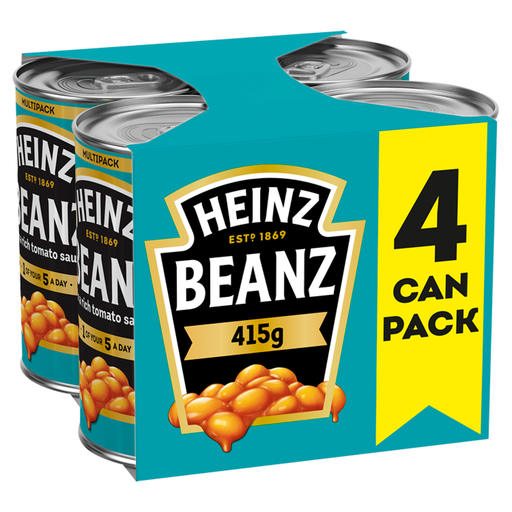
Four larger cans suit a plan that uses beans for more than an individual packed-lunch portion. This is the standard tomato-sauce recipe; check the child’s portion against the pack guidance. Refrigerate opened contents in a non-metallic container and use within 2 days.
 No image available
Six 410g cans provide separate cans for planned household meals and lunch portions. This is a standard recipe; check serving guidance before using a can for one child. Refrigerate unused contents after opening and use within 2 days.
 No image available
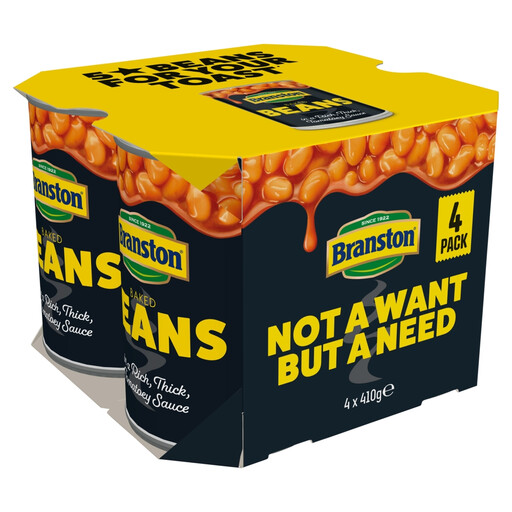
This four-can standard-recipe pack suits lunches planned alongside other uses for a 410g can. Check the child’s serving guidance rather than treating one can as one lunch portion. Transfer opened contents to a container, refrigerate and use within 2 days.
Plan other foods alongside them. Bedfordshire Community Health Services advises choosing foods from different food groups for a balanced packed lunch, so consider a starchy food and fruit or vegetables as well as the beans.
Choose by comparing the labels and the portion the child will eat, rather than treating either recipe type as automatically suitable. For example, Sainsbury’s lists 2.4g sugars and 0.33g salt per 100g for its reduced 215g recipe, compared with 4.5g sugars and 0.58g salt per 100g for its standard 400g beans. Check that the child will eat the chosen recipe.
Do not rely on reheating without checking the setting’s arrangements. Tower Hamlets Council says its holiday childcare team does not reheat packed lunches and asks for food ready to eat; ask the child’s school or club what it permits.
Follow the storage directions on the exact product. For example, ASDA directs shoppers to transfer leftover beans from its 410g reduced-recipe can to a suitable non-metallic container, refrigerate them and use them within 4 days; other products can give different time limits.
No. Read the current allergen statement for the exact can. M&S labels its No Added Sugar Baked Beans vegan and vegetarian but also states that they are unsuitable for people with milk or egg allergies.