Families sharing a tin at mealtimes
A multipack of standard-size tins can suit households that regularly serve beans with breakfast, toast, jacket potatoes or simple dinners and use an opened tin within its stated storage period.


Choose a multipack of standard-size tins if baked beans regularly form part of shared meals and your household can use each opened tin promptly. If salt, sugars or sweeteners matter to your choice, compare the nutrition panel and ingredients of the exact recipes. Smaller tins may be more practical when a standard-size tin would leave unused beans.
A multipack of standard-size tins can suit households that regularly serve beans with breakfast, toast, jacket potatoes or simple dinners and use an opened tin within its stated storage period.
If beans feature often in the household shop, compare salt and sugars on the same serving basis. Check the ingredients too: some no-added-sugar recipes contain sweetener.
One or two people may find smaller tins more convenient when they would not use the remainder of a standard-size tin within its on-pack refrigerated storage period.
Start with how many tins and portions your meals call for, then compare the exact recipes and opened-tin instructions.
| Priority | What to check | Your needs |
|---|---|---|
| Pack quantity | Check the number of tins and weight per tin. The Tesco standard four-pack contains 4 x 420g; the ASDA reduced-salt, no-added-sugar four-pack contains 4 x 410g. | For shared meals, I want enough separate tins for the week without opening more than we can use. |
| Recipe and nutrition | Compare salt and sugars using the same serving size, then read the ingredients for sweeteners. ASDA lists 0.70g salt and 3.1g sugars per half-can for its reduced-salt, no-added-sugar 4 x 410g product. | The recipe matters to my household, so I want to check the actual serving values rather than rely on wording on the front of the pack. |
| Opened-tin storage | Read the exact product instructions for transferring, refrigerating and using leftovers. Tesco specifies use within 2 days for its 4 x 420g beans; ASDA specifies within 4 days for its reduced-salt, no-added-sugar 4 x 410g beans. | If we rarely finish a tin at one meal, I need a size whose leftovers fit our meal plans. |
| Allergens and dietary suitability | Check the current ingredients, allergen statement and any dietary declarations on the exact pack. Marks & Spencer identifies its 400g baked beans as unsuitable for people with a milk or egg allergy. | Before adding several tins to the cupboard, I want to confirm that this particular recipe meets our household’s requirements. |
A no-added-sugar recipe can still contain naturally occurring sugars and a sweetener. ASDA lists steviol glycosides in its reduced-salt, no-added-sugar beans; its half-can serving contains 3.1g sugars.
Read both the nutrition panel and ingredients on the specific pack, and compare salt and sugars on the same serving basis.
Opened-tin instructions differ: the Tesco, Marks & Spencer and ASDA products described here specify use within 2, 3 and 4 days respectively after refrigeration.
Choose a tin size that fits the portions you serve, and follow that product’s instructions for transferring and storing anything left over.
Unused beans may need to be discarded if the household cannot use them within the stated period.
Suitability varies by product. Marks & Spencer states that its 400g baked beans are not suitable for people with a milk or egg allergy.
Check the ingredients and allergen statement on the current physical pack, even if you have bought beans from the same brand before.
These examples describe particular products and formats, not every recipe sold under each name.
Standard baked beans and a no-added-sugar variant are listed in 4 x 415g packs.
Tesco lists its own-label baked beans in a 4 x 420g standard-recipe pack.
ASDA lists its own-label reduced-salt, no-added-sugar baked beans in a 4 x 410g pack.
Marks & Spencer lists a 400g tin of baked beans with product-specific dietary and storage information.
Waitrose lists Heinz baked beans in both 4 x 415g and 6 x 200g formats.
Sainsbury's lists Branston Reduced Sugar & Salt Baked Beans in a 410g tin.
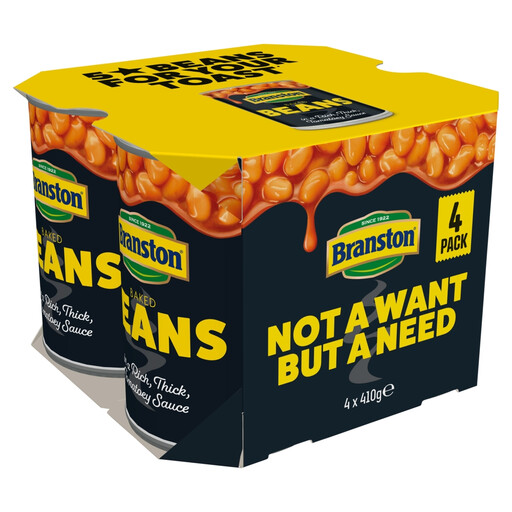
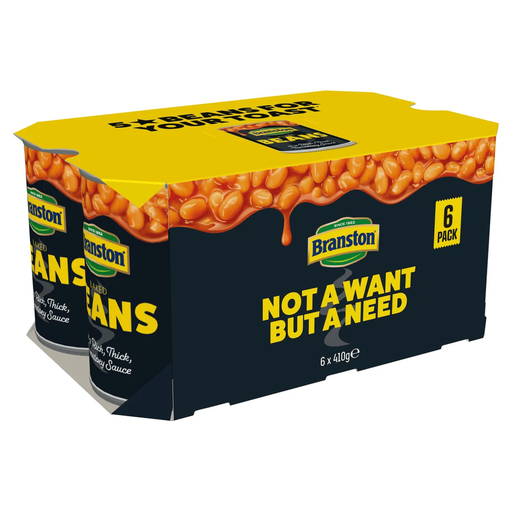
These Branston standard-recipe multipacks offer four- and six-tin formats for planning shared meals during a weekly shop. Check each current pack label for the recipe and storage instructions that matter to your household.
 No image available
Four separate 410g tins suit a shop planned around several shared meals. The product information calls for refrigerated leftovers to be used within two days; check the current pack’s salt figures before comparing serving-level nutrition.
 No image available
Six separate 410g tins provide a larger cupboard quantity for households planning repeated bean-based meals. The product information says to refrigerate opened leftovers and use them within two days; consult the current nutrition panel to compare salt on your usual serving basis.
No. ASDA lists 3.9g sugars per half-can for Heinz No Added Sugar Baked Beans 4 x 415g and states that the product contains naturally occurring sugars. Read its nutrition panel and ingredients; this recipe also contains steviol glycosides.
Compare the amount for the same serving size on each exact product. ASDA lists 1.3g salt per half-can for standard Heinz Baked Beans 4 x 415g and 0.70g per half-can for its own-label reduced-salt, no-added-sugar 4 x 410g beans. Check the current packs if these values affect your choice.
Follow the storage instructions on that tin. Tesco says to transfer unused contents to a non-metallic container, cover and refrigerate them, then use them within 2 days for its 4 x 420g product. Marks & Spencer specifies 3 days for its 400g beans, while ASDA specifies 4 days for its reduced-salt, no-added-sugar 4 x 410g product.
Read the current ingredients and allergen statement for the exact baked beans you intend to buy; do not assume another recipe has the same suitability. For example, Marks & Spencer states that its 400g baked beans are not suitable for people with a milk or egg allergy.