Older adults monitoring salt intake
Compare salt for the portion normally eaten, rather than relying on a reduced-salt claim alone. Any individual advice about salt intake still matters.


If salt intake matters, compare baked beans by the amount in the portion the person will eat; a reduced-salt multipack is worth considering, but a reduction claim is not a personal salt limit. An ordinary multipack may suit someone who enjoys that recipe and can use the portions, while poor appetite or a prescribed modified-texture diet calls for the person’s existing dietary or swallowing guidance to take priority over bulk value.
Compare salt for the portion normally eaten, rather than relying on a reduced-salt claim alone. Any individual advice about salt intake still matters.
For someone eating little or losing weight unintentionally, the whole meal matters more than a lower-sugar label in isolation. Frimley Health and Care NHS Foundation Trust’s food-first advice emphasises overall energy and protein intake for people with a poor appetite.
Consider whether a large tin will be used within the period stated on its label after opening. If the person has a prescribed modified-texture diet, follow their swallowing plan when deciding what and how to serve.
Start with the likely serving and any dietary or swallowing guidance, then decide whether the tin size works for everyday use.
| Priority | What to check | Your needs |
|---|---|---|
| Salt per serving | Compare salt for the same serving size, not just the reduction claimed on the front. Sainsbury’s lists 1.16g salt per half-can for its standard 4x400g pack; GOV.UK advises adults to have no more than 6g salt a day. | If I need to monitor salt, I want to know how much is in the portion served alongside the rest of the day’s food. |
| Fibre and protein | Check the nutrition panel per 100g or per serving, using the same basis across packs. For its 4x410g pack, Sainsbury’s lists Branston beans at 12.1g fibre and 9.4g protein per half-can. | I want the bean portion to contribute to the meal, without choosing between packs on a single nutrient figure. |
| Poor appetite | Consider the energy and protein in the whole meal and follow any individual food-first advice. A reduced-sugar label alone does not answer that question. | When someone is struggling to eat enough, I need to consider what they will actually eat, not just which tin has a reduction claim. |
| Tin size and leftovers | Check the number and size of tins, the intended portion and the label’s instructions for opened beans. | A larger multipack works for me only if the tins can be used and any leftovers managed as directed. |
| Prescribed texture | Check the person’s written swallowing plan before serving ordinary tinned beans. Follow any specified preparation and texture requirements. | If a modified-texture diet has been prescribed, I cannot assume an ordinary tin is suitable as served. |
A reduction describes a comparison with another recipe; it does not account for the portion eaten or salt from other meals.
Read the salt figure for the intended serving and follow any individual dietary advice.
For someone eating little or losing weight unintentionally, the wider meal’s energy and protein intake may be the more immediate consideration.
Use the person’s healthcare or dietetic advice and assess the whole meal rather than the bean label alone.
A tin can be larger than the portion someone wants at one sitting, leaving opened beans to manage.
Choose a tin size around realistic portions and follow its instructions for storing and using leftovers.
South Tees Hospitals NHS Foundation Trust notes that some people with swallowing problems are advised to have modified-texture food or thickened fluids. An ordinary tin does not override an individual prescription.
Follow the person’s speech and language therapist’s written texture and preparation guidance.
Heinz has standard and No Added Sugar baked-bean multipacks, including 4x415g formats.
Sainsbury’s has standard and reduced sugar and salt baked beans in 4x400g packs.
Tesco’s baked-bean range includes branded multipacks.
Branston offers baked beans in a 4x410g multipack.
Waitrose lists branded baked-bean multipacks alongside its wider tinned-bean range.
M&S provides nutrition information for its standard 400g baked-bean tin, useful as a label-comparison reference.
These four- and six-tin multipacks are options for cupboard use. Check each recipe’s label against the intended portion and any individual dietary or swallowing guidance.
 No image available
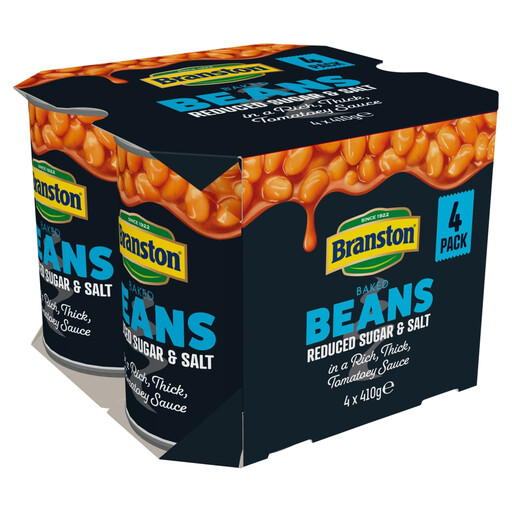
This four-tin pack offers a reduced sugar and salt recipe for comparing with ordinary multipacks. Check salt for the portion served; a reduction claim does not establish suitability for an individual salt limit.
 No image available
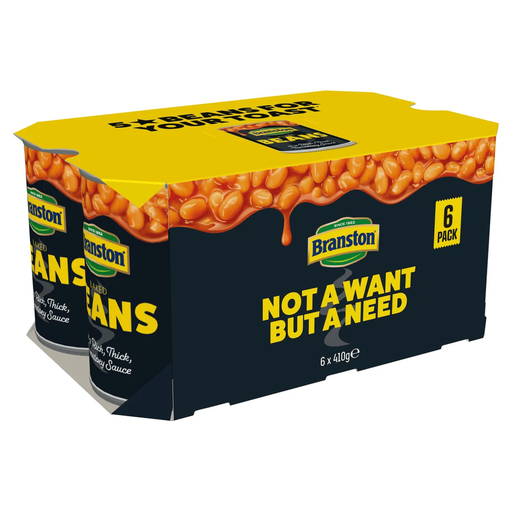
Six 410g tins suit a cupboard plan that will use several full-size cans. Consider the likely portion and the label’s opened-tin instructions before choosing the larger pack.
 No image available
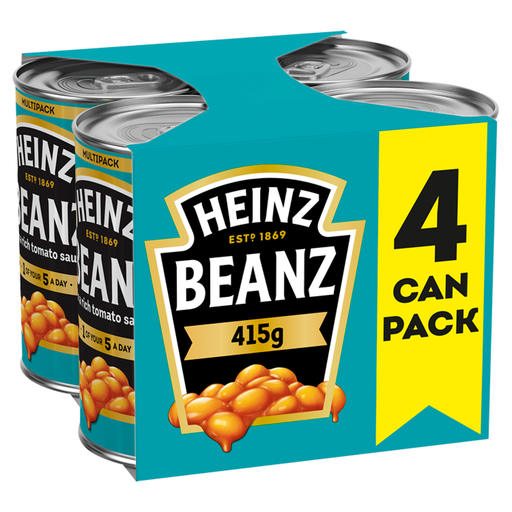
This four-tin standard Heinz pack fits a preference for that recipe. Use its own nutrition label to compare the intended serving with reduced-salt or no-added-sugar alternatives.
 No image available
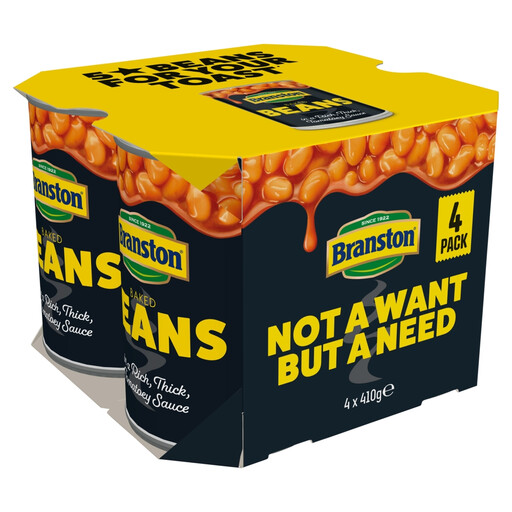
This ordinary four-tin Branston pack is an option when its recipe and tin size suit the household. For this 4x410g product, Sainsbury’s lists 12.1g fibre and 9.4g protein per half-can; check the pack’s salt figure on the same serving basis.
Compare the salt in the portion the person is likely to eat, using the same serving size for each product. GOV.UK advises adults to have no more than 6g salt a day, so consider the beans alongside other food and any individual advice.
No. It describes the recipe, not whether the whole meal meets someone’s needs. For a person with a poor appetite, Frimley Health and Care NHS Foundation Trust’s food-first advice emphasises overall energy and protein intake.
Follow the person’s assessed swallowing plan before serving them. South Tees Hospitals NHS Foundation Trust notes that some people with swallowing problems are advised to have modified-texture food or thickened fluids; do not assume ordinary beans are suitable as served.
Follow that product’s label for storing and using the opened beans. If leftovers are unlikely to be used as directed, a smaller tin or serving format may be more practical.
Do not judge the meal by the beans alone. Consider what the person can eat across the whole meal and follow any individual healthcare or dietetic advice about energy and protein intake.