Households stocking the cupboard
If beans feature in several breakfasts, quick meals or side dishes, compare the number of tins and their combined net weight. A four- or six-tin pack is useful only if its quantity suits the meals you have in mind.


For a large family shop, choose a tin count and total weight that match how often your household uses beans. If salt, sugars or ingredients matter to your choice, compare the label for the exact variant rather than assuming a reduced-salt-and-sugar or no-added-sugar recipe is the same as the standard one.
If beans feature in several breakfasts, quick meals or side dishes, compare the number of tins and their combined net weight. A four- or six-tin pack is useful only if its quantity suits the meals you have in mind.
Standard, reduced-salt-and-sugar and no-added-sugar recipes make different claims. Compare the salt and sugars figures on the exact pack, using the same per-100g basis before considering how much will be served.
If you usually buy Heinz or Branston, check the tin size as well as the number of tins. Their multipacks in the supplied listings include different weights per tin, so pack counts alone do not describe the quantity.
Start with the quantity your household will use, then check the recipe and label details for the specific pack.
| Priority | What to check | Your needs |
|---|---|---|
| Pack quantity | Check the tin count, weight per tin and total net weight. Compare four-tin and six-tin formats by the amount you expect to use. | I serve beans across several meals, so I want enough tins without buying more than we will use. |
| Salt and sugars | Read both figures per 100g on the exact variant. Check what a reduced-salt-and-sugar or no-added-sugar claim compares with. | Salt or sugars matter in our household, and I want to compare the recipe we would actually serve. |
| Ingredients and allergens | Check the ingredient list and allergen information on the exact pack. Confirm any stated dietary suitability for that product, not the brand as a whole. | Before putting several tins in the cupboard, I need to know whether this particular recipe fits our requirements. |
| Opened-tin storage | Read the pack’s instructions for transferring, covering and refrigerating leftovers, including its stated time limit. | If we use part of a tin at a time, I need a practical plan for the remainder. |
Heinz’s No Added Sugar Beanz and Waitrose Essential Reduced Salt & Sugar beans refer to different recipe changes and different standard products. One claim cannot stand in for the other product’s nutrition panel.
Compare salt and sugars per 100g, then read the ingredients on the exact can or multipack.
A standard bean recipe does not establish the ingredients or allergen information for a reduced-salt-and-sugar version, even within the same range.
Check the label for the particular variant you intend to serve, especially where an ingredient or allergen affects your household.
These examples describe specific baked-bean lines and formats; a claim about one variant does not apply to every product from its maker.
The range includes standard baked beans in a 420g tin and a reduced-salt-and-sugar variant.
The supplied Waitrose listing includes standard Branston baked beans in a 4 x 410g pack.
The supplied Waitrose listing includes standard Heinz beans in 4 x 415g and 6 x 415g packs. Heinz also has a No Added Sugar Beanz variant.
Tesco Groceries lists a reduced-sugar-and-salt baked-bean format in 4 x 420g cans.
These Joybuy options are four- and six-tin baked-bean packs for households stocking up. They include standard beans and one reduced-sugar-and-salt variant; compare their stated quantities and current pack labels for your needs.
 No image available
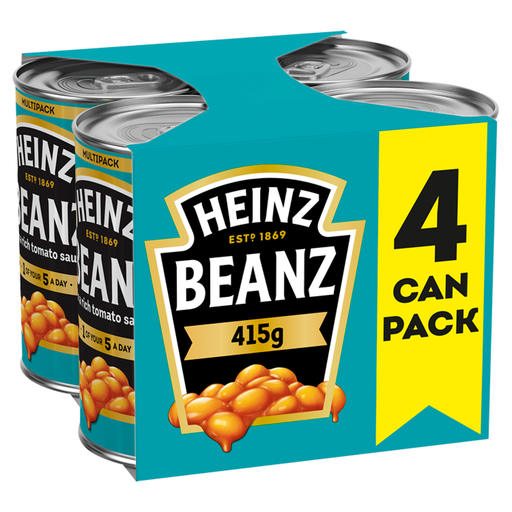
Four 415g tins give households a multipack for several meals, with 1,660g in total. Check the current pack’s ingredients and allergen information before serving.
 No image available
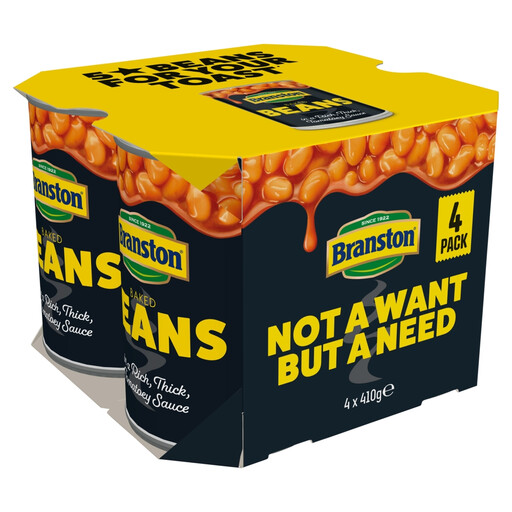
Four 410g tins provide 1,640g for a household using beans over multiple meals. Check the exact pack’s ingredients and dietary information if those details affect your choice.
 No image available
This four-tin, 1,640g pack is an option when a reduced-sugar-and-salt recipe matters alongside cupboard quantity. Read its current per-100g salt and sugars figures and ingredients before comparing it with regular Branston beans.
 No image available
Six 410g tins provide 2,460g for a household planning to use beans across several meals. Check the serving basis on the physical pack when reading its nutrition figures.
Check both the number of tins and the total net weight. Four 410g tins contain 1,640g, while six 410g tins contain 2,460g; choose a quantity that fits the meals your household expects to make.
No. Waitrose & Partners describes its Essential Reduced Salt & Sugar beans as having 30% less salt and sugar than its regular Essential beans. Heinz says its No Added Sugar Beanz has 25% less salt than standard Heinz Beanz. Each statement concerns a particular product and comparison, so read the exact pack’s nutrition panel.
Follow the instructions on the can. Waitrose & Partners directs shoppers to transfer leftover Essential beans to a non-metallic container, cover, refrigerate and use within two days; its Branston product instructions also say to empty, cover and refrigerate the contents and use them within two days.
Read the label on the exact pre-packed product you intend to use, rather than relying on another variant’s details. UK food-labelling guidance from the Department for Environment, Food & Rural Affairs and the Food Standards Agency requires an ingredient list that includes allergens.