For a pie and mash meal with several diners, start by checking a four-pack of full-size tins: the Branston 4 x 410g and Sainsbury's 4 x 400g packs each declare eight half-can servings. A six-tin pack makes more sense if you expect to use the remaining tins for other meals; if salt or sugar is a priority, compare the exact recipe's nutrition panel and ingredients before choosing a reduced variant.
Who this suits
Households serving several people
A full-size four-pack is worth considering when beans are a side dish for a group. ASDA Groceries lists eight half-can servings for Branston 4 x 410g, and Sainsbury's lists eight servings for its 4 x 400g pack. Check how large a portion you plan to serve.
Shoppers comparing salt and sugar
Compare the nutrition panel for the portion you expect to serve, alongside the ingredients of standard and reduced recipes. Pie, gravy and other accompaniments also affect what is on the plate.
Shoppers stocking the cupboard
A multipack can cover this meal and later ones, provided you expect to use the tins and have space to store them. Check the pack size, recipe, dietary declarations and best-before date rather than assuming every baked-bean variant is interchangeable.
What to check before buying
Work out the portions for pie and mash first, then compare recipes and decide whether any unopened tins will be useful for later meals.
| Priority |
What to check |
Your needs |
| Meal quantity |
Check the tin count, weight per tin and declared serving size. ASDA Groceries lists eight half-can servings for Branston 4 x 410g; Sainsbury's also lists eight servings for its 4 x 400g pack. |
Beans are a side for several people, so I want enough for the planned portions without opening unnecessary tins. |
| Recipe and nutrition |
Compare salt and sugars using the same portion basis. ASDA Groceries describes its reduced-salt, no-added-sugar 4 x 410g pack as having 30% less salt and 60% less sugar than a standard equivalent; that comparison is specific to that product. |
If salt or sugar matters for this meal, I want to compare the beans alongside the pie, gravy and other sides, not judge the tin on its front label alone. |
| Ingredients and dietary labels |
Read the exact variant's ingredient list and any relevant dietary declaration. Waitrose & Partners lists Heinz 4 x 415g as suitable for vegetarians and vegans; declarations for other recipes need checking separately. |
The beans need to suit everyone eating the meal, and I may prefer one tomato-sauce recipe over another. |
| Leftovers |
Check the opened-tin storage instructions before serving. Zero Waste Scotland advises transferring leftover tinned food to another container and refrigerating it. |
If we use only part of a tin, I need a container ready for what remains. |
| Repeat use |
For six- or eight-tin packs, check how many later meals you expect to make, your cupboard space and the best-before date. |
A larger pack suits me only if the extra unopened tins have a likely use beyond pie and mash night. |
Common buying mistakes
-
Counting tins as servings
A four-pack is not necessarily four portions. ASDA Groceries lists eight half-can servings for Branston 4 x 410g, while Sainsbury's lists eight servings for its 4 x 400g pack.
Plan portions from the exact pack's serving declaration, allowing for whether beans are a small side or a larger part of the meal.
-
Comparing reduced and standard recipes by name alone
A reduced claim describes a comparison with a specified standard recipe, not the contribution of the whole pie and mash meal. The NHS advises adults to have no more than 6g of salt a day from all food.
Compare salt per serving on the packs you are considering, and read the ingredients if a changed recipe matters to your household.
-
Leaving leftovers in an opened tin
A partially used tin needs attention after the meal. Zero Waste Scotland advises moving leftover tinned food into another container and putting it in the fridge.
Cover and refrigerate the leftovers, then follow the use-within instructions on the pack you bought.
Brand references
These examples show pack formats and recipe details worth comparing; the brand name alone does not determine serving size or ingredients.
Heinz
Waitrose & Partners lists Heinz baked beans in a 4 x 415g pack.
- That listing declares the pack suitable for vegetarians and vegans.
- Check the exact pack's serving declaration and nutrition panel when planning portions.
Branston
ASDA Groceries lists standard Branston baked beans in a 4 x 410g pack.
- The standard four-pack declares two servings per tin, or eight per pack.
- Check whether you are looking at the standard recipe or a reduced-sugar-and-salt variant before comparing labels.
Sainsbury's
Sainsbury's lists an own-label 4 x 400g baked-bean pack.
- Its listing states eight servings per pack, a useful basis for planning a group side dish.
- Check the current label if nutrition or ingredients will decide which recipe you buy.
ASDA
ASDA Groceries lists an own-label reduced-salt, no-added-sugar 4 x 410g pack.
- ASDA describes this specific pack as having 30% less salt and 60% less sugar than a standard equivalent.
- Read its nutrition panel and ingredients rather than applying that comparison to other ASDA recipes.
M&S
Marks & Spencer lists Only 7 Ingredients baked beans in a four-tin pack.
- The product information states 0.50g salt per 100g, providing a labelled basis for comparison.
- Compare products using the same weight or portion basis before drawing a conclusion from their salt figures.
Joybuy multipacks for pie and mash
These Joybuy options cover standard four-tin packs, a reduced-sugar-and-salt four-pack and a six-tin pack to consider if you will use beans for later meals.
 No image available
Branston Reduced Sugar & Salt Baked Beans 4 x 410g
This four-tin pack is an option for a shared meal when the reduced recipe matters to your household. Joybuy describes it as having 30% less sugar and salt than standard Branston beans; check the nutrition panel and ingredients, including steviol glycosides, before choosing it for everyone.
View on Joybuy
 No image available
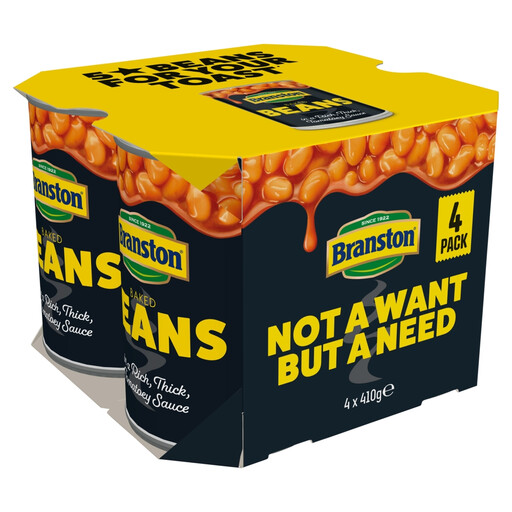
Branston Baked Beans 4 x 410g
For a standard-recipe side dish, this pack has four 410g tins. ASDA Groceries lists eight half-can servings for the matching Branston pack; the Joybuy product information lists 1.24g salt per half-can, which you can consider alongside the rest of the meal.
View on Joybuy
 No image available
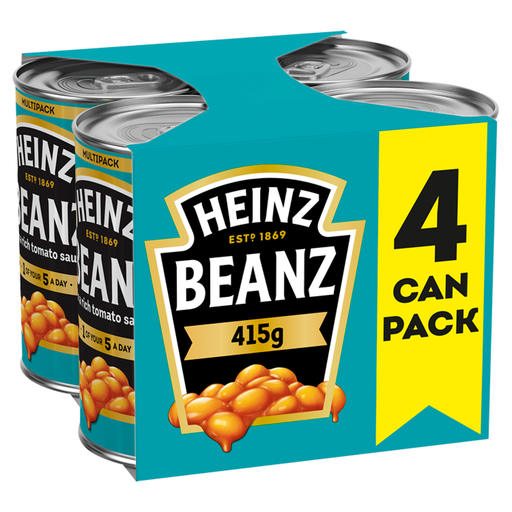
HEINZ Baked Beans in Tomato Sauce 4 x 415g
This four-tin pack is another full-size option for a shared pie and mash meal. Waitrose & Partners lists the matching Heinz 4 x 415g pack as suitable for vegetarians and vegans; check the pack's serving declaration when deciding how many tins to open.
View on Joybuy
 No image available
Branston Beans in Tomato Sauce 6 x 410g
Six 410g tins are worth considering if pie and mash night is not the only meal you have in mind. Plan the portions for this meal separately, then decide whether you will use and store the remaining unopened tins.
View on Joybuy
Questions about buying and storing beans
How many portions will a four-pack provide?
Check the exact pack's serving declaration. ASDA Groceries lists eight half-can servings for Branston 4 x 410g, and Sainsbury's lists eight servings for its 4 x 400g pack. Your portion size may differ if beans are more than a small side.
Should I choose standard or reduced-sugar-and-salt beans?
Choose by comparing the recipes and their labels, rather than assuming either suits every meal. ASDA Groceries says its reduced-salt, no-added-sugar 4 x 410g pack has 30% less salt and 60% less sugar than a standard equivalent; check the nutrition panel and ingredients for the particular packs you are considering.
What should I do with beans left in an opened tin?
Move the leftovers into a suitable covered container and refrigerate them. Zero Waste Scotland advises transferring opened tinned-food leftovers out of the can; follow the use-within instructions on your particular pack.
Does the best-before date matter when buying extra tins?
Yes: check the date and storage instructions against when you expect to use the tins. UK government food guidance explains that a best-before date concerns quality, so food may not taste as good after that date; the pack's condition and storage instructions still matter.


