Households sharing pie and mash
If beans will go on several plates, compare the amount you expect to serve with the number of tins in a pack. Separately sealed tins can remain unopened for another meal.


A four-pack suits pie and mash night if you expect to use several tins across this meal and later ones; individual tins let you buy closer to the quantity you plan to serve. Choose a standard, no-added-sugar or reduced-salt-and-sugar recipe by checking the exact tin’s ingredients, nutrition panel and allergy statement, rather than assuming the recipes are interchangeable.
If beans will go on several plates, compare the amount you expect to serve with the number of tins in a pack. Separately sealed tins can remain unopened for another meal.
If sugar, salt or sweeteners affect your choice, look at the ingredients and figures per 100g on the exact standard or reduced-recipe tin. A similar pack size does not mean a similar recipe.
Check the exact product’s allergy statement before serving a shared meal. Plan to refrigerate any beans left from an opened tin and follow its stated use-within period.
Start with how many tins you are likely to open for pie and mash, then decide whether the remaining tins have a place in later meals. Compare recipes and storage instructions on the products you are considering.
| Priority | What to check | Your needs |
|---|---|---|
| Pack quantity | Check the tin count and net weight. Waitrose & Partners lists a Heinz 4 x 415g pack, totalling 1.66kg; a half-can reference on its label is not a fixed pie-and-mash serving. | I want enough for the plates being served without opening tins that would be better kept for another meal. |
| Recipe | Compare sugars and salt per 100g on the exact tins, and read the ingredients for sweeteners. The Heinz no-added-sugar 4 x 415g pack listed by Waitrose & Partners contains steviol glycosides. | A different recipe matters to us, but I do not want to assume that every no-added-sugar or reduced-salt-and-sugar tin has the same ingredients. |
| Allergens | Read the current allergy statement for each product, not just its vegan or vegetarian description. M&S states that its baked beans are not suitable for people with milk or egg allergy. | Someone at the table needs an allergy check for the particular tin we will serve. |
| Leftovers | Check the opened-tin instructions before planning repeat portions. Waitrose & Partners says to transfer its Essential Reduced Salt & Sugar beans to a covered, non-metallic container, refrigerate them and use them within two days. | If we open more than we eat, I need to know how to store the remainder and when to use it. |
Four 415g tins contain 1.66kg in total, but the number needed for pie and mash depends on how much beans contribute to each plate.
Decide how many tins you expect to open for this meal. Choose the four-pack if you also have a use for the unopened tins.
The Heinz no-added-sugar four-pack listed by Waitrose & Partners contains the sweetener steviol glycosides. Waitrose Essential’s claim of 30% less sugar and salt compares its reduced recipe with its own regular Essential beans, not with every other brand.
Read the ingredients and compare sugars and salt per 100g for the exact products you are choosing between.
M&S describes its baked beans as vegan and vegetarian while also stating that they are not suitable for people with milk or egg allergy.
For a diner with an allergy, check the current allergy statement on the particular pack before serving it.
Opened-bean instructions differ: the Waitrose Essential reduced recipe specifies use within two days, while M&S standard baked beans specify three days after refrigeration.
Transfer and refrigerate unused contents as directed on the tin, and follow that product’s use-within period.
These product lines illustrate different pack and recipe choices; check the exact label when deciding what to serve.
Standard and no-added-sugar baked beans are both listed in 4 x 415g packs by Waitrose & Partners.
Tesco Groceries lists own-label standard and reduced-sugar-and-salt baked beans in 4 x 420g packs.
The range includes a 1.6kg four-pack labelled as having seven ingredients, alongside standard 400g and no-added-sugar 390g tins.
Standard and reduced-salt-and-sugar baked beans are listed as individual 420g tins, allowing shoppers to choose a tin count.
Branston has 410g baked-bean tins and multipack formats relevant to buying for more than one meal.
These Branston standard baked-bean multipacks offer four or six 410g tins. Choose the tin count by what you expect to serve with pie and mash and whether you will use the unopened tins later.
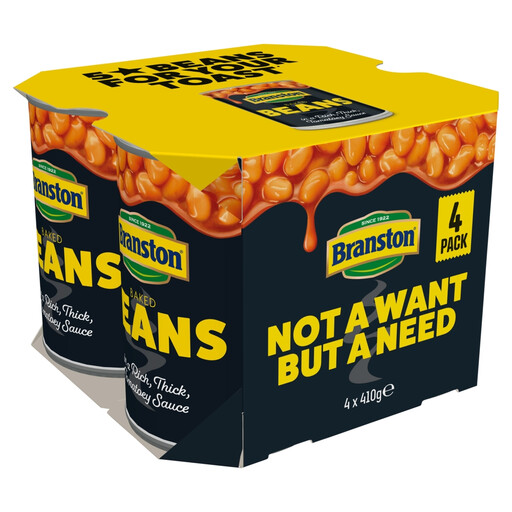 Image unavailable
Consider four tins if you expect to serve beans with this meal and keep any unopened tins for later. The pack contains four 410g tins.
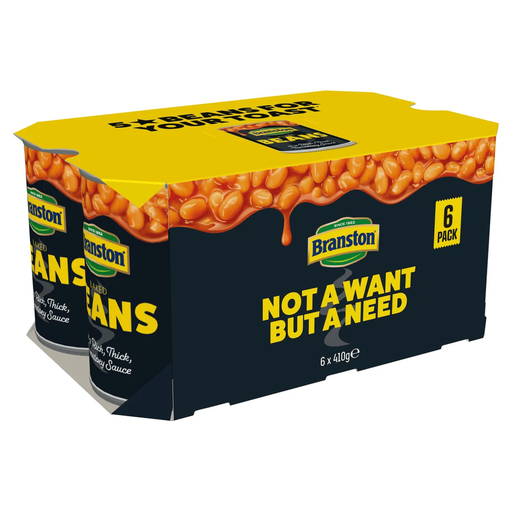 Image unavailable
Consider six tins if you have plans for beans beyond pie and mash night. The pack contains six 410g tins; only open the number needed for each meal.
That depends on how much you serve with each plate. The standard Heinz four-pack listed by Waitrose & Partners contains eight half-can amounts, but a half-can label reference is not a guaranteed pie-and-mash serving; plan around whether beans will be a small side or a larger part of the meal.
Do not assume so across brands. Waitrose & Partners lists 0.6g salt per 100g for its standard Heinz four-pack and 0.4g per 100g for the Heinz no-added-sugar four-pack. Check the figures on the exact tins you are comparing.
No. M&S describes its baked beans as vegan and vegetarian but states that they are not suitable for people with milk or egg allergy. Use the exact product’s current allergy statement for an allergy decision.
Follow that tin’s instructions rather than using one period for every recipe. For example, Waitrose & Partners directs shoppers to transfer leftover Essential Reduced Salt & Sugar beans to a covered, non-metallic container, refrigerate them and use them within two days; M&S standard baked beans specify use within three days.
GOV.UK explains that a best-before date concerns quality, whereas a use-by date concerns safety, and identifies tinned baked beans as a food that commonly carries a best-before date. Check the tin’s condition and its storage instructions when deciding whether to use it.